TLD-Hub-New
The Latest Dirt - January 2025
Editor’s Note:
The devastating fires in Southern California have affected many of our neighbors down south. So many of us have family and friends touched by this tragedy. Missy Gable, Director of the UC Master Gardener Program, recently sent out an email with the link to ANR Disaster/Emergency resources, including planning for emergencies (https://safety.ucanr.edu/Programs/emergency/EmrgResources/). Now is a good time to review your safety plans. We share Missy’s message, “Our thoughts are with our friends and colleagues dealing with the overwhelming loss of homes and property damage.”
Marilyn Saarni, Co-Lead of the Firewise Gardening Project and Rescape-certified in Sustainable Firescaping, writes a must-read article on evacuation preparation. “I want to push people to think ‘Save Lives’ first and then evacuation—evacuation—evacuation.” She also offers the first steps to building a firewise garden, provides resources on home hardening, and shares a CalFire site where you can get a customized wildfire preparedness checklist. If you only read one article in this newsletter, let it be this one.
David George interviews May Coleman, who is not only a very accomplished UC Master Gardener (over 1500 hours in 2024) but also someone who has a fascinating life, including graduating from the San Francisco Cordon Bleu, where she learned her mad cake-making skills. She also has her Master’s in Clinical Psychology. She is also deeply passionate about volunteering with underserved communities.
Liz Rottger writes a poignant and sometimes funny essay reflecting on the 2024 CoCoMG holiday party. For example, do any of us recognize UC Master Gardeners if they’re not in their garden clothes? She describes the camaraderie and the sumptuous feast on “medieval-style long tables laden with a banquet of delicious dishes and desserts...” Susan Domanico and Cynthia Casey, Hospitality Co-Leads, managed over 30 volunteers that evening. Susan writes, “We had one of the largest turnouts in years, 174 attendees." She shared her thanks to all those who volunteered their time for a memorable event.”
Susan Domanico and Pam Austin recently visited two school gardens in West County—Fairmont Elementary and Mira Vista Elementary—to deliver cool-season vegetable starts. She describes how the gardens at both schools are hubs of activities for the students during recess and lunch.
We’ve also included an article on the new leadership structure for the Webinar Team within the Speakers Bureau. And the Help Desk has submitted a client question about a mystery pest invasion. Find out how they solved the problem. Finally, Mary Jo Corby has announced the dates for the Great Tomato Plant Sale for all three parts of the county, and they could use some help sale day.
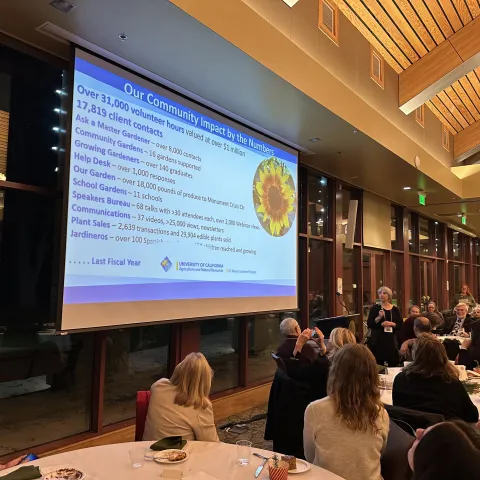
But first, we start with Laura Brainin-Rodriguez’s highlights from the UC Master Gardener Volunteer Recognition Potluck held on December 9, 2024.
Simone Adair, Editor
The Latest Dirt - November 2024
Editor’s Note: A Warm Welcome to Our 2025 UC Master Gardener Trainees!
Dear New Volunteer Trainees,
Welcome to the Contra Costa County UC Master Gardener family! The Latest Dirt Team, including the editors, writers and technical support, is thrilled to have you join us on this rewarding education, outreach, and stewardship journey. This year promises exciting opportunities for learning, hands-on experience, and community impact. As you embark on this path, you will find yourselves in a community of passionate, dedicated volunteers who share a love of gardening and a commitment to sustainable practices.
Before we dive into the year ahead, I also want to extend a heartfelt thank you to everyone who has contributed to The Latest Dirt this year. Your efforts have made it an invaluable resource, helping us stay connected, informed, and inspired. Every article, project update, and bit of shared knowledge has enriched our community, and it has been an absolute joy for me to work with all of you. I am incredibly grateful for your time, creativity, and dedication.
In this issue, our Project Leads share a few words highlighting their team’s accomplishments over the past year and describe ways for you to get involved. They’ve worked tirelessly to bring meaningful projects to life and are excited to welcome fresh perspectives and new energy as they share their plans for the year ahead, but they can't do it alone. We hope you take a moment to read through these amazing articles to see if there might be a job or two that sounds appealing.
We hope you feel inspired by these dedicated individuals and their visions for the coming year. Each Project offers a chance to expand your skills, make new friends, and contribute to impactful gardening initiatives across our community. Let’s continue to grow together, learning from one another and making a difference, one project at a time!
With deep gratitude and warmest regards,
Simone Adair, Editor
The Latest Dirt - September 2024
Editor’s Note: Welcome, UC Master Gardeners, to the fall edition of The Latest Dirt. As the evenings in Richmond bring a hint of chill, we’re still holding out for a few more warm days to savor the garden’s final vibrant colors. Autumn is upon us, and with it comes a new set of garden chores: nurturing the soil, preparing for winter, and protecting the pollinators that keep our spaces buzzing. This summer, we were delighted by the many hummingbirds, butterflies, and big, fat bumblebees gracing our gardens, and we’re committed to ensuring they have a home year-round.
One of the key things we focus on during this season is helping our pollinators. While many prepare to hibernate, it’s essential to support their well-being. We do this by leaving parts of the garden undisturbed, providing bees, butterflies, and other beneficial insects with safe places to rest and survive through the colder months. These small actions make a big difference, helping local pollinators return strong when spring’s bloom arrives. While autumn offers plenty of tasks for gardeners, prioritizing pollinator support fosters a healthier, more sustainable environment. It’s a simple yet impactful way to ensure nature thrives even as temperatures drop.
Our UC Master Gardener Project Leads are also hard at work this season. As we bid farewell to longtime Leads, we’re excited to welcome a new group of volunteers ready to take the reins. The need for members to step up in our many projects remains strong, and, in some cases critical. As you read through the articles below, we hope you find inspiration for a new way to get involved.
David George, a newly elected member of the Executive Leadership Team, starts us off with an article on the organization of our UC Master Gardener program. Community Gardens Co-Lead Meb Philips updates us on new leadership while celebrating outgoing Lead Karen Maggio’s tenure. Karen supported 16 community gardens, including two new demonstration gardens. Meb also highlights the new sign CoCoMG Fletcher Oakes created for use at Community Gardens events.
Vicki Lee updates us on Growing Gardeners and the program’s growth. Emma Connery remembers the Help Desk’s beginnings before computers or the Internet. Everything was on paper! Janet Miller updates us on what’s new at Our Garden and acknowledges longtime volunteer Steve Danzinger. Liz Rottger writes a heartfelt article about Matthew Dwinell and his Eagle Scout project building a new shed for the Water Conservation Garden in El Cerrito. This month, David George interviews Amanda Merrill, the new School Gardens Co-Lead in East County.
Hedwig Van Den Broeck and Andrea Salzman describe the success of the Speakers Bureau and how there is a great need for new leadership and other volunteers. Dawn Kooyumjian thanks Nanette Hefferman and Molly Wendt for their incredible work on this year’s reappointment process. Lori Palmquist describes the Herculean task of moving our website to a new platform called Drupal. Dorothy Abeyta and John Fike announce the New Volunteer Training class schedule and the process for visiting one of the classes. Finally, Susan Heckly shares her Help Desk reply concerning damage from Elm Leaf Beetles and ways to mitigate the damage through integrated pest management.
Simone Adair, Editor
The Latest Dirt
Editor’s Note: I’ve been thinking about why we are UC Master Gardeners. Gardening is such a cherished activity. It serves as a means of connecting with nature and nurturing a sense of community. As CoCoMGs, we assist with school gardens and community gardens. We are always ready to answer the many questions asked at our Ask A Master Gardener booths and Help Desk. Our different demonstration gardens not only produce truckloads of produce for our partner, the Monument Crisis Center, but we also assist with school and community gardens. We are also always ready to answer the many questions at our Ask A Master Gardener booths and our Help Desk. This issue of The Latest Dirt highlights the efforts of so many of our volunteers and staff.
Gardening provides an avenue for relaxation, stress relief, and physical activity and promotes overall well-being. We encourage sustainable living practices, reduce reliance on commercially grown produce, and minimize carbon footprint. Ultimately, despite the adversities posed by the region’s unique environmental factors, we are all driven by a love for nature, community, and the rewards of cultivating a piece of paradise.
This month’s issue highlights ways we nurture a sense of community. Nowhere else is this more evident than at our three Great Tomato Plant Sales. Mary Jo Corby, Janet Miller, Wendy Kraft and Liz Rottger describe the Sales that made over $100,000.
David George interviews Pam Austin, the longtime School Gardens Lead. Ann Ramirez discusses what is appealing about Growing Gardens. Meb Phillips, Community Gardens Co-Lead, describes what’s happening at some of the different gardens, including using the Three Sisters.
The Help Desk’s Susan Heckly, in the spirit of the GTPS, answers a resident’s question about what’s eating their tomatoes. Anne Sutherland then takes on a tour of Peruvian and Andean vegetables. To round this issue out, Liz Rottger describes how three CoCoMGs saved a perch for a little hummingbird who called an elderberry tree at the Richmond Dry Garden home.
Simone Adair, Editor
The Latest Dirt
Volume 14, Issue 2 - March 2024
Editor’s Note:
Editor’s Note: Time has sprung forward as we transition into early spring with longer days and warmer weather. We welcome the blossoming of colorful flowers and greenery in our gardens and the opportunity to be outside amidst the pleasant temperatures and burgeoning nature. Plants burst into bloom, and there is a sense of excitement and anticipation for the warmer months ahead.
Spring also returns with the 12th anniversary of the Great Tomato Plant Sale. In this issue, Robin Moore describes the “All Hands On Deck” effort volunteers need to make the sale successful. Liz Rottger describes in an article about the GTPS’s early history how “a modest sale of 3,000 plants grew into over 37,000 plants, including 73 varieties of heirloom and hybrid tomatoes.”
Terri Takusagawa describes opportunities to complete your CE requirements, including workshops at Our Garden, two Lunchbox webinars and other events. Laura Brainin-Rodriguez also highlights the return of what is shaping up to be an exciting season of Ask A Master Gardener booths. Consider attending their kick-off event on March 25 at Bisso Lane. Jan Manns reports on the Family Garden Bed at Our Garden, which started six years ago. She describes its early history and the many lessons learned.
The Help Desk returns with new questions from a local gardener about mystery mushrooms in their garden. Identified as cup fungi in the Pezizaceae family, these mystery mushrooms perform an essential ecological role but are also harmful if eaten.
Liz Rottger and I both write about seeds. I discuss seed viability and ways to check for it, while Liz reviews Thor Hanson’s The Triumph of Seeds, which discusses seed vaults and answers “some of those vexing questions gardeners always have.”
Looking back to this past fall, Dawn Kooyumjian and David George summarize the 2023 UC Master Gardener Conference, which featured keynote speakers, panel discussions, and breakout sessions on the latest horticulture research and best practices.
Finally, Paige Shoemaker provides essential information regarding our area’s invasive fruit fly quarantine. She writes, “This invasive pest infests and can ruin over 300 types of crops.”
Simone Adair, Editor
The Latest Dirt
Volume 14, Issue 1 - January 2024
Editor’s Note:
Welcome to the first issue of 2024. I’m looking forward to the new year and all the great projects we’ll cover in The Latest Dirt. It always seems like this time of year is slow, but that couldn’t be further from the truth. Garden projects continue. Project Leads are making plans.
And very importantly, we’re in the middle of the New Volunteer Training course. Please join me in welcoming the new trainees. We’ve included their bios and photos below for you to get to know them. I hope you’ll enjoy reading them as much as I did.
Dawn Kooyumjian, the Program Coordinator for the Contra Costa County UC Master Gardeners, welcomes the New Volunteer Trainees and urges them to volunteer for various projects. She noted, "You may be surprised about how much you like a new project or what you'll find."
NVT Coordinator Dorothy Abeyta and John Fike take on the challenge of leading our primary educational program for UC Master Gardeners. As John puts it in his article below, “Our colleagues’ historical precedents and experiences over the past decade or more have provided us with critical insight as we engage the newest UC Master Gardener trainees.”
Many of our 2024 Project Leads have also contributed to an article describing their projects for the NVT class. I remember when I was a trainee, and everyone came in to talk to us about their areas. It was a whirlwind. This article will be a handy reference and include contact information.
We’re also highlighting the fantastic December Recognition Potluck Dinner. Muriel Wilson and Virginia Saifer assembled an excellent team of 30 volunteers to create a seamless event. It was incredible seeing CoCoMGs that I usually only text or email. The potluck was delicious, and here’s a special shout-out to Maiytth Coleman for that fantastic cake of the forest floor.
The recognition ceremony also reflected the hard work and dedication of our UC Master Gardeners. We’ve included an article highlighting those hitting milestones, including Terri Takusagawa reaching over 7,500 hours.
We also learn about the additions at Our Garden by Greg Letts, including new sheds. Thank you to Susan Heckly for providing Sara Hoyer’s reply to a community member’s question concerning the late planting of bulbs, something we have also done occasionally. I’m always astounded at the breadth of questions the Help Desk receives and the comprehensive answers our volunteers give.
At the end of this issue, I've also included a few words about our friend and colleague Kathy Gage, who passed away on January 6. Kathy often wrote and edited articles for both TLD and News to Grow By.
But first, Bill Miller, an Executive Leadership Team member, shares his thoughts on the positive effects and benefits of gardening.
Simone Adair, Editor
The Latest Dirt
Volume 13, Issue 5 - November 2023
Editor’s Note: Welcome to the November issue of 2023. It is chock full of a wide array of articles and updates. It makes me truly appreciate all I continue learning as a UC Master Gardener. We have so many resources available – attending webinars and garden talks, working in four different CoCoMG gardens, and watching YouTube and Vimeo videos. Thank you to all our contributors and the hard work you put into strengthening our organization.
In this issue, David George returns to interview Bill Miller. Many of you know Bill from Ask A Master Gardener Booths. He’s also a member of the Executive Leadership Team. Bill shares his background, as well as great advice for new members.
It is such a pleasure to introduce our newest member Of the UC Master Gardener Bisso Lane crew. Diana Garcia–Colmenarez is our new Administrative Assistant. Diana is also a San José State University graduate student in the Environmental Studies Department. I had the great privilege of chatting with her, and I write about her below.
In an article by Laura Brainin–Rodriguez, newer UC Master Gardeners who volunteer with Ask A Master Gardener booths share their backgrounds and perspectives. Also, we learn more about the recently held EBMUD Landscape Advisory Committee meeting at the Richmond Library highlighting the Richmond Low Water Demonstration Garden. The interest in the Garden from so many partners is fantastic.
Karen Maggio shares an update on the Family Harvest Demonstration Garden in Pittsburg, CA. The landscape plan, developed by the UC Master Gardener Team, and project priorities recently took shape during several weeks of team meetings. Steve Carter shows his enthusiasm for Growing Gardeners in an article about the four successful beginning gardening courses held this year. And Gail Burt thanks all the CoCoMGs who contributed to the Speakers Bureau’s outstanding year.
Lisa Bramblet writes about all the changes at the Rivertown Demonstration Garden, including a new Bee Hotel. Hospitality Committee Co-Coordinators Muriel Wilson and Virginia Saifer share details on the upcoming 2023 Annual Members Recognition Potluck Dinner. Pam Austin reviews the new Ladibug document camera that you can check out.
First, Laura Brainin-Rodriguez chats with project leads about their contributions, how they sustain their engagement with CoCoMGs, and what is most meaningful for them.
Simone Adair, Editor
The Latest Dirt
Volume 13, Issue 4 - September 2023
Editor's Note: Welcome to your September edition of The Latest Dirt. While summer may be waning, we are still experiencing beautiful weather. Gardens everywhere in my neighborhood are in full bloom. My fruit trees are providing a bounty of sweetness, and everything is green everywhere. Here in West County, the temperature is moderate. There is still mist in the mornings, and the afternoons are a luxury. With slightly higher temperatures, Central and East Counties have also been enjoying perfect weather.
Soon, Fall and Winter will return, but only after a truckful of weeds will need pulling. I'm being cautious this year to remove any fallen leaves or dead foliage, especially after watching the devastating footage of the fires in Maui. Marilyn Saarni writes an impressive article on the firestorm, tying it back to our California fires and what Firewise practices you can follow around your property.
In this issue, David George delivers another outstanding interview with Terri Takusagawa, the first Triple Platinum volunteer. After reading his interview, you won't be surprised by this, considering the monumental job she's done for the UC Master Gardeners.
Liv Imset describes an inventive pilot program at the Water Conservation Garden in El Cerrito that collects water onsite using a fog collector. Separately, Dawn Kooyumjian, our UC Master Gardener Program Coordinator for Alameda and Contra Costa Counties, will present on the transformation of the Richmond Low Water Demonstration Garden, in partnership with EBMUD, at the Richmond Main Library, Friday, September 29, 1:00 - 2:30 pm (in person) — https://www.ebmud.com/about-us/events/event-details?occurrenceID=4783.
Anne Sutherland recounts this year's Jardineros highlights of the many potting up classes given to Spanish-speaking mothers at various elementary schools and the Monument Crisis Center.
Sheila Weston at the Help Desk shares an interesting query from a client trying to identify a smallish-looking fly with a green cast tormenting his tomato plants. Terri Takusagawa comes through with the identification. And finally, Janet Miller gives us an update on the incredible bounty of Our Garden and shared with our good friends at the Monument Crisis Center.
Simone Adair, Editor
The Latest Dirt
Volume 13, Issue 3 - July 2023
Editor's Note: Welcome to your July edition of The Latest Dirt. Summer has finally arrived. I hope you are all enjoying this beautiful weather and not overheating, especially our Central and East County UC Master Gardeners. I have truly been enjoying our garden. Well, except for the weeding. Our weeds have benefitted from all the rain we had this year.
One thing is for sure. Project Leads have not been resting this summer. They've submitted great articles, which I hope you'll enjoy. Jon Dwyer updates us on the Annual Reappointment Process and the recent Spring Social at Our Garden. Janet Miller also writes about the transitions at Our Garden. She also describes the new Family Bed to demonstrate what is possible in a small family plot!
Laura Brainin-Rodriguez explains what happens at an Ask A Master Gardener table and why our CoCoMGs should consider joining this fantastic volunteer Project. Karen Maggio shares with us what's happening at our various Community Gardens around the county, including the Gehringer Pollinator Garden in Concord. Kate Verhoef, in her last article for The Latest Dirt before her departure, describes how School Gardens impact our communities and the many projects volunteers have completed at schools around our county.
Susan Heckly shares two interesting Help Desk questions posed by local gardeners and expertly answered by Stephanie Hargrave on problems with succulents and unhappy Bee's Bliss. Kathy Gage describes the South County Gatherings at CoCoMGs various gardens. And Liz Rottger and Liv Imset thank the many UC Master Gardeners who've volunteered their time at the Water Conservation Garden.
But first, David George and I present an interview with departing School Gardens Lead Kate Verhoef. Kate shares many of her upcoming plans, including a 200–mile solo walk in Dorset called "The Hardy Way." I, for one, will miss Kate and her inspiring volunteer spirit. As we say in the Coast Guard, fair winds and following seas, my friend.
Simone Adair, Editor
The Latest Dirt
Volume 13, Issue 2 - May 2023
Editor's Note: Welcome everyone to your May edition of The Latest Dirt. This is such a great time of the year. Spring is well on its way, if not with a few extra downpours. Hopefully, your garden is filled with blooms. We finally got through pulling the weeds in our garden and have filled in empty spots with new plants and herbs and vegetables, including a few tomato plants from this year's big sale in Richmond.
Mary Jo Corby summarizes sales in both central and western parts of the county and highlights both front-of-the-house and behind-the-scenes activities. As a West County resident, we were particularly happy to have the Great Tomato Plant Sale back in Richmond, after a four-year hiatus. Congratulations to the many volunteers who made both these events such an amazing success.
David George interviews the inimitable Emma Connery, who shares many of her memories of the early years with the UC Master Gardeners. Like me, I'm sure that you also remember fondly Emma's instruction during your New Volunteer Training, especially her love for insects. Following David's interview is a heartfelt article about Emma Connery by Liz Rottger.
Lori Palmquist shares her expertise on which irrigation smart controller is best for your garden. As she says in her article, "Smart controllers have revolutionized irrigation, and the water savings are pronounced and undeniable."
Take a moment to read about our new Acting/Interim County Director Sheila J. Barry. She has extensive experience serving also as Santa Clara's County Director, as well as the Livestock and Natural Resources Advisor for the San Francisco Bay Area.
But first Robyn Barker, Executive Leadership Team Member, describes some of the upcoming events on the horizon, such as the Annual Business Meeting and the Get-Together at Our Garden in June. She also bids us a fond farewell from the ELT as she and other ELT members and EC officers near the end of their terms.
Simone Adair, Editor
The Latest Dirt
Volume 13, Issue 1 - March 2023
Editor's Note: Welcome everyone to the March edition of The Latest Dirt. If you're like me, you are looking forward to the spring. It has been a cold, wet winter. Our garden clean-ups here at home have been soggy, though we've had some beautiful clear blue skies. We've rushed out on those days to do some weeding, and it seems like all the rain made our weeds stronger than ever.
So it is with great happiness to read this month's articles. Mary Jo Corby and Robin Moore talk about this year's Great Tomato Plant Sale, our first in-person event since 2019. Several other articles focus on pollinators and beneficials, starting with Liz Rottger's article on the pollinator garden at the Water Conservation Garden in El Cerrito.
Robin Mitchell shares a beautiful article on the many benefits of Fuschia plants for our birds and beneficials. Anne Sutherland describes the history of the Jardineros and then talks about the current events and projects. The Help Desk's Terry Lippert describes the effect of pouring alcohol in your yard. Lisa Bramblet gives a first-hand view of dealing with 811 - Call Before You Dig. Kate Verhoef updates us on a School Garden event. And Laura Brainin-Rodriguez describes the 2023 Ask A Master Gardener project, as well as looks for new volunteers.
But first Greg Letts, Executive Leadership Team Member, looks forward to spring, as well as giving us additional information on the upcoming Great Tomato Plant Sale
Simone Adair, Editor
The Latest Dirt
Volume 12, Issue 7 - December 2022
Editor's Note: All of us here at The Latest Dirt are so excited to welcome the Class of 2023 New Volunteer Trainees. We are so glad to have all of you join us. We look forward to working with you to promote sustainable gardening practices. You will have many opportunities to work in all our various programs. This issue is dedicated to your future as UC Master Gardeners.
Our Program Coordinator Dawn Kooyumjian shares her message of welcome and can't wait for your final presentations in March. She also shares her background, as well as her goals for the Contra Costa Master Gardener Program for the next three to five years.
Our Executive Leadership Team Members also share the various programs they advise, and how excited they are to meet you. They are all available to answer your questions about how to participate in the many hands-on trainings and how to engage with the community.
We hope that your journey with the UC Master Gardener Program will be rewarding and enjoyable. As your fellow UC Master Gardeners, we are eager share our knowledge as you continue to learn and serve our local community. Again, welcome to the Class of 2023!
Special thanks goes out to Liz Rottger who took time and special care to compile all the New Trainee Volunteer Bios. And finally, happy holidays to all of you, and best wishes for the New Year.
Simone Adair, Editor
***Special Note*** If viewing on a mobile device, please use landscape orientation for the best experience.
The Latest Dirt
Volume 12, Issue 6 - November 2022
Editor's Note: Our trees remind me that we are fully into fall. I'm thoroughly enjoying the changing of the colors of the wide variety of trees here in Contra Costa County. I'm also feeling very grateful for the days of rain we've had. Those were several less days that we needed to water our garden. This time of the year also brings many chores that need to be done. I spent the last few Sundays raking leaves. And it's not over.
And as fall turns to winter, UC Master Gardeners are also busy at work at the wide variety of projects in the County. Laura Brainin-Rodriguez shares with us her Ask A Master Gardener end of year report. AAMG is also seeking new Farmers Market Leads so check out her article to see if there's a good fit. Speakers Bureau Co-Lead Gail Burt shines a light on how popular webinars have been. Anne Sutherland explains what Jardineros have been doing. Soubarna Mishra highlights the many successes of the 2022 School Gardens year.
Karen Maggio, Phil Quinlan and Liz Whiteford report on the new Gehringer Pollinator Garden in North Concord. Lori Palmquist discusses the many ways in which Communications shines a light on the many CoCoMG projects. It's a great article on how we all work together. David George shares his interview of Lisa Bramblet and how Rivertown Demonstration Garden is getting a makeover. Sarah Hoyer answers this month's Help Desk question about peach trees. We also spotlight our Statewide Director Missy Gable who has been awarded this year's Distinguished Early Career Coordinator. Separately, Ann Ramirez thanks the Growing Gardeners Project team for all their hard work.
First, Executive Leadership Team Member Bill Miller celebrates all the volunteers who continue to work at Our Garden and discusses the 2022-2027 Strategic Plan and the upcoming December 12 Social Recognition and Appreciation Event.
Simone Adair, Editor
The Latest Dirt
Volume 12, Issue 5 - September 2022
Editor's Note: While the summer is winding down, the heat has been on the rise around the County, with temperatures reaching over 100 degrees in many places. That hasn't stopped our UC Master Gardeners from accomplishing their Project goals. Kathy Gage writes about the new AAMG booth at Dougherty Station in San Ramon. Karen Maggio explains how a garden is so much more than plants. Ann Ramirez and Ann Howard give an overview of the Growing Gardeners Project. We have two Help Desk submissions this month, one on mango health and another on aphids taking over milkweed plants.
Our Garden, Rivertown Demonstration Garden and the new Water Conservation Garden in El Cerrito all give updates. Kate Verhoef recently participated in a teacher exploration seminar at Jack London Elementary in Antioch where teachers were encouraged to think like their students. Robyn Barker clears up questions about qualifying hours. David George profiles ELT member Greg Letts. Our Garden members come together to wish a happy 90th birthday to P.K. Sathe.
First, Executive Leadership Team Member Robyn Barker celebrates the visible and invisible members of our UC Master Gardener Team.
Simone Adair, Editor
***An important note — Some email programs have clipped the bottom part of the newsletter. If this happens, click the three small dots at the bottom of the newsletter. This should bring up the rest of the articles.
The Latest Dirt
Volume 12, Issue 4 - July 2022
The Latest Dirt - Jan 2024
Volunteer Recognition Dinner Tops off Amazing Year
Article & photos by Simone Adair
Muriel directed Allyssa and me to help out at the Appetizer tables, where two other volunteers were already standing by at the ready. The appetizer tables have always been my favorite volunteer station. I can sample dishes as they arrive. And they did not disappoint. We were in for a treat if this indicated the caliber of the evening’s offerings. The CoCoMGs went all out on their dishes.
I had scoped out the dessert table early, as this was where my heart lay. CoCoMGs soon filled the tables with delights. Right in the middle, though, there was what could only be described as a masterpiece. A chocolate cake decorated to look like a forest floor with colorful mushrooms, fantastical flowers, chocolate leaves, gold-dusted bark, and tiny candy insects took center stage. A crowd surrounded Maiytth Coleman, a 2024 trainee and the architect of this beauty of a cake when she started to carve the cake. We had to go and get her, as no one wanted to cut into the cake first. The cake was beyond delicious. I should add that I sampled all the desserts, which I can report were delicious.
Not to be outdone,
I also want to thank and appreciate Terri Takasugawa for the 7,500 Platinum Plus hours she’s contributed to the UC Master Gardeners. We were in the same class together where she was already showing the kind of leadership we’ve all learned is her standard modus operandi. From me to you, you are amazing!
NVT Co-Leads Dedicated to Building Confidence
By John Fike
The challenge to leading an educational program such as this is that the academic experiences of the trainees range from minimal science exposure to advanced degrees in biological, chemical, or physical disciplines. Fortunately, regardless of background, everyone shares a common passion for gardening. So our approach stresses the conceptual basis of better gardening/horticulture/pest management: the ‘so what?’ of their learning. Appreciating or understanding the multitude of details will come later because one of the goals of the NVT program is to teach how and where to find those details. We have structured our hands-on activities toward problem-solving and working in groups, both critical components of the Master Gardener experience. We are dedicated to teaching and building confidence so that when our new colleagues don their UC Master Gardener badges, they will be comfortable when a client walks up, hands them a leaf, and asks, ‘What’s eating my plant?’
Major Milestones Honored at Recognition Dinner
By Simone Adair
One of the highlights of the recent 2023 Volunteer Recognition Dinner was the honoring of UC Master Gardeners, who have volunteered a significant amount of hours with pins and new badges. Our UC Master Gardeners are awarded based on their inputted hours into VMS, starting at 100 hours and going to 7,500 hours.
The recognitions started with CoCoMGs, who had contributed 100 hours of volunteer time. Karen Goodwin, Robin Harper, Tim McClintick, Ben McDonald, Jana Multhaup and Reba Siero received the coveted Bee pin. Next up was the 250-hour recognition. Dorothy Abeyta, Cindy Engers, Stephen Guglielmana, and Lawrence Moglia received their Trowel pins. Ann Howard, Jan Manns, Suzanne Miller, Laurinda Ochoa, Ann Ramirez, Mary Stewart, and Betty Yee contributed 500 hours and received the Watering Can pin. Deborah Christman, Bill Miller, Philip Quinlan, Cheryl Schmidt, Ken Schott, and Allison Thomas received the Pruners pin.
Judy spent five years Co-Directing the Hospitality Committee and directed the Sustainability Fair held in the fall two years in a row. She became a Master Composter through the RecycleSMART program and has given UC Master Gardener workshops on regular composting and vermiculture. “More recently, you will find me at the Wednesday workdays at Our Garden unless I’m traveling, as well as the extra harvesting days on Mondays in the summer,” Judy said.
Finally, Terri Takusagawa reached the 7,500 hours Platinum Plus milestone, an outstanding and well-deserved achievement. Terri said, “I feel so privileged to belong to such a friendly and supportive organization! I came to educate the public, and I stay because of all the wonderful people!”
The 2024 UC Master Gardener New Volunteer Trainees
Compiled by Dorothy Abeyta and John Fike
Nicholas Banks (Antioch)
I’ve always loved the idea of being able to give food to people in need. And that is my prime objective of learning and achieving from the knowledge I gain from the course. I have spent t quite some time searching for what will make my heart sing. I finally found my true calling in the UC Master Gardener program.
Anne Banks (Pittsburg/Antioch)
When I was five, we moved to Concord, California, where my father got a job at Diablo Valley College in Pleasant Hill, California. My father developed all of the vocational education programs, including, but not limited to, the Dental Hygiene Program, the Culinary Arts program, the Welding program, the Apparel Design Program, and the Horticulture program.
Our property in Concord had eight walnut trees and seven almond trees. In addition, my father planted several fruit trees on the property. I always put seeds in the ground to see if they would grow. I will never forget planting watermelon seeds in a small circle in the backyard. When the seedlings grew to about an inch and a half tall, someone took a large, round, bolder and dropped it on my watermelon seeds, killing them. I was devastated. Since then, my goal has been to grow watermelon, but I have yet to succeed.
As an adult, I have worked as a paralegal for 15 years, then as a high school special education teacher for 23 years, retiring six years ago. We have lived in Antioch, California, for the past six years. My goal in Antioch has been to grow tomatoes in our yard, with little success. I believe the tomatoes always have big round black spots on the bottom from incorrect watering. I hope by the end of the UC Master Gardener program, I’ll know how to remedy my tomato problem.
We lost our home in Pittsburg, forcing us to move to Antioch. We live in the older part of Antioch, off of “A” Street, where there are a lot of food insecurities. My goal for the UC Master Gardener program is to build connections in my community to establish a community garden.
We live a block from the church we attend. I founded “Mission Possible” at our church about ten years ago—an outreach program to help feed those needing food in our immediate neighborhood. We donate a different food item to the local food banks in Pittsburg and Brentwood monthly. In addition, Mission Possible has a group of women who meet one Saturday a month and give away little dresses, shirts, shorts, and t-shirts they sew locally and worldwide. Mission Possible is one of the programs I am proudest of.
In addition, every year, we hold a “Santa’s Workshop,” providing hot cocoa, cookies, and a small toy from Santa, in addition to crafts and games for the families in the neighborhood, which includes sending a plate of cookies home with each family.
Through the help of the UC Master Gardener program, I hope to expand our Mission Possible outreach to include helping local neighbors start their gardens and provide their families with fresh produce. I am very excited about being a part of the program, and I am looking forward to helping in my community.
Bennett Berke (Pleasant Hill)
After getting a B.A. and working for several years, I returned to school to study Ecology and Systematics at S.F. State and took Entomology and Plant Taxonomy classes. I did some desert fieldwork, but after getting my M.A., I ended up in computer programming and project management until my retirement.
After retirement, my activities included being a volunteer docent at the Ruth Bancroft Garden and a land steward for Save Mount Diablo.
I enjoy gardening because it is a satisfying and challenging mixture of science, experimentation, and aesthetics. I can see that the UC Master Gardener program is an open-minded and welcoming community, and I’m looking forward to contributing my own.
Neerja Bhutani (Walnut Creek)
We focused our early years in the U.S. on raising our two children and balancing family and career, so gardening was not a prominent interest. However, about 15 years ago, my husband’s passion for gardening ignited, and he became a dedicated and passionate gardener. Inspired by his enthusiasm for growing flowers, I embarked on a journey by taking classes in floral arrangements, a craft that I continue to adore.
Volunteer work has always been an essential part of my life, but for the past few years, various factors and the pandemic have temporarily halted my involvement. I’ve been exploring new areas of interest and observing my husband’s dedication to our garden since our children are grown up. I’ve been motivated to pursue new avenues of community involvement, and I secretly want to know how my husband can grow perfect vegetables and flowers.
Rakesh Bhutani (Walnut Creek)
Some years ago, Our Garden opened a mile from our home. I finally went there after I retired. I was surprised to see how luxuriant and beautiful its plants are, which has caused me great existential pain. These UC Master Gardeners know some secrets that no lecture can impart. I hope to discover them.
I will achieve my purpose in life when I can grow beautiful cauliflower and cabbages, turnips, carrots, and radishes, and my tomato, peppers, and eggplant plants are full of large fruit.
Stephanie Bontemps (Lafayette)
When my husband and I bought our first home in White Plains, New York, the yard had potential but was a mess. Over time, it became beautiful as we learned what worked in the climate and the differences between shady and sunny parts of the yard. Our New York expertise was of very little use when we moved to Lafayette, California, where microclimates are critical and hungry deer and gophers present regular challenges. We’ve re-landscaped our entire one-acre property and continue to find new needs to replace and update plants, particularly as the climate warms.
I’m pursuing the UC Master Gardening program to deepen my knowledge. I’m particularly interested in native plants and landscapes that can thrive in a dry and warming environment. I’ve recently left a 40-year financial services career, so I finally have time to focus on this.
Jim Breuner (Orinda)
Nor did I have an eye for design, flow, and symmetry. Hodgepodge best describes my gardening style. But as I learned by trial and error, my passion for gardening grew, and I understand a lot more Latin now than I used to.
We didn’t stop with the backyard. No, we went around by the front door, the entire front hill, and the back hill “outside the fence.” And I kept buying plants, seeing what worked and what didn’t. My criteria were: 1) deer resistant, 2) clay tolerant, 3) drought resistant, and 4) attract pollinators, in no particular order of importance. Extra points if it was a California native.
I got a lot of inspiration from attending the annual Contra Costa–Alameda Counties Bringing Back the Natives Tour for many years, and I still look forward to that event every May. I am especially fond of Ceanothus, Arctostaphylos, and Salvias. My wife would say I have a bit of a plant obsession. I tell her there are many worse things I could be obsessed with. She thinks I’m crazy for spending so much time on the computer looking up plants. I tell her I’m watching plant porn.
I had wanted to enroll in a UC Master Gardener class for years, but work and other commitments always prevented me from doing so. I’m retired now, so when the opportunity to apply for this class came up, I jumped. I’m so proud of what I’ve accomplished on our hilly property in Orinda, especially in April through May, when the plants are ablaze with color, and the bees are buzzing. People walking or even driving by will sometimes stop and compliment me on how beautiful it is.
My yard is my happy place. It is a mind-blowing experience to know that I’ve put something in the ground and created something so beautiful and that others think so, too! However, I realize there is so much more beyond California natives that I can learn, and I am so excited to embark on this educational journey. I love talking to people about my plants, and I’m eager to start talking to other like-minded people about all that I am about to learn and to share this knowledge so they, too, can create their little piece of heaven on earth.
In my workday life, I have done many things, from police officer, claims investigator, safety coordinator, compliance superintendent, to Regional Safety Manager, to name but a few. To keep busy in retirement – and to stay out of my wife’s hair – I do background investigations on law enforcement candidates for several local law enforcement agencies, which brings me full circle. I swim laps three days a week and go on long hikes whenever possible.
My wife and I just celebrated our 45th anniversary. We have one daughter and three grandkids who live in Pleasant Hill, California, so we see them all the time and are fortunate to be such an integral part of their lives. One of the most significant accomplishments in my life – of which I am very proud – is completing the Camino de Santiago, a 500-mile hike starting in France and ending in Santiago de Compostela in the northwest corner of Spain. The year was 2022, and I was 69 years old. It was on this journey that I fell in love with Flanders poppies!
Cynthia Casey (Walnut Creek)
I’m currently retired from a long career as a software designer, developer, and business analyst. I live in Walnut Creek, California. I’m divorced and have two daughters and three grandchildren.
Maiytth C. M. Takahashi Coleman (El Sobrante)
Later, when I went to school, I longed for the weekend and school breaks to spend time back in our country home with the rest of our family.
I come from a family of immigrants who had to leave behind their lives, reinvent a new beginning, and keep their traditions in a foreign land. Luckily for them, their new home was a gentle land where Nature’s bounty and beauty weren’t in shortage.
My grandparents went from being businesspeople and teachers to becoming farmers. Of course, they learned everything and adapted to their new lives.
At the farm, I used to take long walks exploring the marginal ecosystem of the small river, where I would find myself collecting orchids and admiring the mysterious beauty of Nature for hours. I had a satchel, a packed snack, a stick, and a sketchbook where I would draw and take notes (the best I could) of the specimens I had encountered. There were berries, vines, grass, bromeliads, giant Ipe trees, and plants that looked straight out of a fairy tale book.
During family gatherings, whether after dinner or teatime, all of us, grownups and children, would research botanical encyclopedias and plant taxonomy charts to figure out what those plants were. My huge family shared the love of plants, animals, and cooking, and that, along with the love for each other, was the connection needed to feel at home. It was beautiful chaos.
Fast forward, I moved to foreign lands, had my children, and had a busy life, but again, my family’s love of Nature made me feel right at home anywhere I went. I’m a mother, and like all parents, I desire a beautiful future on this amazing planet for future generations.
My career evolved over the years from psychology, in which I was very involved due to my first child being diagnosed with autism, and then to Culinary Arts and gastronomy. It was a natural evolution, as they are so closely connected. We connect one to another through food and Nature. Food is an essential link to health for us and the ecosystems that maintain life on this planet because of how we grow it.
For this next cycle of my life, it made sense to return to my roots.
Gardening makes me feel closer to my ancestors. Applying the principles of biophilia and exercising my innate wish to seek a connection with Nature gives me a sense of security. There’s also the applied benefit to growing organic foods, learning to cultivate and apply science and information, using permaculture principles while supporting local fauna & flora, and learning more about the systems that keep this fantastic planet alive.
The UC Master Gardening program unifies the science, the community interconnectivity, and love and respect of Nature, offering tools to face the new obstacles that come along with climate changes and the necessary steps needed towards healing and preserving the ecosystem.
Tom Cramer (Lafayette)
As an adult, I always had my own garden, even if only a small strip next to my apartment. I am now fortunate to enjoy a more extensive garden in Lafayette, California. I enjoy sharing produce with neighbors and carrying on my mother’s tradition of canning and freezing.
I have developed an interest in California native plants and especially their traditional uses. Natives are my favored choice for my Lafayette landscape.
Now retired, I have been learning more about soil, pollinators, and other topics that are so important to the area we call home. I look forward to further exploring and am excited to share that knowledge with others in our community.
Kathleen Dell’Aquila (Orinda)
As a transfer “reentry” student to UC Berkeley, my husband, three children, and I moved north. I majored in English, worked in Special Education for two years as a paraeducator, and then pursued my teaching and educational leadership credentials through St. Mary’s College and Chapman University. I taught for 10 years and was an administrator for seven more before retiring. In retirement, I enjoy quilting and food preserving but have become frustrated with the heavy clay soils in my garden. It’s tough to preserve food when those veggies don’t grow!
I consider myself a lifelong learner, so I naturally turned to all the resources I could find, among them the UC Master Gardener presentations at libraries and online. It has taken many years for me to consider myself successful in the garden. Still, Nature is constantly throwing new challenges my way – critters in the soil and air, being on four feet, extreme weather, unpredictable seasonal shifts, too much water, or (usually) insufficient. I consider these challenges new opportunities to continue learning, and now I welcome them. I believe there is no endpoint to learning and that teaching adds to my increased understanding.
I look forward to my training as a UC Master Gardener and the opportunity to share that understanding with other gardeners. In the end, Nature is the Master teacher of us all.
Susan Domanico (Kensington)
My passion for growing things is only part of my identity as a scientist. My career started on the cellular and molecular scale, where I studied the immune system and then did research in cancer biology. After my post-doctoral research, I tested out teaching science in high school and never looked back. I have always taught biology and, over the years, taught chemistry, physics, robotics, and neuroscience.
I introduced plant biology at every opportunity possible in my high school biology classes. We explored hydroponics to understand minimum nutritional requirements for growth, used plants for long-term data collection, and annually used flowers for dissection to understand plant reproduction. I was always amazed that so many of my students never grew a plant from seed and equally pleased that they would cite the plant experiments as their favorite part of the class.
Now that I have retired from managing teams of teachers and teaching high school science, I am eager to pursue a new avenue to continue using science-based education to build community. Since we moved to the Bay Area several years ago, I have used my walks around my neighborhood to start conversations and make connections. I often find myself stopping to admire a flower or tree and notice someone next to me. We stop and talk about the plant, and both leave with a smile. Plants seem to bring out the best in us. Teaching more people how to successfully create gardens – especially edible gardens where we can share what we grow – could help strengthen the connections in our neighborhoods.
Lucy Duquette (Concord)
As a young woman, I planted a small garden in my own home, and nothing was more fun than watching food come out of the ground. When I moved to Florida, I found that flowers were better for that soil type. By then, my career had started absorbing my time, and gardening paid the price. I spent the next couple of decades working long hours and traveling for my job. I moved across the country, from New York and Florida to living in Colorado (where I married), California, Kansas, and Georgia, with extended times in Baltimore, Tennessee, Pennsylvania, and Washington D.C. My husband also had assignments in Utah, Texas, and New York.
We balanced our careers as we moved from place to place, and in 2016, we finally earned the right to move back home to the Bay Area. We had purposely kept our house in California, knowing this was where we wanted to be. And, having seen most of the country, we were delighted with our choice. My husband retired in 2017, and I retired in 2020. We started attending the UC Master Gardener Wednesday lectures. Our yard is small, but since retiring, we re-landscaped it to remove grass or other high water-needing plants and added fruit trees and flowers to attract birds and bees.
Regarding my background, I have an associate degree from the University of Buffalo. As a Senior Manager in a Federal Agency, where I worked for 42 years, I made decisions on business organization, procurement, recruitment/hiring, and program development, including public community services. With over 35 years in management, I led multiple projects and task force teams nationwide for program development, implementation, administration, and oversight. I worked with eight to over 1,000 group sizes on various strategic objectives.
For several years, I was an Operations Manager running a call center in Oakland, California, responsible for serving the public. I spent 10 years as the Manager of the agency’s National Quality Program, which included reviewing employees nationwide and conducting operational reviews for Executives. I have written countless business papers, executive briefing documents, and business plans. I held public workshops, designed public notices, wrote news articles, and sponsored all-employee conferences for various group sizes.
I served as a Public Affairs Specialist for three years, including professional media training from the University of South Carolina. I have appeared on radio and television, issued news releases, and performed public outreach. I have considerable experience as an instructor and have developed numerous technical and managerial training materials. In Florida, I served as the District Electronic Filing Coordinator, which involved conducting seminars for professional practitioners, monitoring their programs for compliance with the laws, and taking enforcement action if necessary. I am good at research and have developed courses, procedures, and plans used nationwide.
I am excited to be part of this program because I have a deep respect for the earth and a strong affinity for plants – watching them grow and develop. I want to learn more about horticulture to do my part and help others save the planet. I value the chance to socialize with people and make more friends. I particularly like the opportunity to feed those in need and help the community. I am willing to work where I am needed, but I am particularly good at accounting and office work.
Stanley Goldman (Walnut Creek)
I am fascinated by the variety and tenacity of plants. Again and again, I ask myself, “How do they do that?” and “What can I do to help them along.” That has led to my life-long interest in and involvement with all types of plants. Over the years, I have had numerous gardens, three in my backyard during graduate school, kept plants indoors, and planted and nurtured trees. I have lived in the Bay Area for over 20 years and have always had a vegetable garden, fruit trees, and various ornamentals.
Now that I am retired, I would like to share what I have learned over the years and increase my knowledge through the UC Master Gardner training and volunteer programs.
Jan Hoehn (Danville)
Every Saturday, our family shared gardening chores with extraordinary laughter and joy! We often visited my grandparents, who lived on acreage in Graton, California, with a Gravenstein apple orchard and a huge vegetable garden! My grandpa would take us through his garden, pulling up carrots, knocking soil off, and letting us chomp away!
Mother’s Day was my special day to visit the San Francisco Conservatory, delighting in the color and fragrance of extraordinary specimens. I often gardened with my mom in her garden, and when she was older, she “supervised” my gardening from her chaise!
We have continued to share gardening with our children and grandchildren. We grew seven citrus trees, tomatoes, potatoes, kale, Swiss chard, and blueberries in our Castro Valley, California garden. After picking grapefruit, oranges, and limes, our nine-year-old grandson introduced us to his best friend, “These are my grandparents who live in California and have an “orchard” (when you are nine years old, an orchard is seven trees). Years later, I picked up my third-grade grandson after school; he came running up to me excitedly, stating, “Gramma, bees are good for us!”
I currently work in a Danville nursery. My passion is to learn through the UC Master Gardeners program to help further educate and solve our guests’ gardening questions. We have an expanded Kid’s club and offer a school program in our local schools.
I look forward to volunteering in schools. I love to teach children the magic of growing their food!
Chris Hsu (Lafayette)
In college, I took my passion to the next level by setting up a grow cart to nurture vegetable seedlings. During this time, I discovered the joy of watching life spring forth from tiny seeds.
In San Francisco, I joined the Fort Mason Community Garden and eventually helped run the greenhouse and lath house that provided seedlings to all in the community garden.
Much later, I turned my front yard into a mini cornfield during the challenging first summer of the COVID-19 pandemic to be a source of sustenance and a symbol of resilience and hope.
A highlight in my gardening journey was the serendipitous discovery of a functioning well in my backyard – a Mother Nature gift equipping me to cultivate the land further.
My commitment to gardening is no half-hearted endeavor. I’m a gardener through and through, as my wife often laments about my perpetually dirty feet, a testament to my preference for well-worn Birkenstock clogs in the garden.
Gardening, for me, is more than a hobby; it’s a way of life. I’ve gained patience, resilience, and an understanding of the intricate balance of ecosystems. As an environmental advocate, I’m passionate about sustainable gardening practices, soil enrichment, and conservation.
I eagerly anticipate continuing my gardening journey, sharing my experiences, and contributing to the beauty and sustainability of our community.
Laura Laird (Alamo)
My grandmother was a gardener. We would spend hours together in her Illinois garden, weeding, pruning, deadheading, and generally watching plants grow. I have spread this love of gardening to my children. I want to gain knowledge and experience to help people outside my family enjoy this excellent and fruitful hobby/life skill.
My daughter got married last year, and instead of floral table arrangements, she wanted long wooden boxes planted with succulents. I made the 10 five-foot-long boxes and got to plant a few myself (she enjoys planting too). They were a big hit.
My neighbor plants 26 tomato plants each year. Bob then shares his bounty with the neighbors, a paper bag on each doorstep. Besides wanting to be the next Bob, I realize the power of growing produce for others and teaching them to do it.
From Illinois to Southern California to eventually settling in Alamo, California, I am excited to give back to a community I have enjoyed for many years!
Charlotte Lee (San Ramon)
However, as I enthusiastically began to plant, confident that my years of gardening knowledge from N.J. would pay off, I realized that gardening in California was completely different. Thus, I began my journey to re-learn how to garden.
While we love wildlife, we constantly try to outsmart the squirrels and gophers. Dealing with gophers was one of our first challenges. A farmer at the farmer’s market told me that gobstoppers would choke the gopher when it would eat it. So, we stuffed gobstoppers down the gopher hole. We found the gobstoppers sitting next to the gopher hole the following day! We try to prevent squirrels from eating the fruit on our fruit trees with netting around the canopy and metal tubing around the trunk, but they still find a way to get to the fruit. Once, I scared a squirrel off our pear tree, and it flew off the tree like one of the squirrels in the Mark Rober Squirrel Olympics video!
Proper irrigation is another ongoing challenge. “Deep watering,” “drip irrigation,” and “transpiration” were new terms for me. Calculating how much water a plant or tree needs? That’s mind-boggling! We hardly ever had to worry about watering in N.J. During the first year in our house in San Ramon, I overwatered the germaniums and underwatered the Meyer lemon tree. Fortunately, both survived.
Gardening has always been a part of my life. From a young age, I learned from my uncle and my parents. When my children were school-aged, I volunteered heavily in my children’s school, setting up and teaching gardening and nutrition appreciation programs. I also worked a few years as a cooking instructor for a local cooking school where I co-taught the “farm-to-table” summer camp program.
As I settle into my home in California, I look forward to expanding my gardening knowledge and abilities, learning how to overcome the unique challenges of the California climate, and sharing my experiences with others.
Amanda Merrill (Oakley)
I grew up in England and, at 19, came to the U.S. to attend college. I later went to the East Bay and have been here ever since. Once we had our own home, I tinkered with a vegetable garden and grew so many tomatoes that I made sauce for days until I finally gave up because I couldn’t make one more batch. I love growing flowers, especially pale pink roses. Since retiring last year after 25 years as a teacher, I have decided to return to gardening and am anxious to learn more and share this knowledge with others.
Steve Parker (Richmond)
My first experience with growing plants was caring for a potted flower I received when I was five. My mother spent time in the hospital, where well-wishers gave her flowers and plants. She gave both of my brothers and I a plant to care for. Mine was a violet. My plant thrived over the next several weeks, while my brothers’ plants did not. I was told I had a “green thumb,” which I thought was strange.
When I was 10, I grew a pumpkin patch after watching Charlie Brown’s “The Great Pumpkin.” Since then, I have been growing fruits and vegetables at every opportunity and learning what grows well, what is accessible and what is challenging to grow, what I like to eat, and what I’m not keen on. In parallel, my cooking skills have improved, and I have learned to use spices and herbs to my advantage.
I collect seeds from vegetables and herbs I have succeeded with and propagate them again the following year. I focus on heirlooms and hard-to-find varieties. I preserve vegetables and make jams and jellies. I volunteer with a group called Contra Coast Fruit Rescue. We harvest fruit from backyard fruit trees and donate it to food pantries.
I have lived in Chicago, Dallas, and Tampa. I lived in Mexico and traveled to Central and South America. I have traveled to Europe, the South Pacific, Japan, and China.
I have a scientific background and a curious mind. At this point, I can call myself a lifelong learner.
Ruth Perelstein (Contra Costa County)
In my late 20s, I moved to San Francisco and worked downtown as a commercial artist. I was amazed by my lush surroundings. Many of the plants only grew inside in Denver. At that time, I was too busy trying to make a life in San Francisco even to consider gardening.
In 1981, I moved to an intentional community called Lafayette Morehouse in Oakland, California. In 1983, I moved to the Lafayette property and played with gardening. In 2015, I fell and suffered a concussion. On my doctor’s recommendations, I immersed myself in pulling weeds and being in Nature, which soothed my recovering brain. My husband, Marty, and I inherited a 1419 ft. community garden three years ago. What a learning curve that has been. We threw ourselves into the project and attended many garden lectures.
We have had two beautiful years of veggies. This year, though, we were inundated with pests, and abatement became the biggest heartbreak and challenge. The UC Master Gardeners program seemed just the help we needed to make gardening even more fun and thriving in our now all-consuming gardening lifestyle.
Marty Perelstein (Contra Costa County)
I live in an intentional community between Lafayette and Walnut Creek. We have 20 acres and keep most of the property in a natural condition. About eight years ago, my wife Ruth suffered a severe concussion. The doctors told us that what the brain likes is being in Nature and doing repetitive tasks such as weeding and gardening. We started what we called a Concussion Garden. We mostly planted ornamentals and some herbs for cooking.
During Covid, we started a community vegetable garden of about 1400 sq. ft. on our property. We have five beds and numerous wine barrels. I have four compost bins. I process the vegetable scraps from about 40 residents I live with. I also have worm bins and am making compost tea for use as fertilizer. Ruth and I started attending the Walnut Creek Garden lectures two years ago and have attended many of them.
I had previously become aware of the global food crisis due to climate and weather issues and the farming practices that depleted the soil. When I attended the lectures in Walnut Creek, I realized that the crisis could be met by people growing their food and by planting native plants and nurturing the soil.
I remember that during WWII, people in the U.S. and Great Britain were encouraged to have Victory Gardens as a patriotic duty.
Previously, I “ate my vegetables” because I was supposed to. Since then, my wife has turned me into a “Foodie,” and the flavor of the food we cook using our homegrown veggies is impressive.
Tina Schumann (Alamo)
Tara Vaishnav (Alamo)
My love for gardening started very early and always stayed with me. Even through my busiest years with a full-time job and three little children, I still found time to plant at least a tomato, a few cucumbers, and maybe some herbs.
Now that the children are grown, I have some mental capacity and time to return to gardening. I actively started gardening right before the pandemic and started my YouTube channel, GreenLove (@greenlove1), to teach, learn, and inspire others and share what I have learned with them. I also love photography and videography, and my social media channels provide me with a much-needed creative outlet.
As a lifelong learner, I love researching and experimenting in the garden and understanding the science behind Nature’s workings. I mimic those ways in my garden.
Professionally, I am a technology executive, but as a recent empty-nester, I want to explore how I can do more of what I love. I love learning (and teaching) about all things gardening. And I also try to tread lightly on this beautiful planet we call home!
Pamela Wagner (El Cerrito)
We have two veggie boxes, and I’ve grown some veggies but have no idea what good fertilizers are, what good bugs are, and why some veggies rot on the vine. So, I want to be a better gardener and share my flowering plants and produce with others. I’m retired with many volunteering projects and am hopeful that I can share more with friends and family.
Diane Worrell (Brentwood)
Help Desk Tackles Forgotten Spring Bulbs
By Sara Hoyer
Client’s question:
Sara Hoyer’s reply:
Thank you for contacting the UC Master Gardener Program Help Desk. Your questions are about storing crocus and daffodil bulbs and whether you can plant them in mid-January. You are certainly not the first person to forget to plant your bulbs at the proper time in the fall. I know that I have done the very same thing at least once.
Of the two varieties you have, the daffodils have the best chance of growing and blooming when planted now. I suggest that you plant them as soon as possible. Just expect them to bloom later than usual. Flower bulbs are survivors and will have a fighting chance to grow and bloom even when planted late. Be sure to plant before spring or next fall.
What Good, Gardening?
By Bill Miller
Many authors have written about the positive aspects of gardening and the direct benefits bestowed upon the gardener. Now that we are in the colder, darker, and wet-winterish days, what an excellent time to step back and marvel and reflect on the advantages of gardening. Way back when Baba Ram Dass encouraged us to “Be Here Now,” what better place than a garden where you can be totally present and available to the very plants you are tending? Mindfulness is all the rage, and quite deservedly so. Being down on your knees, or maybe standing next to your raised bed, lets you focus on what is in front of you. And if we are not wearing headphones to catch the latest podcast, we can be silent and available in the present moment.
What wisdom can be gained as you care for each plant and the soil beneath it? We observe how plants grow, what and how beneficials and not so beneficials affect our vegetation, and how flowers or fruit progress through their maturational stages. Upon close inspection, we see this transformation become apparent before our very eyes, a way to connect to the annual cycles of nature that encircle us. This awareness may allow us to feel closer to the earth and more centered within it.
And what about that earth? Considering the enormous challenges of a warming climate and the overwhelming news unfolding around the world, how does our small effort in our backyards help the world be a better place? Maybe shovelful by shovelful. Acting locally by improving our soil is one small act to better the world. And who knows what ripple effect that may have on the overall health of our planet?
As UC Master Gardeners, we grow stuff. We know what a healthy crop of vegetables can do for us. Beyond that, we can share our harvest with neighbors, people in need, and a stranger…and that sends out another ripple of care and concern into our world.
So enjoy the quiet of your growing habitat, whether it be a patio, a pot, or a plot, and be grateful for the opportunity for self-discovery while making our world just a little bit better place to live.
New Additions to Our Garden
By Greg Letts
You will see some new additions to Our Garden on your next visit.
Two large, barn-red sheds have replaced the old sheds at Our Garden, and the fenced area has expanded 10 feet.
Steve Griffin spearheaded the project to replace them, which took almost two years to organize, coordinate, and weave through the City of Walnut Creek and the UC system.
After all of the necessary approvals, work began in November with our UC Master Gardeners demoing the old sheds and moving the north end fence out 10 feet.
UC Master Gardeners completed the last steps the first week of January. Tuff Shed installed the two new sheds and then the CoCoMGs moved our equipment, pop-up tents, folding tables, tarps, plastic and shade cloth from the parking lot storage container.
Project Leads Welcome New Volunteer Trainees
Photos by UC Master Gardeners
In this month's The Latest Dirt, we present the New Volunteer Trainees bios, photos, and a message from NVT Co-Leads John Fike and Dorothy Abeyta. Here, Executive Committee Project Leads extend a warm welcome and describe the many opportunities available to the UC Master Gardener Trainees.
Communications
News to Grow By
We seek enthusiastic writers and editors who share our commitment to educating and inspiring fellow gardeners. We are excited about the possibility of working together to create informative and engaging content that will benefit our community of UC Master Gardeners of Contra Costa County. Feel free to check us out during one of our next brainstorming sessions on Zoom. You can reach Project Lead Hedwig Van Den Broek at hedwigvdb@gmail.com.
The Latest Dirt
We would love you to join us as writers and editors. And please don't worry about being a perfect writer. Our editors will work hard to make your writing shine. Feel free to contact me at studioadair@gmail.com.
I look forward to working with you. And congratulations on joining the ranks of the UC Master Gardeners of Contra Costa County.
Community Gardens
Where are we, and what do we do?
Community Gardens with active UC Master Gardener participation (Last updated11/5/2023)
Central County
Lafayette Community Garden, Lafayette – Lead: Meb Philips
Monthly garden meetings with UC Master Gardeners and the Community Garden team. Participation in Harvest Festival and special events twice a year with about 100 participants.
Monarch Garden, Rancho Laguna Park, Moraga – Lead: Robin Harper
Provides materials, classes and support to garden club and special events.
Adaptive Learning Center, Concord – Lead: Karen Maggio
A twice-a-month program combining UC Master Gardener and CalFresh Healthy Living for 10-12 participants
Gehringer Community Garden and Native Demonstration Garden, North Concord – Lead: Phil Quinlan, Team: Karen Goodwin, Liz Whiteford, Allison Thomas, Robin Harper
Gehringer is our most extensive community garden, with over 100 gardeners. The demonstration garden is located outside the fence along the sidewalk, attracting community interest. We are planning a public ribbon-cutting event for the spring upon garden completion.
Roger's Ranch – Marian Woodard
UC Master Gardener participation happens during special events with an information table. About 10 UC Master Gardeners participated this year.
East County
Ambrose, Pittsburg - Neal Hoellwarth, Anne Sutherland, and the Jardineros team
UC Master Gardener participation happens during festivals and special events.
Family Harvest Farm, John Muir Land Trust, Pittsburg – Jack Cortis, Kim Overaa, Shawna Anderson, Karen Maggio, Allison Thomas, Suzanne Miller, Jan Manns, Rae Cecchettini, Katherine Wilson, Lawrence Moglia
This is the site of the newest demonstration garden, which is 2000 sq ft. There are weekly work parties, monthly UC Master Gardener programming, and CalFresh Healthy Living classes. Twenty UC Master Gardeners and about eight JMLT staff and interns are active at this site.
Wolwonja Ecocultural Garden, Cal State East Bay – Laura Fairbanks, Joni Stickney, Anna Wendorf, Alice Burns, Meb Phillips This site is currently on hold pending funding. This garden could be an exciting and busy project in 2024.
Healthy Hearts Farm (Ray Harts) Pittsburg – Kim Overaa
This is an active farm.
West County
Discovery House, Martinez – Molly Weden, Judy Clayton, Darlene DeRose
We meet at least twice monthly and provide UC Master Gardener programming for about 20 participants.
Mira Flores (Eden House), Richmond – Vicki Lee, Fletcher Oaks, Titania Buchholdt
Hana (Eden House), El Cerrito – Pam Austin, Fletcher Oaks
Pending evaluation of UC Master Gardener participation upon expiration of Memorandum of Understanding in 2024. There is low participation.
Veteran's Administration Hospital – Martinez – Denece Dodson
This UC Master Gardener program reopened this year to serve outpatients.
Casa Ujima, Richmond – Lead: Katherine Wilson
The program at Casa Ujima combines UC Master Gardener programming and CalFresh Healthy Living classes. CalFresh has lent raised grow beds to assist in this UC Master Gardener partnership. Classes are every two weeks with 8-10 participants.
We had the pleasure of meeting you at our November presentation to the class and look forward to welcoming you all to our program this coming year. I'm adding your contact information to our Community Garden collaborative tools roster, and you should receive communications from the team very soon. You can reach Project Lead Karen Maggio at kjmaggio@gmail.com.
Garden as though you will live forever - William Kent
Continuing Education
Hello, Trainees of the 2024 Class!
General Equipment and Materials
Help Desk
for training with a mentor. We're looking forward to having you join our team! You can reach Project Lead Susan Heckly at sheckly301@gmail.com.
Low Water Garden
Our Garden at Walnut Creek
Rivertown Demonstration Garden
Speakers Bureau
Volunteer Support
Other subcategories include ensuring members have their badges. As members input their hours, they are eligible for special gardening pins and badges when they reach different levels. "We also have VMS Administrators who help members navigate the system, like needing help with their passwords," said Dwyer. "There's always interesting things to do." You can reach Project Lead Jon Dwyer at jon_dwyer@yahoo.com.
In Memoriam: Kathy Gage
By Simone Adair
She was equally helpful to Hedwig Van Den Broeck, the Editor of our external newsletter, the News to Grow By. Hedwig said, “Although Kathy notified me early on that she would no longer be able to actively assist in the creation of the NtGB newsletter, the tragic news of her death nonetheless came as a shock."
“Kathy only contributed two articles to NtGB because she preferred working as an editor,” Hedwig added. “Her enthusiasm for books and the written word in general and the enormous amount of knowledge she accumulated over the years made her an invaluable member of our editorial team. Even when Kathy had to slow down, I still would find links to news articles in my inbox that we could utilize for the next issue of NtGB. Thank you so much, Kathy!”
Kathy attended the 2013 class in Richmond, California. Her carpool classmates were Ann Noll, Greg Doyle and Bonnie Dwyer. Bonnie said, “Kathy was so proud to be a Master Gardener. She wanted everyone to know the breadth and depth of this great organization we call Master Gardeners.”
“While her illness curtailed much of her work with the organization, she took every opportunity to sing the praises of the Master Gardener Program with friends and strangers alike.”
Kathy often worked at the San Ramon Ask A Master Gardener booth with Greg Doyle. They shared a passion for reading and often exchanged books.
“Kathy and I spent many a Peet’s coffee klatch talking about Ireland as we both had various degrees of Irish provenance and liked the same Irish authors,” Greg said. “I was introduced to several Irish authors by Kathy; she was a voracious reader with eclectic tastes. We read all of Adrian McKinty’s novels, sometimes each of us waiting expectantly for our library to make the latest one available and comparing our place in the queue. The protagonist of those novels is a Catholic detective in a Protestant constabulary in Ulster during the troubles; great conversation fodder for us.”
Greg added, “While Kathy was in hospice care at John Muir, I got a chance to talk to her husband, Bill Gage, and he told me that last year, on their trip to Ireland, Kathy made contact with a relative, a second cousin. Going to Ireland was a long-time dream of Kathy’s that she discussed often; meeting a relative was a very pleasant surprise, according to Bill."
“Kathy and I took care of each other’s yards when we were away on trips, had the odd glass of wine when visiting each other’s house, solved most political problems, and enjoyed each other’s company. I’ll miss her.”
There will be a Celebration of Life the last weekend of March, which coincides with Kathy’s birthday. Details to follow as we receive them. Cards can be sent to:
Bill Gage
3217 Ensenada Drive
San Ramon CA 94583
Program Coordinator Dawn Kooyumjian Welcomes Class of 2024
So far, you’ve tasted the many projects in the UC Master Gardener program. As you start volunteering, I urge you to get involved with more projects than you think you might be interested in. You may be surprised about how much you like a new project or what you’ll find. Have fun and explore. You’ll also discover that you know more than you think. Have the confidence to try something new.
Experienced UC Master Gardener volunteers will support and mentor you along the way. You can rely upon them as you become more involved and confident.
Over time, you’ll realize that our overall program is dynamic and able to adapt to the needs of our local communities. Why is this? Because of our great UC Master Gardener volunteers, of course! Our volunteers bring fresh perspectives to new opportunities and energy to accomplish our goals. You’ll all be able to make a difference in our communities very soon.