Preparing: Beds, Containers, Soil, Irrigation
How to Prepare an Edible Garden
Few areas of the garden benefit from detailed preparation like the edible garden. The two most important components are putting the infrastructure in place (beds and irrigation) and using healthy soil. Although this can take time and work, it's worth making the investment upfront so you can enjoy years of successful growing and harvests.
Build healthy soil
Whether you choose to plant in the ground or in raised beds or containers, soil is the key to success. The majority of edible plants grow best in loamy soils, a mixture of clay, sand, silt, and organic matter. Since Marin’s soil is predominately clay, it retains water and nutrients but needs to be amended for improved aeration, drainage, and replacing nutrients that have been used or leached out.
To grow edibles:
Start with healthy soil that has a pH between 5.5 and 7.5, depending on what different plants need:
- Acid soil (pH 5.5) – berries
- Alkaline soil (pH up to 7.5) – asparagus, beans
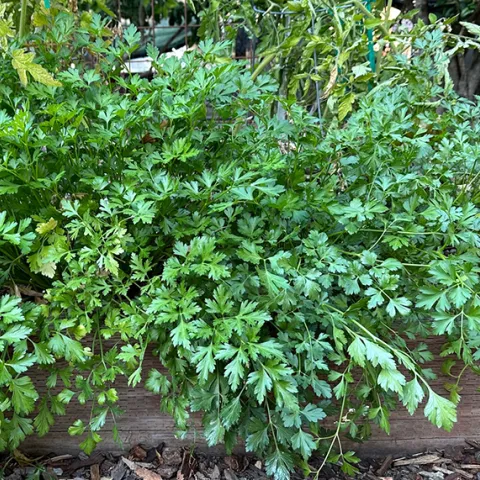
- Wide-ranging soil pH – carrots, cucumbers, garlic, parsley, peppers, pumpkins, strawberries, and tomatoes
Evaluate your soil
Simple tests for drainage, texture, pH, and the primary macronutrients – nitrogen, phosphorus, and potassium -- will help you determine what type of planting situation (in-ground or raised beds) would work best. Learn how to evaluate your soil.
Address soil nutrient problems
Edible plants provide clues when there is too much or too little of one or more of the six macronutrients. Here's how to recognize and address soil nutrient problems in the vegetable garden.
| HOW TO BUILD SOILS FOR EDIBLES 1. Start with compost: Add 1 to 2 inches of compost twice a year, for example in spring and fall, about two weeks before planting. This replaces nutrients, restores microbiological activity, and maintains soil health. 2. Test and add amendments as needed and according to directions on the product. Add amendments 1 to 2 weeks before planting. 3. Grow cover crops in winter and dig the plants into the soil in spring. 4. Add a layer of mulch in summer (leaves, rice straw, or another layer of compost) to retain moisture, minimize weeds, and provide habitat for soil organisms that positively affect plant health. 5. Add organic matter such as compost, leaves, and aged manure. 6. Consider sheet mulching (also known as sheet composting) – This is a process to eliminate lawns and weedy areas while building healthy soil. It is best started in the fall to prepare for a spring garden, but it can be done anytime. Within six months, the sheet-mulched area will have decomposed to about half its height and will be ready to plant. |
MAKE YOUR OWN SOIL MIX Soil mix for starting seeds Soil mix for containers Soil mix for in-ground and raised beds |
Follow these guidelines for beds and paths
To keep your garden accessible and well-organized, use these general guidelines when laying out your planting beds.
Width and length
• Keep beds a maximum 4 feet wide so you can access them from both sides.
• If accessible from only one side, limit to 2 to 3 feet wide.
• Beds/rows may be as long as space and irrigation system allows.
Depth
• Prepare beds to a minimum depth of 6 inches.
• 12 inches is better for drainage, aeration, and root development.
Orientation
• In large gardens there may be advantages for directional orientation of rows and beds, but this is not usually the case in smaller backyard settings.
• Orient planting beds to suit your personal preference and plant your tallest plants on the northern side.
Path width
• Keep paths minimum 2 to 3 feet wide to accommodate wheelbarrow, ease of movement, etc.
Care
• Don’t walk on garden beds or they will become compacted and not drain.
Decide on types of beds
In-ground raised beds and rows:
• Inexpensive way to create a healthy spot for growing your favorite fruits and vegetables
• Easier and less costly to construct than boxed raised beds
• Easier to turn over
• Offer growing spaces in gardens where boxes do not fit
• Build in-ground raised beds where there is at least one-foot of soil with no underground limitations
Boxed raised beds:
• Help with tunneling pests, poor drainage, poor soil, and underground rock
• Reduce the possibility of erosion by containing soil
• Warm up earlier in the spring
• Can be built to heights that limit bending
• Reduce soil compaction
• More expensive to build but are a more permanent option
• Some types of raised beds are portable
Containers:
• Easy and convenient
• No digging and the container may be placed right outside the kitchen door
• Terrific for patio gardens, accent plantings and for plants that may be invasive such as mint
• May be placed on wheels and if tall enough, may be wheelchair accessible
• Most any container made of a material that holds up well when wet and left outdoors will do
• Be creative and take a trip to a salvage yard or hardware store for inspiration
• Learn more about growing edibles in containers
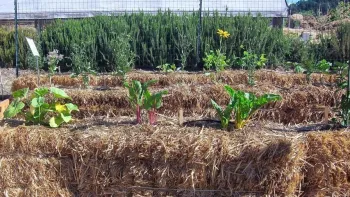
Straw bales:
While most gardeners grow crops using soil or raised beds, it's possible to grow vegetables without soil using straw bales.
• Readily available material for soilless gardening that will provide compost as a byproduct
• Allow gardeners to avoid growing in poor soils or locations where plant diseases may already be present
• Requires additional water and fertilizer to prepare them for gardening
• Have been used as a growing medium for vegetables for at least half a century in Europe
• Learn more about growing edibles in straw bales
Clear and clean your planting site
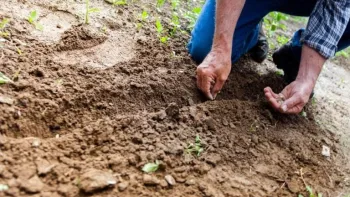
Once you've selected and assessed your site, evaluated your soil, and know what type of beds you want, you're ready to get going.
• If you discovered any hazards or limitations above or below the site, (electrical wires, limbs, plumbing, rocks, high water table, easements etc.) begin by addressing these issues.
• If you are unsure of the location of underground utilities, check with your utility company.
• If your site is sloping, construct terraces or level planting boxes to minimize runoff and erosion.
• If your site includes ornamental vegetation that shades garden beds or competes for irrigation, consider removing it.
• If your site is covered in weeds, remove them when soil is damp and appropriately discard invasive weeds such as Bermuda grass, purslane, morning glory, and Scotch broom.
Construct planting beds
In-ground raised bed:
• Remove weeds when soil is damp but not wet
• Use a digging fork to loosen soil to a depth of 6 inches
• Spread 2 inches of compost on top
• Add other organic matter such as straw and dried leaves
• Evenly scatter amendments such as blood meal, kelp meal, rock phosphate etc., to adjust nutrients as indicated by soil test
• Alternatively, premix compost with amendments and spread the premixed blend over the raised bed
• With a shovel or digging fork, blend the compost and amendments into the bed to a depth of 6 inches
• Mound soil above the height of the ground into rows 30 to 36 inches wide
• Build rows 2 to 3 feet apart and do not step on the beds
Boxed above-ground raised beds solve many problems.
Boxed raised beds
• Often made of 2-inch by 6-inch or 2-inch by 12-inch preservative-free redwood or fir
• Boxes are made in a variety of sizes; multiples of 4 are efficient as they reflect the 8-foot standard length of lumber
• Reinforce corners with 4-inch by 4-inch wooden posts or metal corner brackets
• Install half-inch hardware cloth on the bottom to deter gophers
• Once in place, fill boxes with potting mix or amended local soil
Build an irrigation system for edibles
Irrigation systems in edible gardens need to be flexible because crop locations change from season to season and water requirements differ based on what's growing and whether plants are grown from seeds or starts. It's tedious and time-consuming to change drip emitter locations every season. Overhead or micro-sprayers are good for starting seeds, but not always a good choice for established plants such as tomatoes, which don't appreciate wet foliage. In addition, it is important that the gardener can easily amend beds without having to navigate around irrigation tubing, emitters, etc.
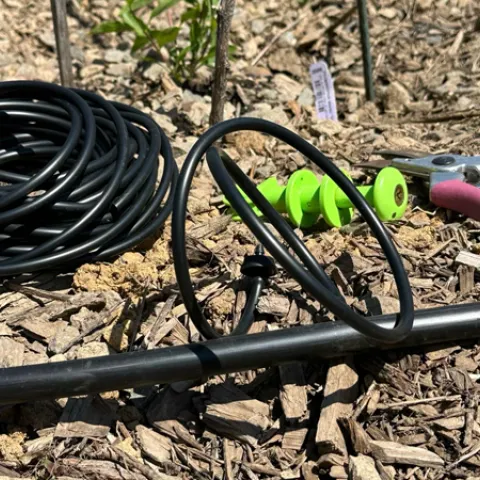
HOW TO BUILD A FLEXIBLE DRIP IRRIGATION SYSTEM for an edible garden bed: Follow these instructions to create an irrigation system that allows you to irrigate your edible crops with drip (for starts and established plants) or spray (for seeds). Because this system only connects to ONE point, it can be "lifted" to allow unimpeded access to the bed for amending soil. 1. Identify one point of connection (to water) for a garden bed. 2. Starting and ending at that one point of connection, build a perimeter 'loop" using 5/8-inch irrigation tubing. It should outline the bed and only be "connected" at the one place. 3. Run 1/4-inch or 5/8-inch emitter lines from one end of the perimeter tubing to the other, 6 to 8 inches apart. Be sure to tap into the perimeter line at both ends. This should allow you to plant anywhere in the bed and access drip irrigation. 4. Install adjustable micro-spray risers to the perimeter tubing so that it's possible to "spray" the entire bed if necessary OR turn one or more off when not needed. (This is helpful when starting seeds outdoors.) |
Rules of thumb for irrigating edible crops:
• Use a drip system if possible.
• Begin the season with a garden bed moist to a minimum of 12 inches deep.
• Check moisture content of soil with your finger several times per week.
• Water when the top 1 to 2 inches of soil is dry.
• Avoid wet/dry cycles and keep your garden consistently moist.
• Occasionally check 8 to 12 inches deep to ensure that the deeper soil is also moist.
• Irrigate early in the day.
• Observe plants for feedback. Yellowing of lower leaves provide evidence of over watering. Wilting and browning at edges indicates under-watering.
• When hand watering, apply water directly to the bed until the soil “shines” for 10-15 seconds.
• Plants need approximately 1 gallon of water per week in peak heat so if you are hand watering 3 times a week, apply about 1/3 of a gallon per plant per watering.
• Shallow rooted plants such as lettuce and other greens may require frequent shallow watering while plants with deeper roots, such as tomatoes, may be irrigated less often.
• Learn more about irrigation.
BACK TO EDIBLES
> What Edible Gardens Need
> Best Choices for Marin
> How to Prepare
> How to Plant
> Edibles in Containers
> Planting Calendar
> Grow & Care Sheets for Vegetables, Herbs & Fruits
> Tips & Techniques
> How to Maintain
> Fruit Trees
> Top 20 Edible Garden Problems
> Cover Crops & Soil Enhancements in the Off-season
> Conserving Water
•••••••••
Visit our EDIBLE DEMO GARDEN at IVC Organic Farm & Garden
News from the Edible Demo Garden
Seasonal Advice and Happenings at our Edible Demonstration Garden
Every month, the team at the Edible Demonstration Garden chronicles what's happening in the garden - planting, harvesting, problems and more. Check out our stories!
> BACK TO THE EDIBLE DEMO GARDEN
June 2025: Patio Gardening
This past month EDG volunteers created a small “patio” in the garden to demonstrate how edibles can be successfully grown in limited space. Too often gardeners are discouraged from growing edibles, believing that it takes a large back yard with room for long rows of plants. However, with the imaginative use of containers even a small deck, patio, or balcony can be converted into flourishing garden.
What are the basic requirements for growing edibles in small spaces?
Sun – Edibles need 4 to 6 hours of sunlight. Regardless of the size of the growing area, sun exposure is essential. Leafy crops such as lettuce and chard require at least 4 hours of sun per day and fruiting crops like tomatoes, melons, and beans need at least 6 hours of sunlight daily. It’s important to choose the sunniest spot on a deck or patio for an edible garden area.
Water – Container plants need water more often than those grown in the ground. The need to transport water to growing plants with buckets or watering cans can diminish the pleasure in growing edibles. While drip irrigation is ideal, a hose attached to a water source will suffice.
Containers – The possibilities for garden containers are numerous and range from commercial pots, planters, troughs, and bags to the creative repurposing of old pans and buckets, wooden crates, wheelbarrows, and, of course, wine barrels. A used filing cabinet with the drawers removed can make a great container for edibles. In the Demo Garden, a straw bale provides a patio container for yellow fin squash. Regardless of the type of container, good drainage is important so it may be necessary to drill holes to allow water to flow through easily.
Containers need to be deep enough to provide sufficient space for root growth. Depth requirements vary with the type of crop. Salad greens and some herbs can grow in 6- to 10-inch-deep containers while peas, eggplant, and peppers need at least 14 to 16 inches to develop a strong root system. Tomatoes in containers require a minimum soil depth of 18 inches.
Soil – The potting mix used in containers should be porous and fast draining, yet moisture retentive. A high-quality mix that contains compost and other organic matter is best. Garden soil is too heavy, difficult to keep evenly moist, and can harbor disease. Organic fertilizers should be added in frequent but light amounts as the watering that container plants require leaches nutrients from the soil.
Additional tips for small space edible gardening
Credit: PickPik
Take advantage of vertical space – Trellises and stakes help tall and vining plants to grow upward. Use walls or fences as additional planting space by adding shelves, racks, or hanging baskets. A recycled step ladder is an inexpensive vertical gardening option.
Avoid damage to structures – Use blocks or bricks under containers to prevent rotting wooden decks or stairs. Consider the weight of the soil and container when planting on a balcony.
Protect against animals and pests – Plants in containers are susceptible to the same pests as in-ground plants. Cages or netting might be necessary to protect against birds, squirrels, and other critters.
Don’t forget the pollinators – Adding a few flowering plants to a container garden can help to attract pollinators to the edibles and increase veggie and fruit production.
Click here for more information on growing edibles in containers.
April 2025: The Joys of Selecting and Planting Seeds
It’s hard to find a gardener who doesn’t love checking out new seed varieties and anticipating the abundant and tasty harvest they promise. The photos and descriptions are tantalizing and the names intriguing. Who wouldn’t be curious about a pumpkin variety called ‘Abominable’, a pepper named ‘Frodo’, or a tomato tagged ‘Dancing with Smurfs’? With so many seed varieties to select from, narrowing down the choices can be challenging. In January this year, a team of EDG volunteers had a lot of fun picking out varieties for our spring and summer crops.
How Seeds are Selected
Seed selection starts with a garden plan, taking into consideration the space available for each type of crop. Once decisions are made about which crops to plant and where to plant them, choosing the right varieties becomes the focus. The Demo Garden is the perfect place to try out some of those new and different seed options while continuing to plant those varieties that have proven to be reliable. Planting more than one variety of each crop makes it possible to directly compare them in terms of growth and productivity.
Time to maturity is important in determining which summer crop varieties to plant. The soil must be consistently warm (over 55 degrees) for the time specified in the variety description to produce a crop. The climate in the Indian Valley Organic Farm and Garden where the Edible Demo Garden is located provides a long enough growing time for most summer crops. However, varieties requiring more than 120 days to maturity may not achieve full production before the weather turns cool.
Seeds planted in the Edible Demo Garden must be organic certified. Organic seeds are from plants grown in compliance with federal standards which exclude the use of synthetic fertilizers, pesticides, and genetically modified technologies. Seed choices for the Demo Garden are often based on the descriptions provided by organic seed companies and it’s up to the volunteers to determine which varieties seem well suited for the garden conditions and promise the best taste.
Planting the Seeds
On February 27th, the new MMG training class got hand-on practice in seed starting. Seeds are planted in a starting soil mix in flats of cells with 2 or 3 seeds per cell. Supervised by EDG volunteers, the trainees planted 60 cells of cucumbers (‘Armenian’, ‘Crystal Apple’, ‘Jin Yang’ and ‘Early Fortune’) and 90 cells of sweet peppers (‘Pusztagold’ and ‘Bacskai Feher’), along with 30 cells of green onions and 72 cells of lettuce. The class will have the chance to take some of the cucumber and pepper starts home to plant in their own gardens where they can assess how well they grow in our different microclimates. The planted seeds are now germinating in the greenhouse.
Starting plants in the greenhouse gives them an advantage and allows better timing for optimum crop production. They are not ready for transplanting outside until they have developed at least one set of true leaves. The first set of leaves to appear are embryonic leaves called cotyledons. They look different from the plant’s typical foliage. True leaves are the more recognizable leaves that develop above the cotyledons. The time required for seedlings to be ready for transplanting varies. Beans can be ready in 3 to 4 weeks while peppers can take more than 8 weeks.
New Varieties in the Demo Garden
EDG volunteers look forward to growing the new seed varieties they have selected for the summer. The seeds have been ordered but not all have been planted. ‘Dancing with Smurfs’, an indigo-colored cherry tomato, along with ‘Altai Orange’ and ‘Woodstock’ are among the new tomato varieties. Two new melon varieties, ‘Sweet Freckles’ and ‘Farthest North Galia’ will be tried in the garden. The ‘Pusztagold’, and ‘Bacskai Feher’ peppers, now germinating in the greenhouse, are small, sweet Hungarian type peppers. Last summer’s pepper crop included an overabundance of hot peppers, so it’s sweet peppers in demand this year.
Starting with seeds is rewarding. There is the pleasure of choosing seeds from the many available varieties and the joy of nurturing them and watching them grow into tiny plants. It’s even better when the veggies and fruits turn out to be as yummy as the seed descriptions promise.
Click here for more information on planting from seeds.
February 2025: Choosing the Right Garden Tools
In January, the 2025 Marin Master Gardener training class was welcomed into the Edible Demonstration Garden for a discussion and demonstration on the use and care of garden tools. The right tools make the difference between gardening that is pleasurable and gardening that is a struggle. Your first experience with a garden tool might have been that pointed stick you used when digging in the dirt as a child. Now as a gardener, you are presented with an array of better tool choices, some essential for basic garden work and some designed for specific tasks. There are tools for pruning, tools for digging, tools for raking, and tools to make gardening easier. Here are some of the more popular tools in those categories.
Pruning Tools
-
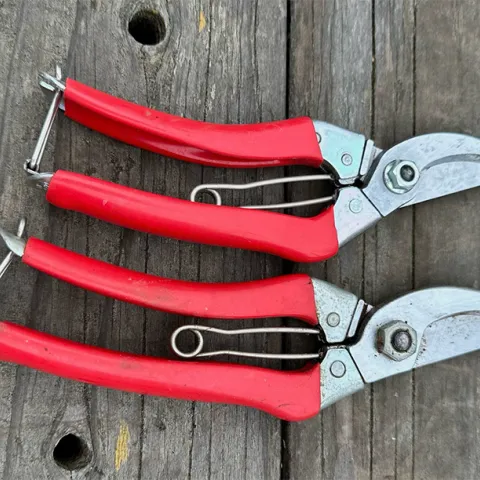
Hand pruners are the favorite tool for most home gardeners. They are the tools used most often for cutting and thinning small branches to maintain plant health and appearance. They are also used for cutting flowers and harvesting vegetables. By-pass pruners, which work like scissors, are best for making clean cuts on living plants. Anvil pruners crush branch tissue and are good for removing and cutting up dead branches.
- Pruning saws are used to remove branches larger than what hand pruners can remove. They can have a fixed or folding blade.
- Loppers are long-handled by-pass pruners that can help access higher and hard to reach branches. The long handles also provide leverage to enable pruning thicker branches.
Digging Tools
-
Trowels are essential for digging, planting, potting, and weeding. A trowel is a spade-shaped hand tool with a slightly scooped blade.
- Garden knives are a type of trowel with a sharp narrow blade and a pointed end. One blade edge is usually serrated. Hori-Hori garden knives are a Japanese design that has proven to be so useful for digging and weeding that the name is often applied to any type of garden knife.
- Shovels and spades are long-handled digging and soil lifting tools with the shape of blade and the length of the handle determining their particular uses.
Raking Tools
- Rakes are useful for cleaning up leaves, removing debris, and spreading out soil amendments like compost and mulch. Hand rakes are great for getting into small spaces. Rakes with flexible, fan-shaped tines work well for cleaning up lighter debris and are sometimes called leaf rakes. Garden rakes have larger stiff metal tines and are intended for heavier use in soil or larger debris.
- Forks are used for raking out stones and weeds. Like a dinner fork, a garden fork has four strong tines which can push easily into the ground and enable it to double as a digging tool for loosening and turning over the soil.
Gardening Comfort Tools
-
Gloves provide the hand protection every gardener needs. They are a barrier against pricks, cuts, abrasions, blisters, insect bites, and other skin irritations. While most gardeners don’t mind getting their hands dirty, getting jabbed with a nasty thorn is not only painful, but it can also lead to serious infections. There are many types of gloves to choose from depending on the type of protection required. Most important is that they fit well and are comfortable to wear.
- Kneelers cushions protect the knees when planting, weeding, and performing other low to ground garden tasks. Kneelers made of rectangular shaped heavy foam are the simplest type. However, kneelers with handles that are lightweight and easy to fold up can make the up and down movements around the garden easier. Some even flip over to form a bench.
- Ergonomically modified tools can help gardeners get more done with less effort by enabling good body alignment and reducing joint strain. Grips should be comfortable to hold and keep hands and wrists in natural positions. Handles should be the right length to enable good posture without excessive bending and twisting.
Tool Care
Tools need to be kept clean, sharpened, in good repair, and organized to keep them working well. Surface dirt and dried sap should be brushed or washed off after each use. Periodically applying a light layer of oil will reduce rust. Pruners need regular sharpening and should be sanitized with a 10% bleach solution following contact with diseased plant material. Storing tools in dry place where they can be easily accessed will ensure they are ready for work when you are.
Click here to learn more about choosing and caring for garden tools.
January 2025: Natives in the Edible Garden
Native Plants Attract Pollinators and Invite Beneficial Insects
Native plants also invite beneficial insects that are natural enemies of vegetable garden pests. Beneficials such as hoverflies, lady beetles, and lacewings go where they find the herbivorous insects they like to eat. It doesn’t matter to them whether their prey is on an edible plant or a native. The natives keep the beneficial insects nearby, so they are there to control pests when the vegetable crops are planted.
Native Plants Improve Soil Health
Native plants support soil biodiversity by providing habitat for beneficial microorganisms like fungi and bacteria. Some can act as nitrogen-fixers to improve soil fertility. Natives with deep root systems can improve soil structure by creating channels through which water and nutrients can penetrate. When the roots and leaves of the native plants die back, they add organic matter to the soil reducing the need for soil amendments.
Native Plants are Low Maintenance
Natives don’t need fertilizing and require little watering once they are established. While some need deadheading and cutting back, it’s best to minimize the kind of tidying up that’s done in the edible garden. The native plants can offer a refuge for beneficial populations, providing them with undisturbed nesting and overwintering sites. Ideally the native plants attract enough beneficial insects and other natural enemies to maintain a healthy balance so that pests are kept in check.
Native Plants Add Beauty and Interest
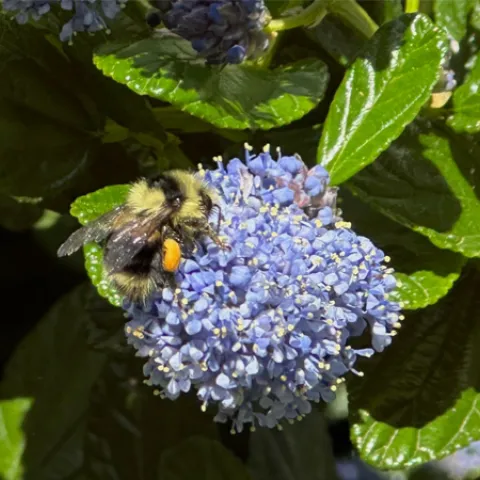
Native plants bring unique beauty to the garden. The natives planted in the Edible Demo Garden were initially chosen to provide blooms throughout the year. Some flower early and bring color into the winter garden and others extend their blooming period into late fall. They add contrast to the flowering of the vegetables and fruit trees. Ceanothus ‘Concha’ now masks the compost bins with its copious cobalt blue flowers in early spring. Coast Aster, Aster chilensis, provides bright, daisy-like blossoms throughout summer and fall. Bees and hummingbirds enjoy the showy red tubular blooms of California fuchsia, Epilobium, into late fall. The goal to bring native plants into the Edible Demo Garden to provide year-round beauty has been achieved.
For more information on growing native plants, click here.
December 2024: Giving the Garden a Rest
Planting cover crops
There are many advantages to planting cover crops. Cover crops, sometimes referred to as “green manure”, are an excellent way to protect and improve soil. They increase organic matter, suppress weeds, prevent damage from wind and water erosion, and support beneficial insects and earthworms. Plus, they can look attractive while nurturing the garden.
Two different cover crops were chosen for the Edible Demo Garden. Fava beans were planted in several of the garden beds and in the straw bales used for the summer crops. The latter is an experiment to determine if there is sufficient residual fertility in the straw bales to support another crop. In order to aid in germination and enhance their nitrogen fixing effects, the fava bean seeds were soaked in an inoculant containing rhizobacteria prior to planting. As an alternative cover crop, a green manure mix of bell beans, field peas, and purple/hairy vetch was planted in some of the raised beds. Past experience with crows eating the sprouting seeds necessitated the use of compost, straw, and protective netting to give the cover crop seedlings a fighting chance. The effectiveness of the different cover crops will be tested in spring when it is time to plant again.
Allowing beds to remain fallow
Click here for more information on cover crops and soil enhancement in the off-season.
November 2024: Experimenting with Different Tomato Varieties
Tomatoes are among the top summer crops in the Edible Demo Garden and each year there are decisions to be made about which varieties to grow. Since there are reported to be over 10,000 varieties of tomatoes, it’s important to narrow down the selection considerably and plant only those varieties that grow well in Marin and are appealing to consumers. However, even within those broad parameters, many choices can be made. The Marin Master Gardeners typically offer sixteen varieties in their annual tomato plant sales. These are the varieties that have proven over the years to be the most popular with customers. Each year one or two new varieties may be offered to replace some that have not fared so well in terms of sales or customer reviews. Choices about new varieties are usually based on members’ recommendations.
The Tomato Experiment
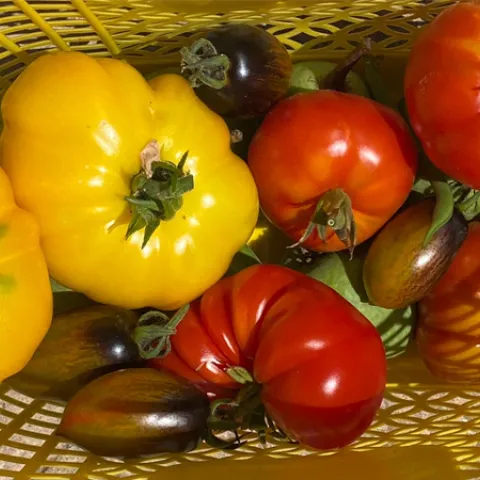
This spring the Edible Demo Garden and the Edibles Guild launched a collaborative experiment to determine which of seven tomato varieties not previously sold in the tomato market, would be most successful in Marin’s different growing conditions. The experiment involved adopting out 132 plants grown in the Indian Valley Organic Farm & Garden greenhouse to 37 Marin Master Gardeners willing to try growing them in their own gardens. The seven varieties were:
- Costoluto Genovese – a classic red Italian heirloom
- Bicolor Marvel Stripe – a marbled red and gold heirloom
- Moonglow – a bright orange heirloom
- Mortgage Lifter – a large meaty red heirloom
- Magic Bullet – an elongated cherry-sized open pollinated variety
- Pink Berkeley Tie Dye – a wine-colored open pollinated variety with green stripes and pink flesh
- Amish paste – a small bright red heirloom best used for sauces
The tomato adopters agreed to submit data describing their experiences growing the trial tomatoes. They recorded the garden type, location, and microclimate, when the tomatoes were planted, how they were cared for, and when the first tomato was harvested. Then they subjectively rated the tomatoes on yield and taste. Finally, and most importantly, they answered the question – “would you grow this variety again?”.
Which varieties had the best results?
What matters most when choosing tomatoes to plant
One of the most important factors to consider when choosing a tomato variety is the microclimate in the growing location. Tomatoes need sunshine and warm soil. All the experimental tomatoes required temperatures above 65 degrees and some preferred 75 degrees. During a typical spring, in most areas of Marin, around May 1st is when the temperatures are best for planting tomatoes. Tomatoes planted before the air and soil are sufficiently warmed, will sit idly by until the conditions are right. Conversely, tomatoes don’t like extreme heat and will stop production during heat waves like those experienced in parts of Marin this summer.
Linked to microclimate are days to maturity. This is the average time it takes for the first ripe fruit to develop in ideal heat conditions. Magic Bullet, Pink Berkely Tie Dye, and Costoluto Genovese are considered mid-range, requiring 70 to 80 days to mature. The others are late maturers, needing more than 80 days to produce ripe fruit. Bicolor Marvel Stripe takes 95 days to mature. In cool areas of Marin, there may not be enough warm days for some late maturing tomato varieties to reach full production.
Click here for more advice on selecting and growing tomatoes.
October 2024: Herbs Among the Edibles
The supporting cast of herbs in the Edible Demo Garden includes basil, oregano, thyme, lemon verbena, chives, Mexican tarragon, anise hyssop, chocolate mint, lavender, pineapple sage, and rosemary. Some are harvested and sold fresh at the Indian Valley Organic Farm and Garden farm stand and others are dried and offered as seasonings and teas. They are among the most reliable plants in the garden.
What is an Herb?
The word “herb” can be applied to any non-woody plant with leaves, seeds, or flowers used for seasoning, medicine, or fragrance. It’s the culinary uses that most commonly interest home gardeners. Herbs are considered different from spices based on the part of the plant that is used. Spices are derived from the roots, bark, fruit, berries, and seeds of plants. Some plants can be both an herb and a spice. Coriandrum sativum, also known as Chinese parsley, is called cilantro when the green leaves are used as an herb and coriander when the seeds are used as a spice.
Why Grow Herbs?
- Herbs make good neighbors with other plants and can be easily integrated into both edible and landscape gardens. They are attractive enough to do double duty as ornamentals.
- Herbs are cost-effective. They are inexpensive to grow and can be harvested in the amounts required for a recipe. No need to spend money at the supermarket on packages of herbs.
- The blossoms on herbs attract pollinators and other beneficial insects.
- Herbs are usually not bothered by pests and diseases. Some herbs have been shown to repel pests affecting companion plants. An example is the ability of basil to deter thrips from invading tomato plants.
- Deer usually leave herbs alone, especially those with strong tastes and scents.
- Herbs grow well in containers and are a good choice when garden space is limited.
Tips on Growing Herbs
Some herbs are started from seed while others are easy to grow from cuttings. Information on the growing needs of common edible herbs can be found at http://marinmg.ucanr.edu/EDIBLES/EDIBLES_GROW_SHEETS/
Check the upcoming events listings on this website to register for a hands-on public workshop on growing and using popular edible herbs. There will be a workshop held on the College of Marin Indian Valley Campus on November 2, 2024, from 10:00 am to 12:00 pm.