
PalmArbor Articles 2025
PalmArbor Articles 2025:
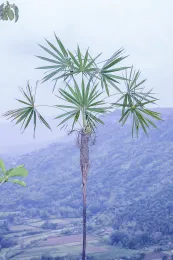
The collectors of Cuban palms (Arecaceae) 3. Charles Wright. Celio E. Moya López. PalmArbor 2025-01:1–72. DOI: https://doi.org/10.21414/B1H59F
The taxonomy of Charles Wright’s palm (Arecaceae) collections in Cuba in the mid-19th century is discussed and updated. Wright collected 14 genera of palms in Cuba, only Pseudophoenix eluded him. From his palm collections, six new genera were described, five of them as correct names: Acoelorraphe (1879), Colpothrinax (1879), Calyptronoma (1864), Gaussia (1865), and Hemithrinax (1883). He also collected the first specimens of the genus Leucothrinax in Cuba. Of the 621 specimens of Cuban palms that C. Wright collected, I identified 11 holotypes, 4 isotypes, 14 lectotypes, 21 isolectotypes, 1 neotypes 2 isoneotypes, 37 syntypes, and 531 without type status. A total of 84 syntypes from 14 other collectors were also identified.

Ganoderma butt rot of palms: first report of this lethal disease in California. Paul Santos and Donald R. Hodel. PalmArbor 2025-02: 1–26. DOI: https://doi.org/10.21414/B1MW2Z
The lethal disease Ganoderma butt rot of palms is reported for the first time from California and its history, biology, symptoms, signs, and management strategies are discussed and amply illustrated.

No time to wilt! Max F. Rothschild. PalmArbor 2025-03: 1–3. DOI: https://doi.org/10.21414/B1KG61
This editorial explores why the general public's perception of science and scientists has declined and what remedies can be implemented to bolster and enhance science and scientists in this increasingly hostile environment.
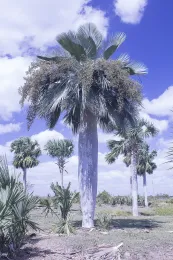
Contributions of Brother León to the study of Cuban Copernicia (Arecaceae), 1931–1936. Celio E. Moya López. PalmArbor 2025-04: 1–101. DOI: https://doi.org/10.21414/B1FS3R
The nomenclature, classification, and distribution of the genus Copernicia (Arecaceae) in Cuba, published by León (1931 and 1936), are revised and updated. León's first collection of Copernicia was in 1911 and the last in 1945. More than 90% of his collections were between 1930 and 1936. I reviewed 808 specimens of León’s Copernicia collections, most of which he personally collected; the remainder his collaborators collected but León attached his own collection number to them. I designated 25 second-step lectotypes and their respective isolectotypes of species León described: 17 correspond to correct names; six are considered synonyms; and two varieties need further herbarium studies. Also, I designated two lectotypes of species that N. L. Britton and P. Wilson described and confirmed six lectotypes: one a species O. Beccari described and five I had previously designated. All corresponding syntypes are also listed. DOI: https://doi.org/10.21414/B1FS3R
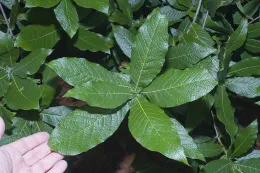
The growth of six species of Mexican oaks at The Los Angeles County Arboretum and Botanic Garden, 2005–2022. Donald R. Hodel, James E. Henrich, Emily Vicioso, and James Komen. PalmArbor 2025-05: 1–36. DOI: https://doi.org/10.21414/B1B014
We planted mostly multiple plants of six species of mostly evergreen Mexican oaks, Quercus affinis, Q. crassifolia, Q. polymorpha, Q. resinosa, Q. rysophylla, and Q. sartorii, out of 3.8-l (1-gallon) containers at The Los Angeles County Arboretum and Botanic Garden in Arcadia in 2005. We measured and evaluated their growth over 17 years. Nearly all trees have performed admirably, demonstrating their adaptability and suitability to an occasionally summer-irrigated landscape and/or urban forest, and would make superb ornamentals in coastal southern and likely central California. These trees will be much prized for their strong, robust growth of good to excellent conformation with few or no structural defects, handsome leaves, and mostly evergreen habit. DOI: https://doi.org/10.21414/B1B014

History of the date palm (Phoenix dactylifera) and other exotic palms of St Helena, Ascension, and Tristan da Cunha Islands, South Atlantic Ocean. Dennis V. Johnson and Jane C. MacKnight. PalmArbor 2025-06: 1–17. DOI: https://doi.org/10.21414/B16889
This study documents the historic introduction and recent presence of the date palm, Phoenix dactylifera, and other Phoenix spp. on the remote, isolated islands of St Helena, Ascension, and Tristan da Cunha in the South Atlantic Ocean. In the course of research, information about the other exotic palms of the islands was found and is included here because it, too, is also poorly known. No palms are indigenous to any of these islands. In addition to published documents, paper ephemera, such as photographs, postal cards, and postage stamps, were important source materials.

From demise to revival: the unexpected persistence of Panama redwood (Platymiscium pinnatum) (Fabaceae) after complete stump removal. Linton Arneaud. PalmArbor 2025-07: 1–7. DOI: https://doi.org/10.21414/B12G6C
Despite being felled with its stump removed because it was deemed hazardous and unsafe, a Panama redwood tree (Platymiscium pinnatum) has defied expectations by producing over 100 new shoots from its roots over three cutting episodes. It is unlikely that most tropical woody tree species can survive after being levelled to the ground, let alone produce three generations of healthy sprouts. This event showcases the remarkable resilience inherent in the plant kingdom and warrants further investigation.

The effect of pruning on growth and flowering of Lantana strigocamara ‘Balandrise’ as a landscape groundcover, Part II: effect of late-season pruning. Donald R. Hodel and Max F. Rothschild. PalmArbor 2025-08: 1–18.
Severe late-season, height-reduction pruning of Lantana strigocamara ‘Balandrise’ (LuckyTM Sunrise Rose) to 15 to 20 cm tall to assess whether plants could be maintained low and compact without loss of flowering performance had significant but mixed results. Six months after pruning and at peak flower for pruned plants, the latter had significantly better overall quality; greater overall height increase; more and longer shoots; longer internodes; more leaves per shoot; more leaves until inflorescences formed; and more inflorescences than unpruned plants. Overall height, length, and width were not significantly different between pruned and unpruned plants. The results suggest that late-season pruning can lead to earlier and better floral display and enhanced overall quality the following growing season but, like early-season pruning, did not achieve the goal of low, compact, dense growth with enhanced floral display. This pruning did lead to earlier flowering and earlier increased overall quality than unpruned plants. However, this advantage is somewhat tempered by the four-month winter period when pruned plants tended to have poorer overall quality than unpruned plants and the fact that unpruned plants, after about a month past peak flowering of pruned plants, “caught up” to and equaled pruned plants in overall quality and surpassed them in the quantity of inflorescences per 15 × 15 cm square area. Consistent anecdotal evidence suggests that over the long term minimal and less severe pruning might result in plants of equal or better quality, a subject that needs further investigation. DOI: https://doi.org/10.21414/B1XS33
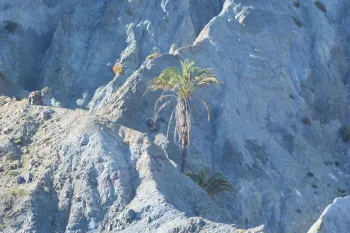
New records of naturalized and invasive Phoenix dactylifera and Washingtonia robusta (Arecaceae) on Cedros Island, Baja California, Mexico. Dennis V. Johnson and Jane C. MacKnight. PalmArbor 2025-09: 1–13. DOI: https://doi.org/10.21414/B1T01G
This study confirms about 105 date palms (Phoenix dactylifera) and 35 Mexican fan palms (Washingtonia robusta) (Arecaceae) naturalized and invasive on Cedros Island (one of the Pacific Islands of the Baja California Peninsula Biosphere Reserve) just off the west coast and about halfway down Baja California, Mexico. Most frequently, these palms occur at current or former habitation sites and in association with waterworks. Speculatively, palm seeds were dispersed from those locations into more remote uninhabited sites by water, gravity, or animal means. Where palm seeds encountered a favorably moist environment, they germinated, grew, and naturalized. The evidence presented of palms growing and naturalizing on Cedros covers the southeast coast and southern portions of the island and is incomplete. More remotely sensed and field data are needed to determine the extent to which exotic palms occur elsewhere on the island. The present results are a first step, newly recording for Cedros Island the cultivation and naturalization of these two invasive palm species within the Baja California Peninsula Biosphere Reserve.
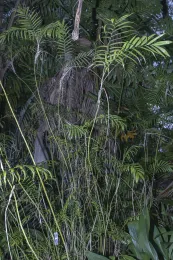
Chamaedorea delicata (Arecaceae): a new species from cultivation. Donald R. Hodel, Mychael McNeeley, Robert Dengler, Saula Ligani, Michael Letzring, and Andres Espinosa. Palm-Arbor 2025-10: 1–21. DOI: https://doi.org/10.21414/B1P88N
Chamaedorea delicata (Arecaceae: Arecoideae: Chamdoreeae), a new species from cultivation at the San Diego Zoo Wildlife Alliance, San Diego, California, U. S. A., is named, described, illustrated, discussed, and compared to related species. The new species is a clustered, dioecious palm, forming open clumps to 4 m tall and wide of several to numerous, very slender, erect to leaning, bamboo-like stems each topped with a few, small, long-pinnate leaves, lending a dainty or delicate nature to the plant.
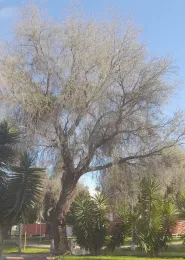
A preliminary investigation of canopy decline and thinning of urban pepper trees (Schinus molle) in Cochabamba, Bolivia. Jaime G. Rivero-Moreno. PalmArbor 2025-11: 1–26. DOI: https://doi.org/10.21414/B1JG6Q
The pepper tree(Schinus molle), known in Bolivia as "molle", is indigenous and widely distributed in the Cochabamba Valley, Bolivia, as well as in other countries in the Americas, and is widely cultivated around the world in regions with an appropriate climate. Between April and June 2025, a general decline in vigor and loss of foliage was observed in several specimens of this species distributed throughout the metropolitan area of Cochabamba. The signs and symptoms might be attributable to common parasitic species such as the mistletoe (jamillo, Ligaria cuneifolia) and harmful insects such as the psyllid Calophya schini.Uncommon, harmful insects have also been observed in pepper trees showing decline symptoms, such as the leafhopper Aethalion reticulatum, the thorn bug Enchenopa sp., and the green leafhopper Empoasca cf. sativae.However, the most worrisome potential cause of decline is a fungus in the genus Botryosphaeria, which causes dieback of new shoots. Studies are recommended to understand the factors influencing pathogen-host distribution and -interaction in order to assess and predict current and future damage, as well as the biological changes that trees experience due to infection.
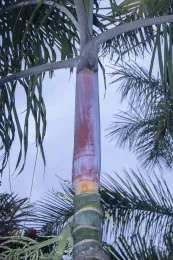
Chrysalidocarpus hamannii (Arecaceae): A splendid, new species from cultivation. Donald R. Hodel. PalmArbor 2025-12: 1–40. DOI: https://doi.org/10.21414/B1DS3F
Chrysalidocarpus hamannii (Arecaceae), a splendid, large, tall, solitary, plumose-leaved palm found cultivated in a southern California garden, is named and described as new, and is profusely illustrated, discussed, and compared to related species.
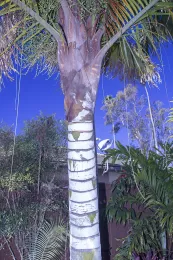
New artificial hybrids in Chrysalidocarpus (Arecaceae). Part 1. The tri-bear palm: Chrysalidocarpus x leptocaryi. Donald R. Hodel, Justen B. Dobbs, and Robert H. Burtscher. PalmArbor 2025-13: 1–39. DOI: https://doi.org/10.21414/B1901T
This article, the first in an occasional series about the hybrid palms in Chrysalidocarpus (Arecaceae) that co-author Justen B. Dobbs is developing in Florida, U. S. A., addresses the tri-bear palm, Chrysalidocarpus × leptocaryi, a stunningly handsome hybrid in tropical and subtropical private collections and botanical gardens. This new hybrid palm is formally named, described, and illustrated, compared to its parents, and its cultivation and landscape use discussed.
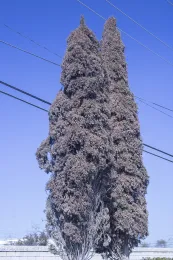
A serious and potentially new aphid pest in the genus Cinara (Sternorrhyncha: Aphididae) attacking Cupressus sempervirens in coastal southern California. Paul Santos and Donald R. Hodel. PalmArbor 2025-14: 1–33. DOI: https://doi.org/10.21414/B15880
Co-author Paul Santos recently detected a serious and potentially new aphid pest of Cupressus sempervirens (Italian cypress) in coastal regions of southern California in May and July, 2025. The aphid is in the genus Cinara, the conifer aphids, but identification to species is difficult based on morphological characters only; molecular data are necessary to resolve a species level identification. We provide an overview of Cinara aphids and in particular the C. cupressi species complex to which the new pest likely belongs and discuss and illustrate this potentially new Cinara aphid pest, the host plant Cupressus sempervirens, damage symptoms, and possible management strategies.

Chrysalidocarpus andersenii and C. ×lafazamanga (Arecaceae): a new species and its hybrid from cultivation. Donald R. Hodel and R. H. Burtscher. PalmArbor 2025-15: 1–46. DOI: https://doi.org/10.21414/B11G62
A new species, Chrysalidocarpus andersenii (Arecaceae), a moderate, clustering palm with arching, long-pinnate leaves, white crownshafts, pinnae thickly covered abaxially with white-waxy indument, and cultivated in Hawai’i, is named, described, discussed, and illustrated. It performed poorly in the Mediterranean-type climate of southern California and no plants survived but it grew much better in Hawai’i. In contrast, an inadvertent hybrid of it (commonly known as lafazamanga) with the suspected pollen parent in Hawai’i of C. lutescens, is a splendid, handsome, and superb palm that displays strong hybrid vigor and performs exceedingly well in southern California; thus, C. × lafazamanga is formally named, described, discussed, and amply illustrated as an artificial hybrid species new to science.
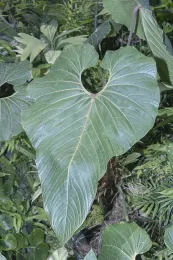
Anthurium viridifructum (Araceae): A new species in sect. Belolonchium from cultivation. Thomas B. Croat and Donald R. Hodel. PalmArbor 2025-16: 1–26. DOI: https://doi.org/10.21414/B1WS3S
Anthurium viridifructum (Araceae), in section Belolonchium, is named, described, copiously illustrated, compared to similar species, and its distribution, ecology, and cultivation are discussed. Although originally from Loja, Ecuador in high-elevation, montane cloud forest, it is named and described from cultivation in a garden in San Francisco, California, U. S. A., where it has been a superb performer for nearly 30 years.