
Reducing 1,2,3-TCP Contamination in Drinking Water
The Challenge of Clean Water Access
Across the country, many communities are fighting an uphill battle to protect their drinking water. Newly detected chemicals that may pose health risks—known as emerging contaminants—often fall outside current regulations and are hard to remove with standard treatment methods. At the same time, aging pipes and other environmental problems threaten the safety and reliability of local supplies. In California, chronic drought, overdrawn groundwater, and decades of industrial and agricultural pollution add to the challenge. Disadvantaged communities often face the greatest risks, with fewer resources to respond to contamination [1]. In rural areas, many households rely on small, shallow wells that are especially vulnerable to pollutants. Meanwhile, many small public water systems lack the funding and technical capacity to install the advanced treatment needed to meet today’s water quality demands.
While emerging contaminants draw growing attention, longstanding pollutants continue to affect water safety. One especially concerning contaminant is 1,2,3-Trichloropropane (1,2,3-TCP or TCP)—a synthetic chemical that was an unintentional ingredient in soil fumigants and industrial solvents used in California from the 1940s through the 1980s. Although no longer used, TCP leached into groundwater in areas where it was applied. Because it breaks down very slowly, it still contaminates some drinking water supplies today. The U.S. Environmental Protection Agency classifies TCP as a probable human carcinogen because studies in animals show it can cause cancer at low levels, raising concerns about health risks even at extremely small concentrations [2]. In response, California set a maximum contaminant level (MCL) of 5 parts per trillion (ppt) for TCP in drinking water—the lowest level that laboratories can reliably measure [3]. To put that into perspective, 5 ppt equals just 5 drops of TCP in 20 Olympic-size swimming pools. Small water systems face high costs and technical challenges when treating TCP, and many households using private wells lack the resources to test or treat their water—leaving them unaware of potential risks.
Addressing Contaminated Water Supplies
Solutions for drinking water contamination generally fall into two categories: temporary measures that provide immediate relief, and permanent infrastructure changes that offer long-term protection. While community-wide treatment systems are ideal, they often take years and substantial investment to implement. In the meantime, many residents—especially in under-resourced areas—must continue drinking, cooking, and bathing with water that may contain harmful contaminants or rely on costly alternatives such as buying and transporting bottled water. This reality reflects a broader pattern of environmental inequity, where the communities facing the most severe pollution are often the least equipped to respond. In these contexts, practical and affordable solutions become even more urgent.
Point-of-use (POU) filtration systems offer a promising middle ground—more sustainable than bottled water and more immediately accessible than building and maintaining municipal-scale treatment plants. These systems filter water at a specific location where people drink or use it, such as under a kitchen sink, attached to a faucet, or into a pitcher [4]. While the California State Water Resources Control Board does not consider point of use as a permanent solutions, these systems can provide critical protection while longer-term remediation efforts are developed and implemented [5]. Understanding the effectiveness of various POU options is important for communities facing TCP contamination today.
New Research on Affordable Solutions
A recent study at UC Merced offers promise for residents in California’s agricultural areas. We tested the effectiveness of simple point-of-use water filters- developed in water pitchers- as a practical, accessible, and short-term solution to TCP contamination. Published in the journal PLOS Water, our findings suggest these filters can remove high levels of TCP from drinking water. A key finding was that countertop pitcher carbon filters could remove enough TCP to comply with California’s low regulatory limit of 5 parts per trillion (ppt). While carbon filtration was already known to reduce TCP contamination, before this study it was unclear whether the faster flow rates and shorter contact times in point-of-use filters would be sufficient to reach such low concentrations.
The testing showed that common filters in water pitchers consistently eliminated over 98% of TCP throughout their service life, with some maintaining effectiveness beyond their rated capacity. or a family of four, drinking 2 liters per person daily, the $160 annual cost of this solution offered substantial savings compared to bottled water, which would cost the same household over $1,000 per year (based on 2022 prices) [6].
Such devices also have limitations. While effective at removing TCP, carbon filters may not address other contaminants, such as bacteria or nitrates, and are prone to biofilm formation if not replaced on schedule. Biofilm, a buildup of microorganisms like bacteria on the filter surface, can reduce filtration efficiency over time [7]. Additionally, water from private wells, which often contains high levels of dissolved organic matter, can prematurely clog filters, limiting their ability to absorb contaminants. As a result, while the taste and smell of water may improve, filtered water may still contain significant contaminant levels. Moreover, this study did not test water with different levels of organic matter, so there’s still more to learn about how these filters perform in those conditions.
Searching for Sustainable Treatment Alternatives
Another important aspect of our research was exploring almond shell biochar as a sustainable alternative to traditional carbon filtration materials, such as coal- or coconut shell-based options. Biochar is a charcoal-like substance made by heating organic materials—such as agricultural waste—in a low-oxygen environment. This process, called pyrolysis, results in a porous material that can absorb certain contaminants from water, similar to activated carbon. While almond biochar showed lower absorption efficiency compared to commercial activated carbon, its renewable nature and local availability suggests it could play a key role in future water treatment technologies.
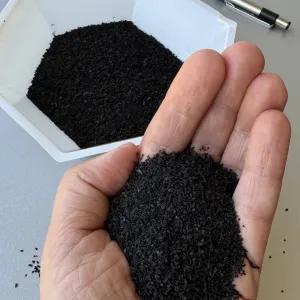
This solution may be especially useful in the San Joaquin Valley, where almonds are abundant and TCP contamination is widespread. Random sampling of wells by the U.S. Geological Survey (USGS) found that about one in five drinking water wells (341 out of 1,902) in the San Joaquin Valley exceeded the maximum contaminant level for TCP due to past agricultural use [8]. Many affected areas are rural communities that lack access to affordable water treatment facilities and rely on buying bottled water [9]. Although our study represents an important first step, there remains the need for more low-cost solutions to offer immediate protection while longer-term strategies to reduce TCP contamination are developed.
Steps You Can Take
As communities work toward better water treatment solutions, there are simple steps you can take now to get to know and improve your water quality. A good starting point is learning what is in your local water. Consumer Confidence Reports (CCRs) provide detailed information about water quality to help you determine if you need a filter. Local water providers are required to complete these reports each year by July 1st. They are often available online through your water provider’s website or the EPA’s CCR search tool, which lets you locate your report by zip code [10]. Note that CCRs are not available for small, private wells. Using NSF/ANSI-certified water filters, like those tested in this study, can be another effective way to improve water quality in the short term. These filters are tested to remove specific contaminants, which you can identify in your CCR. To ensure a filter is certified, look for the "NSF/ANSI" marking on the product or packaging, or verify its certification on the NSF website [11]. Choosing the right filter can improve the safety of your drinking water while long-term solutions are being developed.
Hope Hauptman is an Assistant Project Scientist with the California Institute for Water Resources. Previously, Dr. Hauptman was a member of the FEWS-US Lab at UC Merced, where she conducted research on TCP and groundwater contamination.
Acknowledgments: Thank you to Colleen Naughton and Erik Porse for input to this article.
-----------------------------------------------------------------------------------------------------
Research that this article is based on:
Hauptman BH, Harmon TC, Nasef Z, Rosales AA, Naughton CC (2024) Evaluation of point-of-use treatments and biochar to reduce 1,2,3-trichloropropane (TCP) contamination in drinking water. PLOS Water 3(7): e0000244. https://doi.org/10.1371/journal.pwat.0000244
References
[1] California Department of Water Resources. (2023). California Water Plan 2023 Update. https://water.ca.gov/Programs/California-Water-Plan/Update-2023
[2] Agency for Toxic Substances and Disease Registry. (1992). Toxicological profile for 1,2,3-trichloropropane. U.S. Department of Health and Human Services. https://www.atsdr.cdc.gov/toxprofiles/tp57.pdf
[3] California State Water Resources Control Board. (2024). 1,2,3-trichloropropane page. California State Water Resources Control Board. https://www.waterboards.ca.gov/drinking_water/certlic/drinkingwater/123TCP_page.html
[4] Hauptman, B. H., Harmon, T. C., Nasef, Z., Rosales, A. A., & Naughton, C. C. (2024). Evaluation of point-of-use treatments and biochar to reduce 1,2,3-trichloropropane (TCP) contamination in drinking water. PLOS Water, 3(7), e0000244. https://doi.org/10.1371/journal.pwat.0000244
[5] California State Water Resources Control Board. (2017, August 16). SWDDW-17-003: Point-of-Use and Point-of-Entry Treatment. https://www.waterboards.ca.gov/drinking_water/certlic/drinkingwater/documents/swddw_17_003/2_resolution.pdf
[6] International Bottled Water Association. 2023. Retrieved from: https://bottledwater.org/how-much-does-bottled-water-cost/
[7] Shi, X., Liu, D., Chen, L., Lin, Y., Fu, M. L., Sun, W., & Yuan, B. (2023). Challenges of point-of-use devices in purifying tap water: The growth of biofilm on filters and the formation of disinfection byproducts. Chemical Engineering Journal, 462, 142235. https://doi.org/10.1016/j.cej.2023.142235
[8] Burow, K. R., Floyd, W. D., & Landon, M. K. (2019). Factors affecting 1,2,3-trichloropropane contamination in groundwater in California. Science of the Total Environment, 672, 324–334. https://doi.org/10.1016/j.scitotenv.2019.03.420
[9] Becker, R. (2024, September 9). The CA towns where safe drinking water is out of reach. CalMatters. https://calmatters.org/environment/water/2024/09/california-drinking-water-contamination/
[10] U.S. Environmental Protection Agency. (n.d.). Consumer Confidence Reports (CCR) EPA Tool. https://ordspub.epa.gov/ords/safewater/f?p=ccr_wyl:102
[11] National Sanitation Foundation & American National Standards Institute. (n.d.). Standards for water treatment systems. https://www.nsf.org/consumer-resources/articles/standards-water-treatment-systems