
My Favorite Plants
Here are a few plants that are blooming in my garden now or were until very recently.

Layia platyglossa, or tidy tips, is an annual California native with a sweet scent and sunny innocence. It is easy and quick to grow and you will be rewarded with a profusion of 2-inch blooms with clear lemon-yellow and pure white scalloped petals. The 14 x 18-inch plants start blooming in the spring and continue into mid fall. These self-sowing plants are an important nectar source for butterflies and hummingbirds. They also attract pollinators. Tidy tips are fast growing and perfect for naturalizing banks and roadways. They can be a good addition to a cottage garden or in containers, baskets, and rock gardens. The bright blooms are drought resistant and easy to take care of. They do best in full sun and loamy soils.
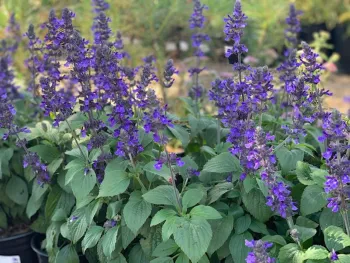
The perennial is a sage with an almost never-ending display of 14-inch velvety-purple spikes. From late spring through fall, they reach for the sky on a bushy 4-foot x 30-inch plant. This sage fits politely between neighboring plants and makes a strong, vibrant, vertical accent in the middle or back of the bed. Pleasing heart-shaped leaves clothe its stems all the way down to the base. It should be cut back to 8 inches in the winter. Provide a rich compost rich soil and full to part sun for a gorgeous plant. Bees, butterflies and hummers are attracted to it.
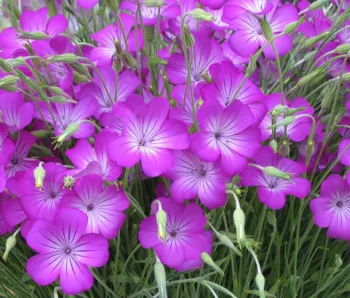
Finally, Agrostemma githago, the common corncockle, is a herbaceous annual flowering plant and a member of the Caryophllaceae, or the pink or carnation family of plants. It came here as an invasive non-native. It grows with a stem to nearly 40 inches tall. The slender deep pink to purple flowers are up to 2 inches in diameter, usually single at the ends of the stem. The sepals have five narrow teeth much longer than the petals. It has ten stamens. The flowers are scentless and bloom in the summer months—May to September. Each petal bears two or three discontinuous black lines. Leaves are pale green, held nearly erect against the stem and from 2 to 6 inches long. Seeds are produced in a many-seeded capsule. The corncockle can be found in fields, roadsides, railway lines, waste places, and other disturbed areas. All parts of the plant are poisonous so be careful with this lovely plant.
Author: Lee Miller, UC Master Gardener