
Landscaping for Wildfire Resilience
By Trish Ringley, UC Master Gardener
Landscape Design with Defensible Space
Defensible space is a carefully maintained area around your home that reduces the risk of wildfire reaching your structure. It works by limiting the amount of vegetation and other flammable materials near your home. This helps slow the spread of fire and reduces the heat and intensity of approaching flames. Whether you live on a large property or a small lot, these principles can be adapted to fit your space.
Fire spreads by moving through fuels such as dry plants, woodpiles, fences, and debris. By managing these fuels near your home, you create a buffer that helps protect your property. CAL FIRE recommends dividing your landscape into Defensible Space Zones that extend outward from your home. Each zone is designed to reduce the likelihood that fire will ignite your home and to provide firefighters a safe space to work.
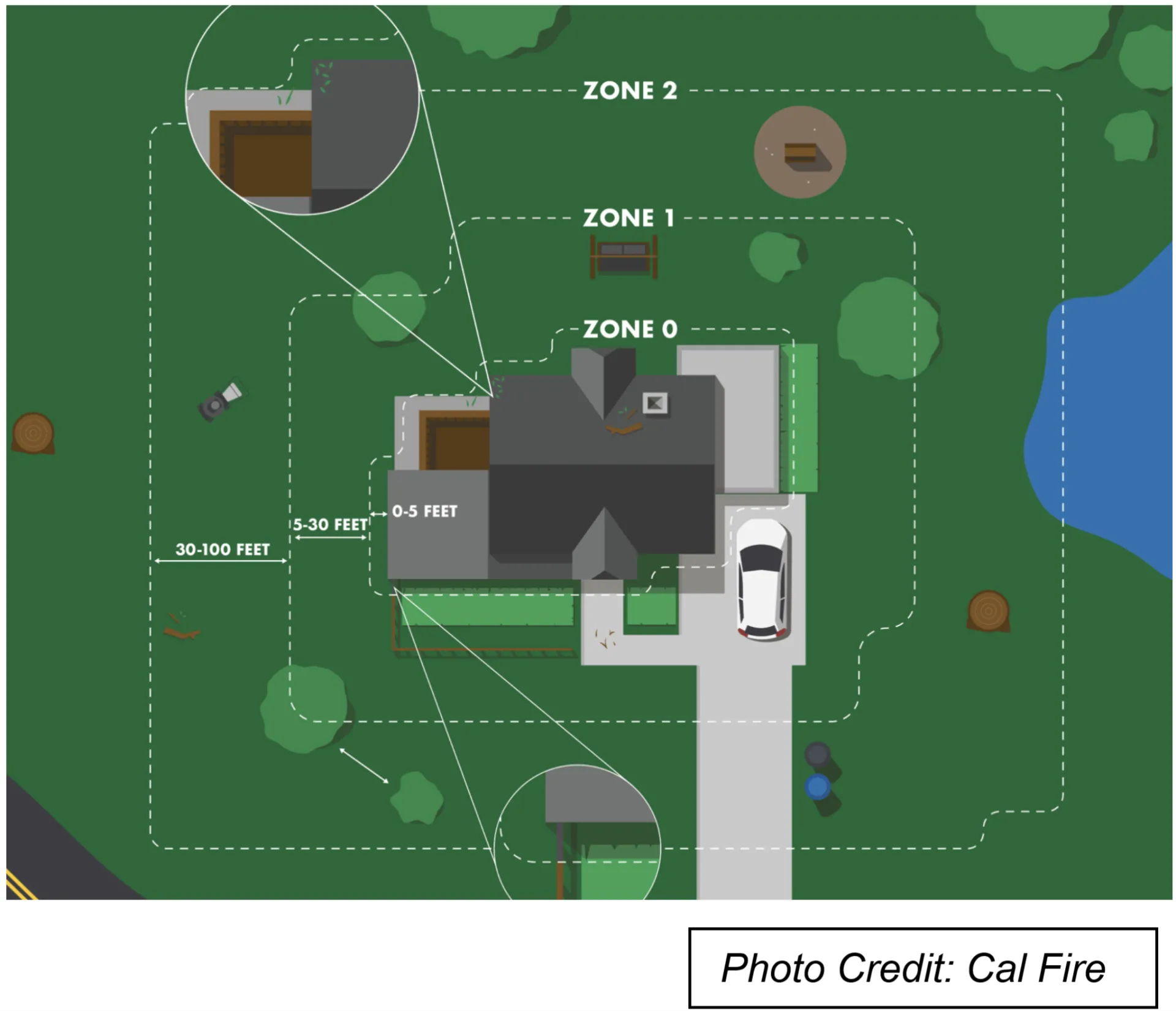
Zone 0: 0 to 5 Feet from Your Home - Keep everything ember-resistant in this zone
This area is most likely to be hit by wind-blown embers, which are the leading cause of home ignition during wildfires. Embers can travel far ahead of flames and ignite anything flammable they touch. The first five feet around your home should be completely clear of anything that can catch fire.
Stand next to your home and measure five feet out in every direction. That entire area counts as Zone 0. If your roof overhang is more than five feet, then your Zone 0 should also be more than five feet.
- Remove anything flammable, including dead leaves, dry mulch, firewood, wooden chairs, or plastic bins. Remove any organic ground cover such as gorilla hair, wood chips, bark mulch, compost, straw, grass clippings, pine needles, and shredded leaves.
- Use non-combustible materials such as gravel, brick, stone, or concrete.
- Avoid wood fences or decks that attach directly to the house. If that is not possible, create a five-foot separation with metal or another fire-resistant material.
The idea is simple. If an ember lands in this zone, there should be nothing for it to burn.
Zone 1: 5 to 30 Feet - Keep it Lean, Clean and Green in this zone
This is the first line of defense against direct flame. The goal here is to keep this area lean, clean, and green so that fire cannot travel easily across your landscape or create intense heat near your home.
- Plant low-growing, well-spaced plants that retain moisture.
- Keep plants well-watered and remove dead leaves, branches, and weeds regularly.
- Trim tree branches so they do not hang over roofs or touch other trees.
- Provide vertical spacing between plants. For example, remove lower tree branches to create at least six feet of clearance from the ground, or maintain a space three times the height of any nearby shrubs.
- Avoid dense planting. Fire spreads more easily when vegetation is continuous.
This zone acts as a buffer. It slows fire and gives firefighters a safer space to protect your home. If there is a slope in Zone 1 consider expanding the zone.
Zone 2: 30 to 100 Feet or to the Property Line - Reduce Potential Fuel in this zone
This zone is about reducing overall fuel. It is designed to interrupt fire progress and reduce its intensity as it moves closer to your home.
- Thin trees and shrubs so they are not packed close together. Aim for no more than fifty percent plant coverage in this area.
- Remove low branches on trees so flames cannot climb from the ground into the canopy.
- Keep grasses cut short and rake up leaf litter, especially under trees.
- Break up large areas of vegetation with walkways, gravel strips, patios, or other hardscape features.
Choose the Right Plants
Many homeowners ask for a fire-safe plant list, but it's important to remember that any plant can burn. Certain plant traits can affect susceptibility to fire.
More fire-resistant plants have characteristics that help them withstand heat, resist ignition, and slow the spread of flames. These traits include:
- Moist, fleshy leaves rather than dry, papery ones
- Low oil or resin content
- Compact growth that is not too dense or tangled
- Little seasonal buildup of dry leaves or branches
California native plants fit these criteria and are adapted to our dry summers. Examples include yarrow, toyon, coyote brush, and deer grass. Succulents that retain moisture in their leaves are also in this group. These plants often require less water once established, making them both fire-smart and drought-tolerant.
Avoid plants like juniper, rosemary, eucalyptus, and unmaintained pampas grass that do catch fire more easily. These species have high oil content or tend to build up dry material, making them highly flammable.
A healthy, well-kept, HYDRATED garden with thoughtful layout is much more effective than relying on plant choice alone.
Mulch and Water with Fire Safety in Mind
Mulch helps prevent weeds, retains soil moisture, and protects plant roots, but not all mulch is safe when it comes to wildfire.
- In Zone 0, do not use any combustible mulch like bark or shredded wood. Stick to rock, gravel, or hardscape.
- In Zone 1, you can use composted mulch or large bark chips, but keep it thin and well-maintained. Avoid shredded bark or rubber mulch, which can ignite easily.
- Drip irrigation is ideal. It keeps plants hydrated while conserving water and helps maintain plant health during fire season.
Regular Landscape Maintenance is Essential
- Mow grasses short, ideally under four inches.
- Rake fallen leaves and remove pine needles.
- Prune shrubs and trees regularly to maintain space in between.
- Remove dead plants, limbs, and weeds throughout the year.
- Clear roofs, gutters, decks, and under-eaves of leaves and debris.
Special Considerations for Slopes and Structures
Fire moves faster uphill. If your property is on a slope, increase the spacing between plants and consider using terraces or retaining walls to help break up fuel and reduce erosion.
Space structures such as wooden fences, arbors, trellises, or sheds away from the house. Use non-combustible materials for these structures or separate them from your home with non-combustible materials.
Resources:
To find your property Fire Hazard Severity Zone, visit Fire Hazard Severity Zones | City of San Luis Obispo, CA.
References:
Wildfire is Coming. Are you Ready? CAL FIRE. Prepare | CAL FIRE
Defensible Space. CAL FIRE. How To Create Defensible Space for Wildfire Safety | CAL FIRE
Quarles, S., Valachovic, Y., Nakamura, G., Nader, G., & De Lasaux, M. (2010). Home Survival in Wildfire-Prone Areas: Building Materials and Design Considerations. UC ANR Publication 8393. https://anrcatalog.ucanr.edu/pdf/8393.pdf
Fire Hazard Severity Zones and Wildfire Risk. CAL FIRE. Fire Hazard Severity Zones | OSFM
Wildfire Preparedness in the Home Landscape. UC Master Gardeners of Sonoma County. UC ANR. UC Master Gardeners of Sonoma County. Wildfire Preparedness in the Home Landscape | UC Agriculture and Natural Resources