
Putting the "YAY" in Espalier
Whether you are a newly budding gardener or a vine-ripened horticulturalist, espalier (pronounced “es-PAL-yer” or “es-pal-YAY”) is an artistic and skill-building method of growing plants that can be incorporated into your home garden. The word "espalier" refers to the technique of training and pruning a woody plant to grow in a flat, two-dimensional plane, usually along a wall, against a fence, or between support posts. This style of growing can be an incredibly beneficial method for saving space, improving access to fruit, managing pests, and protecting plants against harsh weather.
There are several shapes, known as forms, that can be created using espalier, from the classic horizontal cordon structure seen in vineyards across the Contra Costa American Viticultural Area1 to the more complex, lattice-style Belgian fence. Although many types of ornamental and fruiting plants can be trained using espalier, some species are more suited for these formal, symmetrical shapes. When choosing a plant to espalier, you will want to consider the characteristics of the individual plant, including age, maintenance, chill hours, and pollination requirements. Young, bare-root trees are a wonderful choice for espalier, as they are considered easy to train.
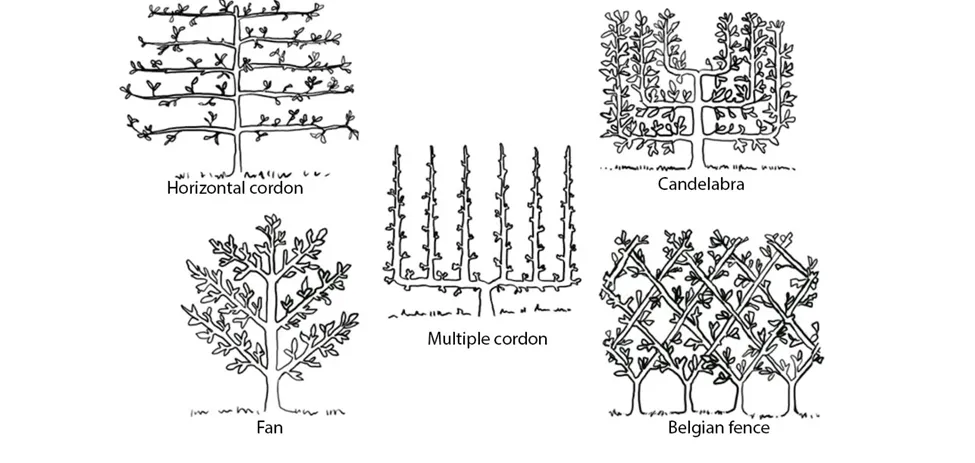
Fruit trees are a popular option for formal espalier forms, with apples, apricots, cherries, and pears being an easier choice due to fruit production on short branches or many fruiting spurs. Species that fruit on longer branches, such as peaches and nectarines, can also be used but may require more training and thoughtful pruning practices. For an additional challenge, gardeners can combine espalier training with grafting to grow multiple varieties of fruit, often seen with apples and pears, on one plant. Commonly espaliered ornamentals include magnolia, camellia, bougainvillea, and pyracantha. These flowering trees and shrubs can be well-suited for creating informal-style espalier forms.
After you choose a plant, the next step is to determine the right location and type of structure needed for your espalier. When deciding where to plant, pay attention to the soil drainage and the proximity to other plants or structures. Espaliered plants can be especially sensitive to sunburn, so it is important to consider the angle and quantity of sunlight the location receives. Before planting, you will want to build a structure to support your espalier form. Although materials used may vary, the basic structure requires a foundational post, wall, or fence with support wires set and spaced to reflect the chosen espalier form. You can find example images and tips for creating an espalier structure in this UC ANR article.
Once your espalier structure is created, it is time to plant! First, dig a hole at least twice the width of the root ball of the plant and at a depth so that the crown, or flare, of the plant is 1-2 inches above the surrounding soil level. If you are using a fruit tree grafted onto a rootstock, face the notch of the graft union northeast. Water, mulch, and fertilize as required for your chosen plant species.

The espalier training technique used will depend on the type and form of the plant. Maintenance of your espalier plant should be conducted year-round. For all espalier plants, prune and tie new shoots to conform to the desired pattern and structure of your espalier during the dormant season and remove branches that grow outward at right angles to the flat surface and those that crowd other branches during the spring and summer. The technique for creating a traditional horizontal cordon-style espalier is pictured below.
Even with a modest learning curve and an initial financial investment, espalier is a rewarding technique that provides gardeners of all experience levels an opportunity to create eye-catching structures that combine beautiful, elegant form with practical abundance.
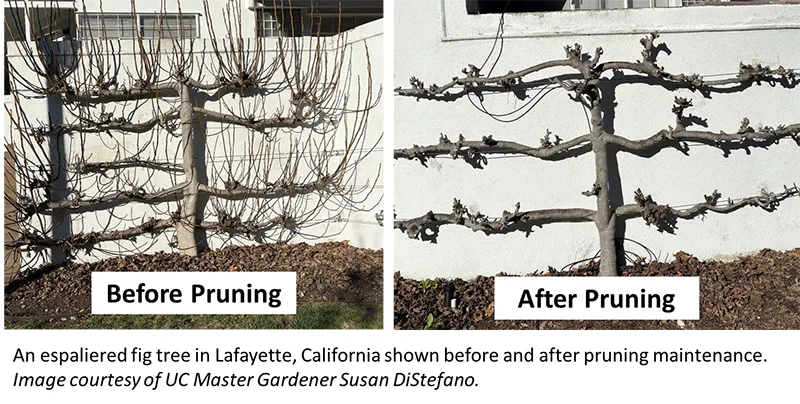
1An American Viticultural Area, or AVA, is a designated region that has specific geographic and/or climatic features that distinguish it from surrounding areas and impact how grapes are grown. The Contra Costa viticultural area was established by the Alcohol and Tobacco Tax and Trade Bureau (TTB) on March 14, 2024. More information about AVAs can be found here.
For more information on espalier plant choice, structure creation, planting, and maintenance, check out these UC ANR resources:
"Espalier" by the Marin County UC Master Gardeners
"How to Espalier" by the Marin County UC Master Gardeners
Garden Talk: Espalier Fruit Tree Basics by the Marin County UC Master Gardeners
Talk: Introduction to Espalier by the Napa County UC Master Gardeners