UCANR

About California Forests

California forests we see today are the product of the long history of physical, biological and cultural events taking place in California. 

The climate and geology along with a long background of use first by Native Americans, then settlers have shaped the forests into the assemblage trees and wildlife that we find today. 

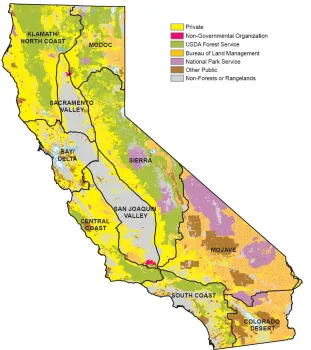
CalFire's 2010 Ownership of Forest and Rangelands in California

California is a large state: 300 miles East to West and 800 miles North to South.  It is very diverse geologically, topographically (mountains and valleys) and climatically (coastal, desert and continental). These diverse conditions conspire to create the many different California forest types, forest ecosystems. 

 
The forests of California are plentiful, diverse and managed for many different objectives. 

Approximately 33 million acres of forest in California are owned by different public and private entities.

  • 58% (19 million acres) is owned by federal, state, and tribal agencies. This includes (but is not limited to)  the USDA Forest Service, USDI Bureau of Land Management, National Park Service, tribes, and California Department of Forestry and Fire Protection (CALFIRE).
  • 27% (9 million acres) is owned by families.
  • 15% (5 million acres) is owned by industrial timber companies.

The history and future directions of California's forests are as diverse as the forests themselves. 


Today, California forests face a number of threats. 

The greatest threat is not loss of forest due to harvesting and the lack of subsequent regrowth, but conversion to non-forests from serious catastrophic events such as large wildfires and land use conversion to agricultural and residential land uses. While standing forest volume continues to increase on both private and public forest lands, we are witnessing a significant increase in the occurrence of large wildfires. At the same time, California’s forests are feeling the impacts of population growth. Urbanization, development and parcelization in rural areas are changing land use away from forests. CALFIRE's 2010 Forest and Rangeland Program assessment found that blue oak woodland to be the habitat type in California with the most acres at risk from development. 

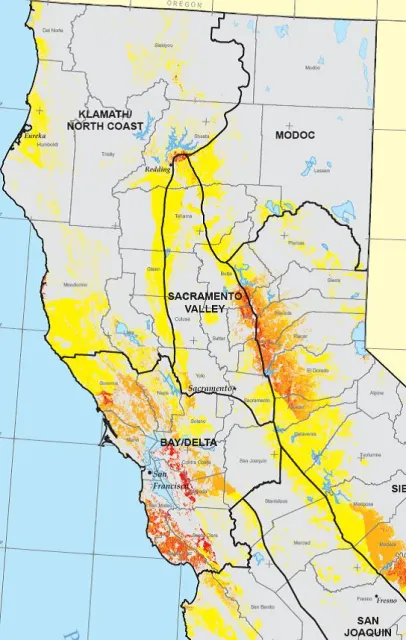
CalFire's 2010 Priority Landscapes for Population Growth and Development Impacts

At the same time, California’s forests are feeling the impacts of population growth. Urbanization, development and parcelization in rural areas are changing land use away from forests. Examples of habitat types at risk include:

  • Blue oak woodland
  • Sierra Nevada montane–hardwood-conifer type

    Forested areas are at risk are shown on the figure at right: red is high priority, orange is medium priority, and yellow is low priority.


Managing California's forests to withstand the threats of conversion and population growth requires partnerships between forest land owners, agencies, research institutions and the public.  For example, strategies to address wood products infrastructure loss have often involved collaboration between all four.

A strategic goal of the University of California Division of Agriculture and Natural Resources is to help sustain the resilience of the forest ecosystems of California by working in partnership to provide research based information on forest ecosystems and growth, vegetation management, wildlife, plants, insects and disease, wildfire, streams, roads, climate and policies to help reduce these threats. We hope to help landowners improve their stewardship of forest lands and educate the public on management of public forests in California.

Resources:

The US Forest Service assessment of California's forests describes the ownership, status and conditions of California Forests: California's forest resources, 2001-2010: Forest Inventory and Analysis Report, PNW-GTR-913 -USFS 

This 2006 US Forest Service publication on the Family Forest Owners of the United States summarizes results from the National Woodland Owner Survey of the estimated 10 million family forest owners who collectively own 35% of the nation's forest lands.

CalFire's 2017 Forest and Rangeland Assessment describes the threats and opportunities facing California's forest lands.

The growth and yield of California's forest ecosystems is available using a variety of growth and yield models. The Forest Vegetation Simulator (FVS) is a national system of forest growth models maintained by the USDA Forest Service. It is the official tool for stand growth projection on National Forest lands, but it is also used widely on other ownerships. 


return to top

Recent Blogs

Keeping people and resources connected: a conversation with Contra Costa RCD’s Ben Weise

Primary Image
Two people standing on a ranch, shaded by a large tree.
Body

Forest Stewardship comes to Contra Costa! Contra Costa Resource Conservation District's Ben Weise has been working with UC ANR's Forest Stewardship team to plan the next Forest Stewardship workshop series for landowners. We spoke with Weise about how the RCD has responded to changes in community needs over the years, and the role the organization plays in landscape-level planning for wildfire resilience.

For some time, fire had been on the periphery of Ben Weise’s work with Contra Costa ranchers. The projects he would help implement as the Contra Costa RCD’s Agriculture Program Director often had an element of reducing wildfire risk, but “it wasn’t necessarily our primary focus at the time,” he shared. But in 2020, Weise recognized a growing community need for wildfire preparedness. “The Contra Costa RCD needed to figure out where we belong in the fire world,” he recalled. “We recognized that there were a lot of people in this space already, but there was a role for us in here as well.” 

Two people standing on a ranch, shaded by a large tree.
Weise has been working to expand the Contra Costa RCD's role in the wildfire resilience space. Credit: P.Green.

Weise and other regional organizations began drafting a Regional Priority Plan (RPP), a planning document that would identify opportunities to build wildfire resilience while prioritizing natural resource concerns. Five months later, the Bay Area would experience wildfire effects firsthand. On a September morning, smoke from nearby wildfires, including the North Complex, caused a haze of smoke in the region thick enough to cover the sun. 

This event was dubbed “Orange Sky Day” and served as confirmation to Weise that there was a pressing need for wildfire preparation on a larger scale. This is where the RPP comes into play- he noted that this type of planning document was key to identifying and addressing larger-scale issues. “A lot of natural resource concerns aren’t specific to one city in our area. There are regional issues across Alameda and Contra Costa County, which have very similar landscapes,” he stated.

Collaborating on this project was a special opportunity for Weise to engage with others in the region committed to the health and resilience of communities and natural lands. “Our operating procedure at that point was to think about the projects that will provide value and benefit to communities and protect natural resources. What forests or landscapes do we need to look at? What are the species we need to be thinking about in this context?” he said. 

The RPP was completed in 2022, and one of the outcomes for the RCD was starting a Wildfire Conservation and Resilience program. The program works to connect a varied clientele of landowners, homeowners, and community leaders to the wildfire prevention services they need. This could mean introducing a landowner to the local Air Quality district’s free chipping program, or helping a neighborhood implement defensible space with the Diablo Fire Safe Council. Weise shared that the ability to bring in new Wildfire Conservation Coordinator Zoë Fung furthered the RCD’s ability to “be on the ground, in the community, and listen to what people need.”

He also pointed to the variety of projects the RCD is directly involved in: helping a FireWise community limb trees, establishing a Vegetation Treatment Program in central  Contra Costa, and offering education in the form of a “Living with Wildfire” webinar series. Weise has also been a key voice on the planning team for UC ANR’s Forest Stewardship Contra Costa Workshop, which will help landowners across California learn strategies for promoting wildfire resiliency and forest health on their land. “I have yet to meet someone I can’t work with,” said Weise. “We are connected enough now to be able to point people to where they need to go.” 

It's been three years since the RPP was completed, and Weise sees the Contra Costa RCD occupying a familiar role in the new world of fire. “We find ourselves doing much of the same work we've done for the last 80 years,” Weise shared. “Our place is connecting people to resources and bringing people together. I like to think of the RCD as the glue.” 

__________________________________

Registration is open for the Contra Costa Forest Stewardship Workshop (October 7-December 16)! The series begins October 7, with weekly meetings over Zoom and an in-person field day on Saturday, November 8. Learn about forest ecology, wildfire resilience strategies, financial assistance, and earn a free site visit with a CA Registered Professional Forester, Burn Boss, or Range Manager.

Registration is $60, with scholarships available by request. Contact Forest Stewardship Program Academic Coordinator Kim Ingram (kcingram@ucanr.edu) to request a scholarship. Register here.

Blog - Forest Research and Outreach

Cones and seedlings and freezers, oh my! UC ANR co-hosts field day at CALFIRE’s L.A. Moran Reforestation Center

Primary Image
A pile of pinecones in a gree bin.
Body
Image
A group of people standing inside listening to a presenter.
In the LA Moran Seed Lab, Marisol Villarreal (far right) explains how nursery staff select viable seeds for planting.


Summer days call for unique ways to beat the heat, so here’s a well-kept secret: the best place to cool off is a warehouse-sized freezer, tucked away at CALFIRE’s Lewis A. Moran Reforestation Center (LAMRC). The freezer’s primary residents are thousands of tree seeds: species like Jeffrey pine, Douglas -fir, and ponderosa pine, stored at frigid temperatures until they can be planted and nurtured into seedlings. A fan-favorite stop on LAMRC tours, the seed freezer is just one piece of the cone-to-seedling pipeline

UC ANR’s Forest Stewardship Education (FSE) program recently invited forest landowners and forestry professionals to tour the Reforestation Center. While 9-week regional workshops are FSE’s primary form of landowner outreach, the team will also host field trips to discuss pertinent forest stewardship topics. With California's fire season underway, the timing was ideal for a day focused on the reforestation cycle and resources for the public.

Landowners, natural resource professionals, and academics all gathered to see the cone-to-seedling process up close. Guided by various CALFIRE LAMRC employees, participants learned how the agency collects and processes cones, sorts viable seeds, grows and nurtures seedlings, and provides healthy trees to the public. 

Rows of conifer saplings in planting containers
A pile of pinecones in a gree bin.

California is home to only three seed banks: LAMRC, US Forest Service’s Placerville Nursery, and MAST Reforestation. The USFS nursery provides seeds and saplings for federal land, and MAST’s sapling offerings are limited to their work area, making LAMRC the only bank that can provide seeds and saplings for landowners across California.: “This is the only conifer seed bank for the public in California,” stated Marisol Villarreal, LAMRC Assistant Seed Bank Manager. For forest landowners seeking to replant burned or pest-affected forests, LAMRC is often their only option for sourcing climactically appropriate seed and seedlings. 

To meet landowner needs, CALFIRE requires access to the right seed source. A seedling sourced from one area, or ‘seed zone’, will struggle to survive on a parcel with vastly different environmental conditions. On the tour, Villarreal shared that “Most of the seed need is for private landowners at lower elevations,” and LAMRC Operations Manager Kuldeep Singh noted that “For us to provide seedlings for the entire state, we rely on assistance from Resource Conservation Districts (RCDs) and private landowners.” Increased outreach to private landowners has been a priority for CALFIRE, both to sell seedlings and source the seed itself.

Jake and Melissa Lehr are forest landowners in Sonoma County who attended the field day, curious about their stewardship options post-fire. “Our parcel burned in the Tubbs Fire,” shared Melissa. “We wanted to come to the field day because our oaks are doing really well, but we are looking to reforest areas where there used to be Douglas-firs.” The Lehrs shared that it was helpful to understand the time and labor required to grow a seedling, “if I ordered one now, it would take a long time to get here!” Melissa noted. They also underscored the urgency for more landowners to know about this public resource. “No one, not our neighbors or our friends know about this,” they agreed. “And they need to know. This is such an important resource for us.”

Another participant shared that she left the field day feeling inspired to do exactly that: spread the word. Genevieve Tarino is a Forestry Project Manager with the Sonoma RCD and works with private landowners like Jake and Melissa. “I had heard about tree nurseries and seed banks like this one, but have never actually seen one in person,” she said. “In our area, there’s a need for these seedlings. There are a lot of trees infected by pests and diseases on private land that need to be removed and then the area needs to be replanted.” 

The tour concluded at L.A Moran’s shade houses, the final step in the cone-to-seedling pipeline.  While participants walked among rows of conifer and hardwood seedlings, LAMRC staff noted that crews were currently out in the forest, collecting cones for another batch of seedlings.

For more information on reforestation in California, see the resource links below.

Blog - Forest Research and Outreach

A new life for sawmills: UC ANR’s Haris Gilani leads wood products innovation project in San Bernardino and Fresno counties 

Primary Image
Photo of unmerchantable timber in a California forest
Body

When seeking to make forests more fire resilient, removing fuels from the landscape is a tough task to make cost-effective. Thinning and limbing trees during fuels reduction treatments will sometimes produce marketable timber, but more often will produce small-diameter wood pieces that have traditionally been considered unmarketable. These pieces are typically chipped, masticated, or pile burned, and have long been considered ‘wood waste’.  

Image
Photo of unmerchantable timber in a California forest
Non-merchantable wood from a forest health thinning project that can be utilized to produce energy. Credit: UCCE Humboldt/Del Norte.

California researchers, industry leaders, and private forest landowners have been looking at ways to transform forest wood waste, particularly in wildfire-prone areas, into sustainable products. Utilizing forest biomass for building materials, soil amendments, and clean energy is a key strategy to economically incentivize improving forest conditions and can address both public and private industry needs. 

The state has also been making moves to decrease greenhouse gas emissions and aims to eliminate emissions entirely by 2045. Biomass-derived hydrogen (biohydrogen) a zero-emission alternative to fossil fuels, offers an exciting opportunity for advancing the state towards its zero-emissions goal while also addressing the buildup of forest fuels.   

Biohydrogen is produced through the gasification of woody residues sourced from fuel reduction and other forest treatment projects. Converting wood waste into usable products creates a regional, closed loop system that not only adds to the low-carbon fuel market but can also provide a benefit to forested communities by creating jobs and reducing wildfire risk. California has invested time, money, and research in this sector, but challenges remain. One of the biggest hurdles to increasing bioenergy production is a lack of adequate infrastructure.  

One solution posited by UC ANR Biomass and Bioenergy Advisor Haris Gilani is this: can the state breathe new life into old sawmills, and transform them into biohydrogen production sites? Gilani is leading a new CAL FIRE-funded project which seeks to answer this question, while facilitating the public and private connections necessary for implementation.   The establishment of biohydrogen sites, or campuses, has the added benefit of stimulating economic growth in rural areas through job creation and local tax revenue increases.  

Image
A man speaks into a microphone during a legislative hearing.
As a UC ANR Biomass and Bioenergy Advisor, Gilani has also shared his bioenergy research findings with California state lawmakers. 

By seeking to facilitate the commercialization of forest biomass-based hydrogen and developing the necessary markets, this project has the potential to yield significant economic and environmental returns for rural communities. Gilani’s team will be evaluating the bioenergy campus potential in two counties: Fresno and San Bernardino. “By using the excess of biomass that we already have, we can help protect communities from wildfire risk, improve air quality, and advance statewide environmental goals,” notes Gilani.  

This project aims to address needs throughout the supply chain by assessing available forest biomass resources, identifying existing and potential businesses and suppliers, evaluating workforce training needs, and providing direct support to attract and foster business growth in the two regions. Through collaboration with public and private partners like San Bernardino County, ATIP Foundation, NovoCarbo, Fresno County Economic Development Corporation, San Bernardino Economic Development, and Sierra Resource Conservation District, Gilani’s team will also identify old sawmill sites and assess the feasibility of repurposing into bioenergy campuses.  

An established statewide bioenergy campus network would be a welcome resource for small, non-industrial landowners in California grappling with the cost of managing their land. One UC ANR study found that landowners throughout the state “overwhelmingly listed cost as their major barrier to [management] action”, and many “have paid for work done on their property themselves.”  

“Landowners are a critical part of the supply chain,” says Gilani. “They would experience economic benefits from a thriving biohydrogen industry, as revenue from biomass sales could help offset the cost of forest management projects.” A crucial piece of Gilani’s project is stakeholder outreach, and he aims to host workshops to gain support from Fresno and San Bernardino landowners for this initiative.  

In addition to the creation of two bioenergy campuses, Gilani seeks to ensure other rural areas can replicate the effort to leverage biomass resources to support their economies.  “This is about supporting landowners, strengthening rural economies, and turning a challenge into a sustainable opportunity for California,” says Gilani. He and his team will create and publish strategic business plans for the Fresno and San Bernardino projects, with the hope that these two campuses are just the beginning of a statewide effort.   

For more information about this project, visit this 2024 UC ANR policy brief, or contact Haris Gilani at hgilani@ucanr.edu, . 


Blog - Forest Research and Outreach

Source URL: https://ucanr.edu/site/forest-research-and-outreach/aboutforests