
Rick Karban and the Wooly Bear Caterpillars of Bodega Bay

Ever seen the wooly bear caterpillars at Bodega Head, Sonoma County?
UC Davis Distinguished Professor Emeritus Richard “Rick” Karban of the Department of Entomology and Nematology has studied the population dynamics of these caterpillars at the University of California Bodega Marine Reserve for the past 40 years.
Some years, the wooly bear caterpillars, Arctia virginalis, are everywhere; other years, they’re almost absent. Why?
In a newly published research article in the journal BioScience, Karban and six colleagues attribute precipitation (rain) as being an “important driver of abundance everywhere we looked."
“In other words, wet winters were associated with many caterpillars,” said Karban, a Fellow of the Ecological Society of America and the American Association for the Advancement of Science. “More caterpillars were found in wet sites compared to drier sites. Almost all of the factors that we considered that affected survival and reproduction interacted with precipitation.”
The article, “Precipitation Drives the Abundance and Distribution of Arctia virginalis: A 40-Year Study,” may lead to widespread interest in understanding the processes that govern the abundance and distribution of species, not just wooly caterpillars.
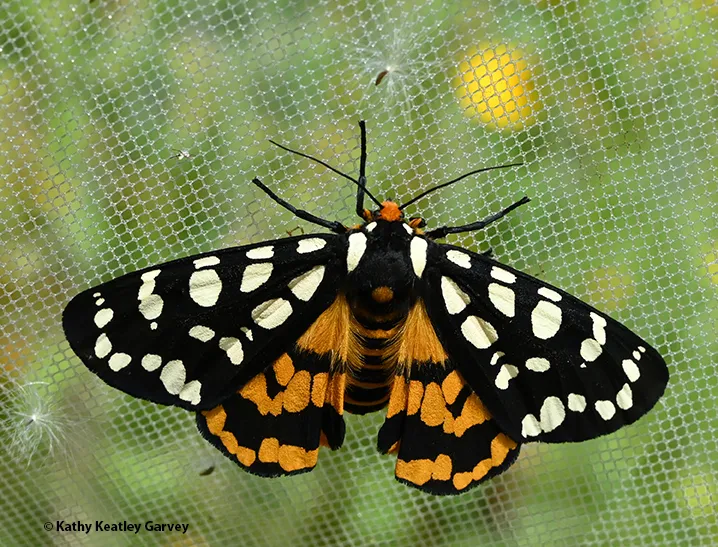
The caterpillar is the larval form of a Ranchman's tiger moth, family Erebidae, first described by Jean Baptiste Boisduval in 1852.
“Unlike other insect populations that have declined over this time period, this population has not appeared to be declining although the pattern of population dynamics was different from 1985 to 2000 compared to what we have seen more recently.”

“We also looked at patterns of abundance in various locations in central California, Oregon, and Washington,” Karban said. “We have tried to consider as many potential drivers of the population trends as we possibly could. We looked at weather, the quality and quantity of food, the predators, parasitoids and diseases that they face. Almost all of these factors were found to explain some of the pattern at some time and place. However, precipitation was found to be an important driver of abundance everywhere we looked. In other words, wet winters were associated with many caterpillars. More caterpillars were found in wet sites compared to drier sites. Almost all of the factors that we considered that affected survival and reproduction interacted with precipitation.”
Not many scientists track a population of insects at the same site for four decades. The authors wrote that “these issues have taken on a new urgency in the context of global change. For example, during the past 30-50 years, many insect populations have declined, experienced range shifts and novel interactions, or even gone extinct.”
“We now have long-term surveys of other species but these are rarely coupled with an understanding of the drivers of abundance,” Karban commented. “If we want to manage insect populations--keeping populations of pests low but encouraging populations of beneficial species--we need to know both the longer-term trends and the factors that are driving those trends. This study suggests that precipitation is an important driver of abundance that causes both direct effects (e.g., reducing mortality of small caterpillars caused by desiccation) and indirect effects (e.g., allowing small caterpillars to escape predation by ants, providing more and better food for caterpillars).”
The Abstract:
“To understand processes that govern the abundance and distribution of species, ecologists typically collect either long time series without surveying potential drivers or perform short-term experiments which may not scale up. We characterized the annual population dynamics of Arctia virginalis for 40 years and conducted experiments to examine the relative roles of abiotic conditions, host plants, predation, parasitoids, and viral infection. Rather than finding a single limiting factor, these factors were all important at some times or places. Annual densities varied by 1000-fold and showed evidence of a regime shift around 2002, coincident with changing precipitation patterns. Wet sites and wet years supported higher densities, and precipitation interacted with most of the factors considered. Population control was context-dependent, but water availability was generally the relevant context. Precipitation seems to be important for other Lepidoptera in western North America. Studies that include experimental tests of population drivers are required to effectively manage insect populations.”
Co-authors include two UC Davis scientists Mikaela Huntzinger of the Department of Entomology and Nematology, and Marcel Holyoak of the Department of Environmental Science and Policy. Others co-authors are Adam Pepi of the Maine Department of Environmental Protection, Augusta; Patrick Grof-Tisza of the Department of National Science, Converse University, Spartansburg, S.C.; Vincent Pan of the W. K. Kellogg Biological Field Station, Hickory Corners, Minn.; and Gregory Loeb of Cornell University, Geneva, N.Y.
The Washington Post featured Karban's research in an article titled "These Fuzzy Little Caterpillars Are Better at Predicting Elections Than Most Pundits," published April 26, 2016.
Karban, a member of UC Davis Department of Entomology and Nematology faculty since 1982, and who received emeritus status in 2024, currently focuses his research on two main projects: volatile communication between sagebrush plants that affects resistance to herbivory, and factors that control the abundance and spatial distribution of wooly bear caterpillars.
He is an international authority on plant communication and the author of landmark book, Plant Sensing and Communication. Karban has researched plant communication in sagebrush (Artemisia tridentata) on the east side of the Sierra since 1995. His groundbreaking research on plant communication among kin, published in February 2013 in the Proceedings of the Royal Society B: Biological Sciences, drew international attention. In that study, Karban and his co-researchers found that kin have distinct advantages when it comes to plant communication, just as “the ability of many animals to recognize kin has allowed them to evolve diverse cooperative behaviors.”
Cover Image: A wooly bear caterpillar at Bodega Bay. (Photo by Kathy Keatley Garvey)