
Reflections on thrips and INSV during the 2025 Lettuce Season
Reflections on thrips and INSV during the 2025 Lettuce Season
Dylan J. Beal, Daniel K. Hasegawa, Yu-Chen Wang
INSV:
- Early Spring and Summer: isolated, small INSV outbreaks were observed. These outbreaks were associated with adjacent, unmanaged weedy sites.
- Late Summer and early Fall: more widespread fieldwide INSV outbreaks were observed. Some of these outbreaks were adjacent to unmanaged weedy sites, while some were more indicative of lettuce to lettuce spread.
- Sampling of weed hosts during the December lettuce free period indicated an increase in INSV incidence compared to 2023 and 2024 (Figure 1).
Thrips:
- January to February: Thrips populations were above average compared to prior sampling years (Figure 2).
- March to May: Thrips populations were low, similar to prior years (Figure 2).
- June to November: Thrips populations rebounded to high levels, similar to prior years (Figure 2).
December: Thrips populations were higher than in previous years (Figure 2).
In the Spring of 2025, we heard reports and visited a few sites across the Salinas Valley with greater than expected Impatiens necrotic spot virus (INSV) incidence. Although few in number, the affected sites were associated with neighboring properties that hosted older, unmanaged broadleaf weeds. These broadleaf weeds can harbor both the virus and its main vector, Western flower thrips. The neighboring properties with unmanaged weeds included open lots, abandoned greenhouses, and vineyards. By late Summer, we heard reports of a number of sites experiencing more widespread, fieldwide outbreaks of INSV. Although these sites were still usually associated with an unmanaged and weedy neighboring property, the scale of these late summer INSV outbreaks was more indicative of lettuce to lettuce spread.
So why do we think INSV started to increase in prevalence for certain parts of the Salinas Valley in 2025? Although thrips populations were above average in January and February, likely due to a warmer, drier winter, thrips counts returned to more typical low numbers from March to May due to the late February/early March rain. Still, thrips and INSV were likely sustained in unmanaged sites harboring the common broadleaf weed hosts of INSV (Annual sowthistle, Little mallow, Nettleleaf goosefoot, Mare’s tail, Field bindweed, Shepherd’s purse, Common purslane, Hairy fleabane, Burning nettle, and Common lambsquarter). These thrips could then move to neighboring lettuce fields and transmit INSV, leading to the small, isolated outbreaks observed in early Spring. As Summer arrived and conditions got warmer and drier, thrips populations continued to build in vegetation, which includes crops such as lettuce, as well as old, unmanaged weeds. The intersection of large thrips populations with INSV infected weeds or lettuce would then lead to lettuce to lettuce transmission, giving rise to the more widespread outbreaks we observed in late Summer and Fall.
Given the potential for broadleaf weeds to serve as reservoirs and green bridges for thrips and INSV, the USDA in collaboration with UC Cooperative Extension, has conducted annual sampling of the common INSV weed hosts during the December Lettuce Free Period since 2019. In 2025, 17.23% of sampled weeds (1,085 total) tested positive for INSV, which was greater than 2023 (3.45%) and 2024 (8.99%), but remained lower compared to 2019 (29.67%) and 2020 (33.88%) when INSV outbreaks occurred throughout the Salinas Valley. During the 2023 and 2024 lettuce seasons, very few outbreaks of INSV were reported, however, the steady increase in INSV incidence in both lettuce and weeds suggests that PCAs and growers should be especially mindful of INSV weed management for the upcoming 2026 season.
To reduce the potential for INSV spread, it is critical to manage key broadleaf weeds before thrips build up large populations. From December to February, lettuce acreage is low and remains an ideal time to manage broadleaf weeds. However, from March until May, it is not too late to manage weeds in and around your properties, especially as thrips populations have historically remained low during this time. If you have lettuce acreage bordering sites that may harbor broadleaf weeds, you should scout crop edges for thrips and monitor for plants showing symptoms of INSV infection. In addition, you may want to communicate with the neighboring property manager or owner about the potential risk of thrips and INSV. You can also submit a request to Monterey County’s mandatory weed abatement program, which can assist in managing common INSV hosts. Current communal efforts to reduce potential sources of thrips and INSV will help support lettuce production later this summer and fall.
Some key points to consider:
- Old and unmanaged weeds have the highest risk for INSV infection; however, it is not too late to manage them.
- Ten important weeds that can host INSV include Annual sowthistle, Little mallow, Nettleleaf goosefoot, Mare’s tail, Field bindweed, Shepherd’s purse, Common purslane, Hairy fleabane, Burning nettle, and Common lambsquarter.(Click to see more information on each weed species.)
- Grass cover crops or resident grasses are not a concern for INSV.
- Thrips rely on wind for dispersal, so take notice of areas that are upwind, as well as farming activities such as mowing, which can trigger thrips dispersal. Scout crop edges for thrips and early symptoms of INSV, especially those that are downwind and adjacent from problematic areas.
For further questions, please reach out to Dylan J. Beal (djbeal@ucanr.edu), Daniel K. Hasegawa (daniel.hasegawa@usda.gov), and Yu-Chen Wang (yckwang@ucanr.edu).
To submit a request to the Monterey County mandatory weed abatement program, please contact Nathan Fishburn (FishburnNK@countyofmonterey.gov).
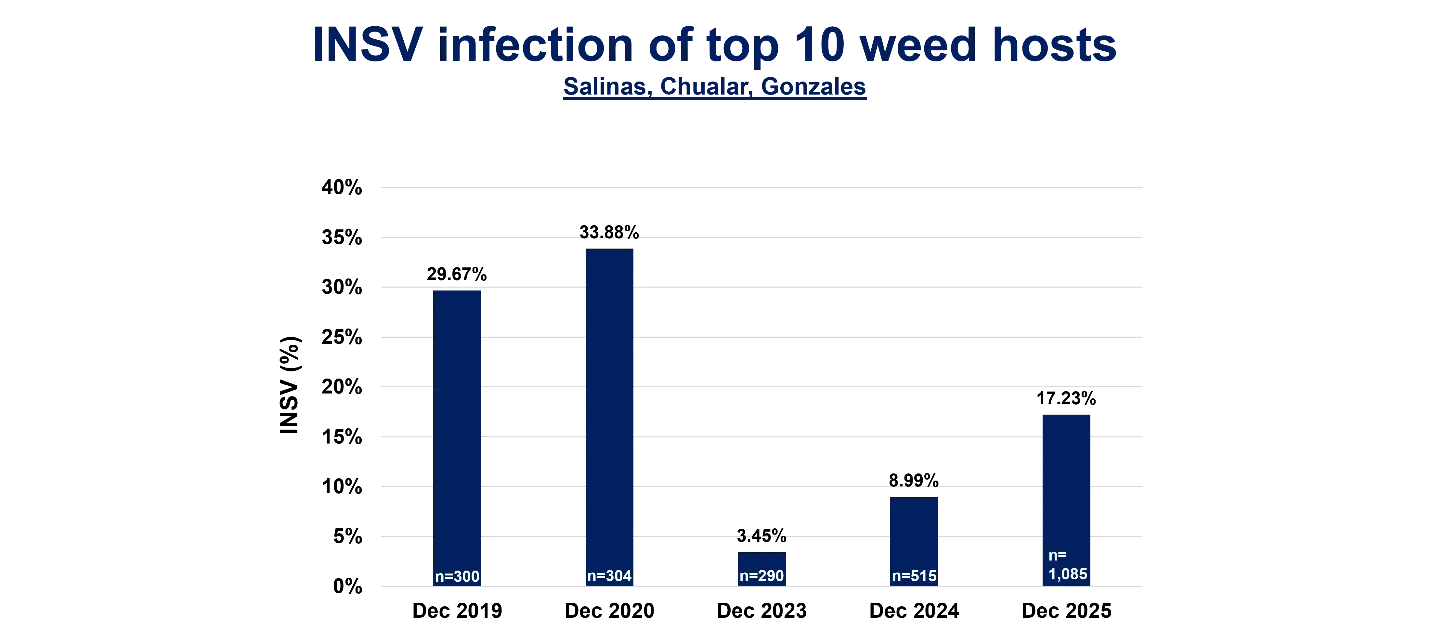
Figure 1: INSV monitoring of non-crop hosts from 2019 – 2025. Data is reported as the percent of plant samples that tested positive for INSV. Samples were collected during the December lettuce free period from sites near Salinas, Chualar, and Gonzales. Each year’s samples included the top ten non-crop hosts for INSV.
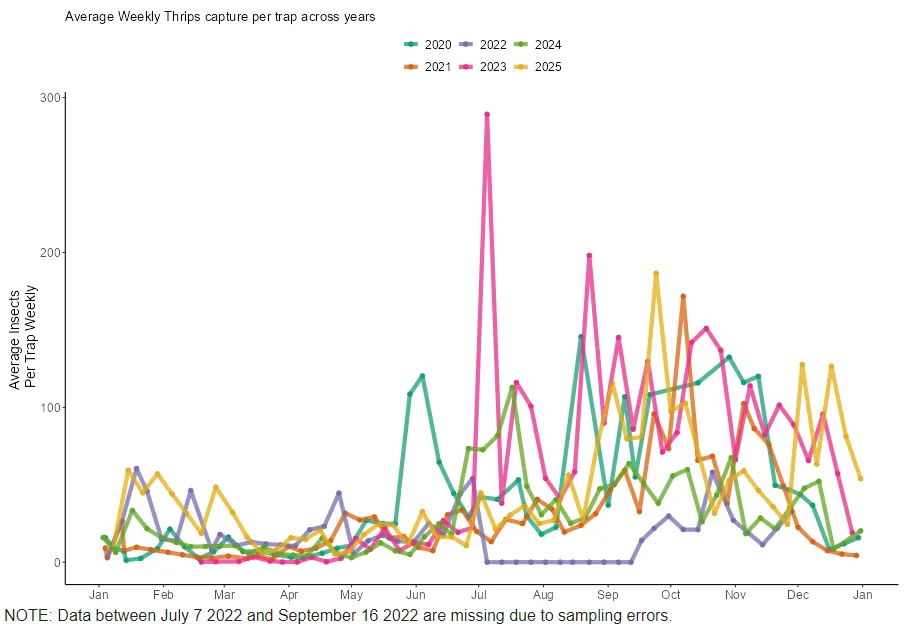
Figure 2: Salinas Valley thrips monitoring from 2019 – 2025. Data is reported weekly as the average number of thrips collected per sticky card from 21 locations (Castroville to King City). The data can be viewed in the Salinas Valley Lettuce Pest Mapping Tool, which was developed by Ian Grettenberger and Benjamin Lee (UC Davis).
Desktop version: https://salinaspestmap.shinyapps.io/salinas-pestmap/
Mobile version: https://salinaspestmap.shinyapps.io/salinas-pestmap-mobile/