
Chinese Elm-Color and Texture Galore!
Blog by Michelle Krespi
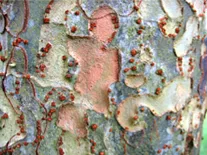
I so rarely write about trees, but this particular tree, Ulmus parvifolia, commonly known as Chinese Elm or Lacebark Elm, was up close and personal to me as I was having brunch at a Fairfield restaurant. I pay attention to the barks of trees after taking Plant ID at Solano Community College, led by a very experienced Master Gardener and the head of their Horticulture program, Sandy Diehl. If the tree is deciduous and lost it’s easily most distinguishing trait, the leaves in this case, there is always the bark, which is how I identified this enormous tree. The picture on the left[1] is an example of this colorful bark.
The tree reaches heights of between 33’ and 59’ and is between 49’ and 66’ wide. It has a growth rate of up to 13” per year. The leaves stay on the branch as late as Dec. or Jan. in North America and Europe. The leaves are serrated and have a leathery feel with a glossy green color. They take on a purple-red color in autumn. Chinese Elms have “weeping branches” and are remarkably resilient, thriving in different climates and soil conditions. It has many physical qualities that add to its appeal. Its lush foliage provides great shade on hot sunny days, providing nature's air conditioning! It is also able to add great visual appeal that is grounded in deep cultural significance.
The tree is native to China and is treasured for its endurance, stability, and strength. It is a popular choice among woodworkers and for furniture makers because of the hardness of the wood. That hardness is attributed to the silica[2] in bark and wood, making both hard and abrasive, causing the dulling of tools, chisels, planar knives, and even chainsaws![3] It has many advantages. This tree plays a big part in sustaining ecosystems and supporting a diverse array of wildlife, from squirrels and birds like sparrows, blue jays, and robins, while hosting caterpillars and other insects, which attracts insect-eating birds and bats with its wide array of food choices.[4]
Here are some tips on taking care of this elm:
- Keep soil moist but not waterlogged. Water deeply during dry spells or if planted in a pot.
- Plant in fertile, well-draining soil.
- Feed with a balanced fertilizer[5] in spring through fall.
-Will tolerate heavy pruning to maintain shape, but best done in late winter or early spring.
The tree is hardy but requires frost protection.
Is pest resistant, but be on the lookout for aphids and mites.
My final note is that much has been written about how adaptable this tree is to being bonsaied.[6] If you do so, keep it in a bright spot, preferably outdoors for most of the year, and repot approximately every two years in early spring!
[1] Image of bark of Ulmus parvifolia taken from it’s Wikipedia page
[2] Silica is made up of sand which are tiny quartz crystals. Quartz crystals are rated #7 on the Moh’s Scale (used to rate the hardness of minerals and other objects. The numbers 1-10 are used to chart an objects resistance to being scratched with Diamonds being #10.
[3] North Carolina Extension Gardener Plant Toolbox “Ulmus paravifolia”
[4] Article written by Giancarlo Maurici 9/24/25 The Cultural Significance and Identifying Features of the Resilient Chinese Elm
[5] A balanced fertilizer has the the three macro-nutrients (N-P-K) in the same proportion.
[6] Bosai info for this tree found on the online platform Bonsai Empire started two decades ago and is dedicated to the Japanese art of bonsai cultivation.
Photo by Michael Hamments: https://www.pexels.com/photo/close-up-of-exfoliating-chinese-elm-bark-texture-32949367/