
How Does A Community Garden Grow?
Article by Denise Cottrell and Stephanie Myers -
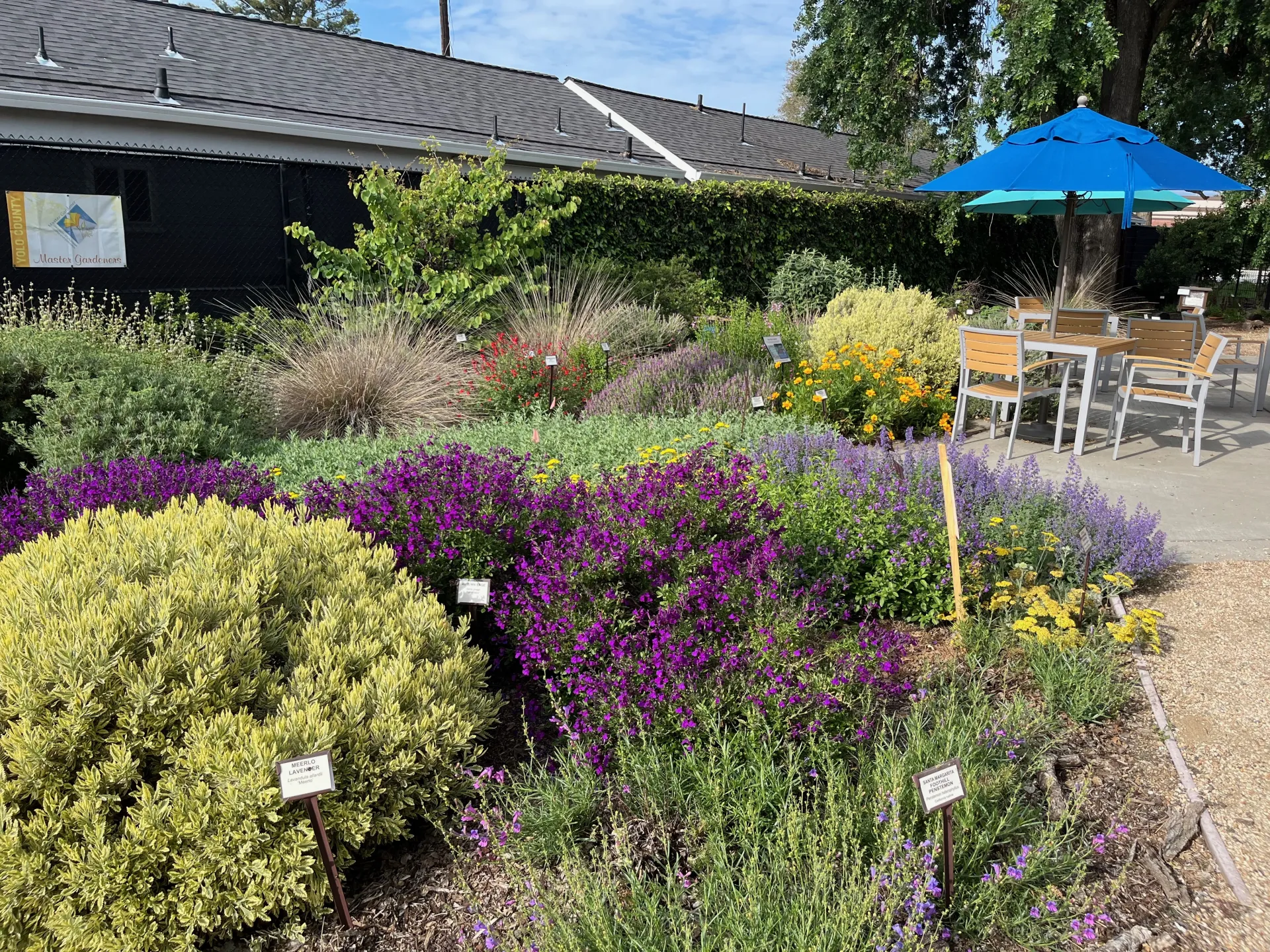
Gardening is often thought of as a solo undertaking, working by oneself, planting, tilling, raking, deadheading flowers, yet eight years ago, UC Master Gardeners of Yolo County were instrumental in creating The Winters Community Library Teaching Garden (located at 708 Railroad Avenue). Led by UC Master Gardener Stephanie Myers and accompanied by the dedicated work of UC Master Gardeners, volunteers, and local organizations, the site became a garden for the community.
Recently, the Winters Community Library Teaching Garden was selected as one of the forty-plus tour gardens on the 13th Annual Gardens Got Natives Tour coordinated by the Sacramento Valley chapter of the California Native Plant Society (CNPS). This year’s tour is on Saturday, April 18th, and Sunday, April 19th, from 9:30 am to 3:30 pm. So how did this garden “grow up” to be a designated site for the Gardens Got Natives Tour?
The vision began in 2018 when Stephanie Myers was asked by Winters Friends of the Library (WFoL) to rejuvenate the underutilized plot next to the library and create a teaching garden. They envisioned a garden that provides learning opportunities on low-water-use plants, plants that provide year-round habitat for pollinators, a space where visitors can sit and enjoy the garden, educational opportunities for school groups, a space to train community members in ongoing garden maintenance, and a place to hold workshops on a variety of topics.
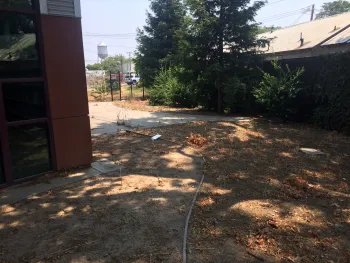
The plot, located on the south side of the library and bordering Winters High School, is part of a joint use agreement that provides for Winters Joint Unified School District (WJUSD) and Yolo County Library to share the indoor and outdoor footprint of the library. The outdoor garden space was landscaped when the library was first built, but no one used the space, and it had become an area full of weeds, overgrown shrubs, and a couple of trees. Myers accepted the challenge and began visioning, planning, and organizing with a former UC Master Gardener.
The first few months were spent creating a Memorandum of Understanding (MOU) between UC Regents/Cooperative Extension Capital Corridor, WJUSD, and Yolo County Library. The MOU for the garden site provided an understanding of responsibilities and expectations for funding, maintenance, and long-term management of the garden project.
Once the MOU was signed, the work for Phase 1 in the garden began. Planning a garden involves several steps,including examining the environment, noting sunlight patterns, wind direction, and soil quality, in addition to determining the main function of the garden, the style, planning a layout to scale, and selecting plants. The size of the plot was a given, and Myers and her fellow UC Master Gardener had a plan and a focus to create a habitat with trees, shrubs, plants, and wildflowers and create healthy ecosystems that would support a variety of species from insects, birds, butterflies, and mammals, in addition to setting up compost bins and installing a rocket bat house.
There were features onsite that remained from the original landscape plan, including decomposed granite (DG) pathways, a metal fence that faced the street, and a valley oak and a trident maple. All other vegetation was cleared from the site. A local arborist donated his services and equipment to remove shrubs and trees and grind and remove stumps.
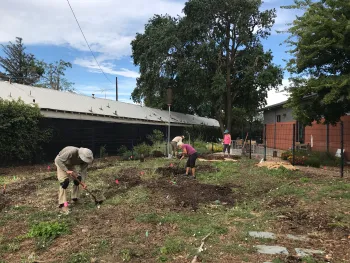
In addition to removing unwanted vegetation, the original irrigation system was no longer functioning and was removed by UC Master Gardeners and volunteers and replaced by a landscape construction team, who installed a new drip irrigation system, dry rock drainage beds, and refurbished the DG pathways. The City of Winters maintenance crew installed new irrigation valves and boxes. The Winters Joint Unified School District’s facilities maintenance team aided with weed spraying and technical assistance on site access.
Soil is a complex ecosystem that supports plant life, and to maintain the soil's integrity and structure, the ground was not tilled. Additional soil was brought in for mounding and sloping. With the site ready for planting, volunteers from UC Master Gardeners and community members worked for two days planting the garden and topping off the soil with mulch.
Additional organizations also provided services and funding. The Rotary Club of Winters purchased plant identification stakes. WFoL donated benches and contributed funds for garden maintenance. The City of Winters utilized recycling funds to purchase tables, chairs, and umbrellas for the outdoor patio.
In 2019, the garden design was completed and installed; as it turns out, this was only the “first” phase. To date, the garden has gone through three phases of expansion (2018, 2020, and 2025), and the total number of different plant species has grown to 130, of which 65 are California natives.
In 2020, the MOU was amended for Phase 2 to expand the garden area from the fence line to the sidewalk. The city relocated the metal fence and installed a new irrigation valve box, UC Master Gardeners and volunteers created new DG paths, and, along with volunteers from Putah Creek Council, planted and mulched the new area. Additional funding and support were donated by Yocha DeHe and the Yolo County Resource Conservation District and UC Davis Arboretum.

In 2025, the third expansion took place, when the UC Master Gardeners took over an abandoned area between the library and a high school entrance. This site was planted with California natives. Both expansions required the same planning steps and coordinated care as the original site, but when one has community support, creating a garden is possible. As Myers states about the process, “Investing in community relationships is important; the results are in the garden.”
The garden continues to be supported by donations and by funds earned from the yearly spring plant sale. This year’s plant sale on Saturday, April 18th,from 9:00 am to 1:00 pm will coincide with the Gardens Got Natives Tour. Click the link for more information about the tour and free registration.
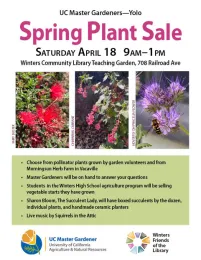
The plant sale is another community affair. The annual sale will feature plants from Morningsun Herb Farm of Vacaville in addition to plants propagated by UC Master Gardeners-Yolo and community volunteers. The Winters High School Agriculture Class and the Future Farmers of America (FFA) will sell vegetable starts and hanging baskets filled with flowers. For succulent aficionados, Sharon Bloom, “The Succulent Lady,” will have boxed succulents by the dozen and individual plants for sale in addition to her handmade ceramic planters. The atmosphere will be enlivened with music provided by Squirrels in the Attic.
The Winters Library Teaching Garden continues to thrive due to the support of UC Master Gardeners-Yolo and community volunteers who provide year-round maintenance. One doesn’t need to know about gardening to volunteer; UC Master Gardeners lead the way and provide information about plants and the process to take care of them. Volunteers learn through doing and from the care of plants as they change through the seasons. This is a teaching garden, where there is opportunity for everyone to learn and enjoy.
Photos by Stephanie Myers.