
Don’t Hesitate to Thin That Fruit!

By Brent McGhie.
It is time to start thinking about thinning the fruit on peach, nectarine, plum, pluot, apricot, apple, and pear trees.
To produce fruit that is large and healthy, fruit trees need plenty of leaves to feed the developing fruit. Since trees often set far more fruit than their leaves can adequately support, it is generally a good idea to remove a percentage of the developing fruit. Thinning fruit improves the leaf-to-fruit ratio, which results in improved fruit size and quality. Thinning also reduces the overall weight of fruit, thus decreasing the possibility of overburdened limbs splitting or breaking. In addition, over cropping can trigger alternate bearing, with significantly less fruit production the following year. Thinning can also limit the spread of diseases (such as brown rot) of fruits that are touching one another.
Thinning is usually done from early April to mid-May, depending on whether the fruit is an early-ripening or late-ripening variety. Fruit should be thinned when it is about three-quarters of an inch in diameter. If fruit is smaller than this, it may be too hard to see, but if thinned when the fruit is larger than this part of the advantage of thinning will be lost. The larger the fruit is when it is thinned, the smaller the ripe fruit will be at harvest. In other words, it is best to thin fruit early -- but not too early. Thinning also provides an opportunity to remove small, misshapen, or damaged fruit, and these should be the first ones eliminated by thinning. Retain the largest fruit whenever possible.
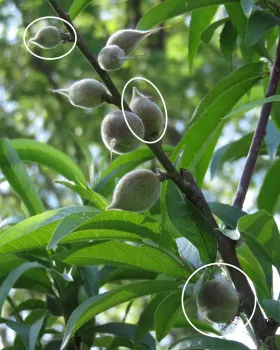
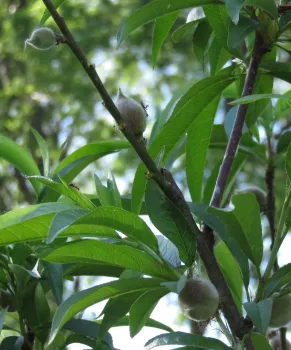
Rather than pulling it from the branch, fruit should be hand thinned either by 1) twisting it off the stem, 2) pinching off the stem between the fingernails of the thumb and index finger, or 3) using clippers. Peaches and nectarines should be thinned to about five to eight inches apart on the branch. Plums and pluots are smaller, so they can be slightly closer together, about four to six inches apart. Apricots are smaller still and can be thinned to about three to five inches apart. Apples and pears produce clusters of flowers and fruit from each bud and should be thinned to one fruit per cluster. However, if the crop is light, two fruit per cluster is acceptable. If the apple or pear crop is heavy, the fruit should be spaced no less than six to eight inches apart. Since the stems of apples and pears are relatively thick and tough, it is best to use clippers to thin them.
Most home fruit growers do not thin enough fruit from their trees. While it may be hard to thin off that potential fruit, if thinning is done properly both the harvester and the trees will reap the benefits.
For more information on fruit thinning, see Fruit Thinning by UC Master Gardeners of Sacramento County.

One way to maximize your home orchard space is to graft together different fruit cultivars so they grow together on the same tree. If this interests you, attend our upcoming workshop, Grafting Fruit Trees, on Thursday, April 9, part of the Master Gardeners 2026 Spring Workshop Series. For information about all the workshops, and to register, visit our workshop webpage. All Workshops are free, but registration is required.
UC Master Gardeners of Butte County are part of the University of California Cooperative Extension (UCCE) system. To learn more about us and our upcoming events, and for help with gardening in our area visit the UC Master Gardener website. If you have a gardening question or problem, email the Hotline at mgbutte@ucanr.edu or leave a phone message on our Hotline at 530-552-5812. To speak to a Master Gardener about a gardening issue, or to drop by the MG office during Hotline hours, see the most current information on our Ask Us section of our website.