
Dorothy Gets to the Root of the Problem
Dorothy Abeyta's Expert Approach to Fire Blight
Dorothy Abeyta, a UC Master Gardener, frowned as she examined the sprawling pear tree. She quickly diagnosed the problem: fire blight. She explained, "It is a biotic disease caused by bacteria that overwinter, then become active in the spring. First signs are oozing, then blackened twigs and wilted buds. We have to act fast, before the disease spreads to the rest of the orchard."
Responding to the City's Call for Help
The City of San Ramon had asked for assistance at the San Ramon Crow Canyon Gardens. Dorothy arrived, armed with her tools and accompanied by fellow UC Master Gardeners. The group was about to receive an impromptu master class in plant pathology.
A Step-by-Step Guide to Treating Fire Blight
Dorothy instructed us to cut the infected branch into 6-8-inch sections and inspect each section by cutting away the outer bark to expose the vascular tissue. "Fire blight damage causes the vascular tissue to turn brown. Healthy vascular tissues will be green. Keep cutting and inspecting until you reach the healthy part. Then stop." The team complied. The final cut was made at an appropriate side branch or bud.
Investigating the Underlying Issues
Next, Dorothy investigated abiotic stressors that could exacerbate biotic disease. She observed:
- Mulch was piled high around the trunk. Wielding her soil knife, Dorothy deftly pushed the mulch back, two feet away from the trunk.
- The root collar was buried under wet, sticky soil.
- Digging further, she found shallow, stringy roots. These thin roots are secondary to the main structural roots, which were still buried under the wet soil.
Dorothy surmised that the tree had been improperly planted too deeply, as its structural roots were not in the upper layers of soil. Water was suffocating the roots in the wet, clayey soil. While the team worked to break up the soil and expose the woody roots, Dorothy looked for the source of the water.
Identifying an Abiotic Issue
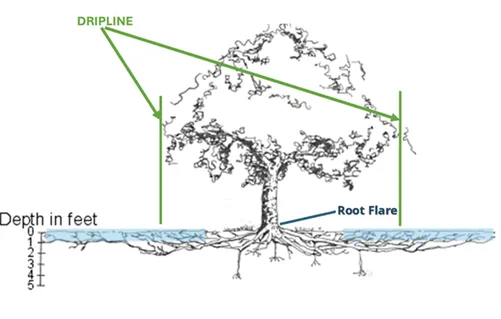
When Dorothy asked why the soil was so wet, the City revealed that a newly planted lawn along the pathway had been heavily watered. Also, volunteers water trees at the base of the trunks, and a nearby hose bib could be leaking. Dorothy recognized that overwatering, an abiotic stressor, was likely exacerbating the fire blight. She recommended the City stop watering the lawn and instead use wood chips on the path. "Call any tree service and ask for a load of wood chips, for free," she suggested. She also instructed the City on the proper drip line area to encourage good root growth.
Preserving the Orchard's Legacy
Many more apple and pear trees in the orchard remained at risk. The orchard holds historic significance, having been planted by Virginia Mudd, founder of Mudd's—the area's first farm-to-table restaurant. Despite prior community workdays, untrained volunteers often became discouraged and gave up. Under Dorothy's leadership, at least one tree now has a chance for survival. The City representative expressed sincere gratitude. Looking ahead, perhaps UC Master Gardeners can train city volunteers, empowering them to tackle these issues one tree at a time.
A Master Class in Plant Pathology
Throughout the day, Dorothy led a master class that incorporated all the essential New Volunteer Training lessons: observation, identification, distinguishing abiotic disorders from biotic diseases, understanding plant pathology, and managing soil, water, air, and compost. All the principles taught in class came together in her learning lab beneath the pear tree.
Dorothy, you are truly a pear-fect teacher. Thank you!
< Previous Articles Next >
Go to: Current Issue UCANR Home CoCoMGHub