
Grow ‘true tea’ at home in your Fresno garden or landscape
A wide variety of plants for making herbal infusions can be grown in Fresno County gardens, but there is only one “true tea.” The source plant for black, green and oolong teas – teas that originated in Asia and are wildly popular around the world – is Camellia sinensis.
Camellia sinensis is a perennial shrub with deep green, glossy leaves. As its scientific name suggests, it has similar needs in the backyard as garden-variety camellia shrubs. Unlike those plants, however, true tea thrives under the full Central Valley sun. Acid-loving true tea may be fertilized with commercial products labeled for ‘azaleas, camelias and rhododendrons’ and irrigated regularly through the dry season. Once established, harvest the tender new leaves and dry them for a home-grown cup of tea.
True tea in California
In the 1950s, the company founded by Sir Thomas Lipton in 1890 considered growing tea on California’s fertile agricultural land. It funded research at the UC Kearney Research and Extension Center in Parlier to identify varieties suited for the climate and soil. When the project ended, tea production in California didn’t take off, but a few of the best cultivars were planted in the landscape surrounding Kearney offices and laboratories. Those unremarkable shrubs, more than 65 years old, became the basis for a new tea research trial planted at Kearney in 2017. For this study, UC Davis chemistry professor Jackie Gervay-Hague grew tea to study the effects of drought stress on the production of phenolics and tannins in the tea.
While conducting the experiment Gervay-Hague and a support team at Kearney honed their tea propagation and growing skills. They shared what they learned at a tea culture field day at Kearney in March. The field day featured tea-production experts from the San Joaquin Valley, UC Davis and Taiwan to speak on what Katherine Burnett, the director of the UC Davis Global Tea Initiative, called a “tsunami of interest” in high-value artisanal and locally grown tea in the state.
Tea propagation and production
High propagation success from the cuttings taken at Kearney, Gervay-Hague said, was achieved when they were dipped in rooting hormone and given 2 months to root. Since they were found to be vulnerable when transplanted to pots, they found that repotting only once into a gallon-sized vessel works best. The team established the plants in a greenhouse, then moved them to a lath house before planting in the field, finding the ideal timing to be late November to early December. Mature plants, 3 to 5 years old, can be harvested in the spring to early summer.
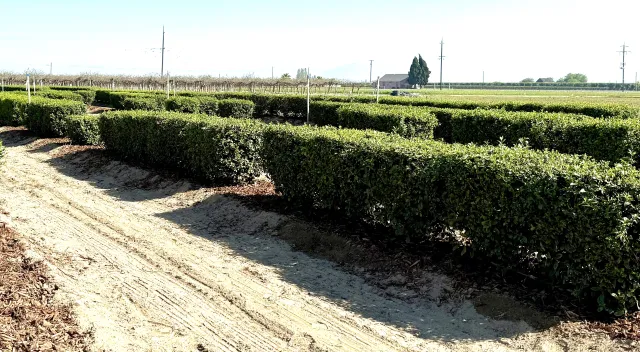
True tea is grown in hedge rows at Kearney. The most serious pests have been wasps, which were found nesting in the branches and pose a danger to workers. No pesticides are applied and weeds are being controlled with a thick layer of mulch.
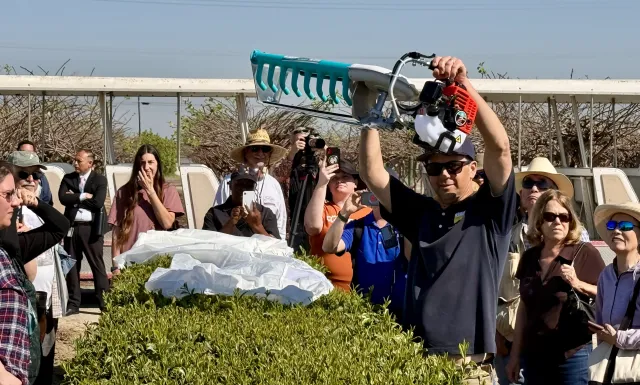
Harvesting tea is labor intensive and could be prohibitively expensive for commercial tea production in California. Ryan Puckett, staff research associate at Kearney, said the center recently acquired a hand-held harvesting machine used in China. The team will determine whether this reasonably priced tool could make commercial tea harvest economically viable.
______________________________
Written by UC Master Gardener Jeannette Warnert