
All About Peat - an interview Marie Antoine
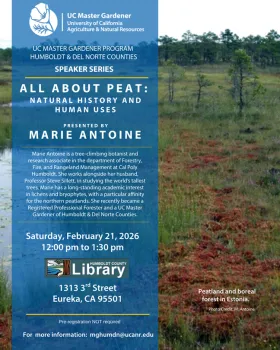
A post-presentation interview with Marie Antoine by Laurel Condro, UC Master Gardener of Humboldt and Del Norte Counties.
Hi Marie, I learned so much from your lecture. I never thought about where peat comes from or why we put it into our gardens.
Why is peat used so much in gardening products?
Peat has excellent water-holding capacity and cation exchange capacity. It's a good organic soil conditioner, and it's useful for improving heavy soils. Peat is naturally antimicrobial, so it makes a good sterile seed starting medium or a raw material for pressed pots.
It seems like peat generates very slowly.
Yes. Given the right conditions, peat accumulation is inexorable but very slow. It accumulates at a rate of about 1 mm per year. This means the material at the bottom of a 10-meter-deep peatland is 10,000 years old!
How does the extraction of peat affect the environment?
Extraction requires first draining the wetland, which of course affects ecosystem hydrology. Removal of peat irrevocably destroys habitat for a rich diversity of animals, plants, and fungi. Peat extraction liberates deep soil carbon which instead of being safely stored will instead find its way back into the atmosphere as either carbon dioxide or methane, further exacerbating our current problems with anthropogenic greenhouse gases.
Did you say that some countries are banning peat?
Sort of. Some countries whose peatlands have been heavily degraded through millennia of small-scale peat extraction are taking action to try and preserve their remaining peatlands. For example, the UK is doing a "phased ban" starting with retail peat sales already being banned and working towards a ban on professional peat use in the coming years.
What are your recommendations for peat alternatives?
If you look at the other ingredients on a bag of potting mix, those are all the alternatives! Things like pulverized wood / bark fiber, composted vegetation, kitchen waste, or animal manure, coir, shredded cardboard or newspaper, coffee ground, peanut hulls... all of these are viable alternatives. Peat wasn't widely used in horticulture until after WW2, so it's obviously quite possible to start seeds and grow plants without peat.
Did you miss the presentation?
View Marie Antoine’s presentation, ‘All About Peat: Natural History and Human Uses’, from the UC Master Gardeners of Humboldt and Del Norte Counties, 2026 Speakers Series in collaboration with the Humboldt County Main Library, and Access Humboldt.