
Gardening for Life - spotlight on Glen Paul School
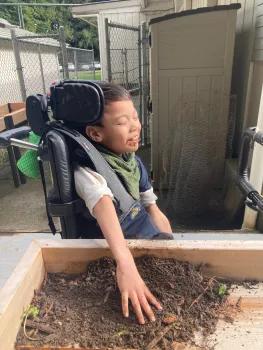
On a warm day, a child was playing in the dirt at school. The special thing about this dirt is that it is raised up to meet him where he is. His smile says it all. How wonderful that gardening can be accessible to everyone.
This adaptive garden is being created at Glen Paul School. The garden is the brainchild of Rachel Lyon, a teacher at Glen Paul. She followed the principles of Universal Design for Living (UDL), a design philosophy aimed at creating environments that are accessible, functional, and usable by all people to the greatest extent possible, regardless of their age, size, or physical ability.
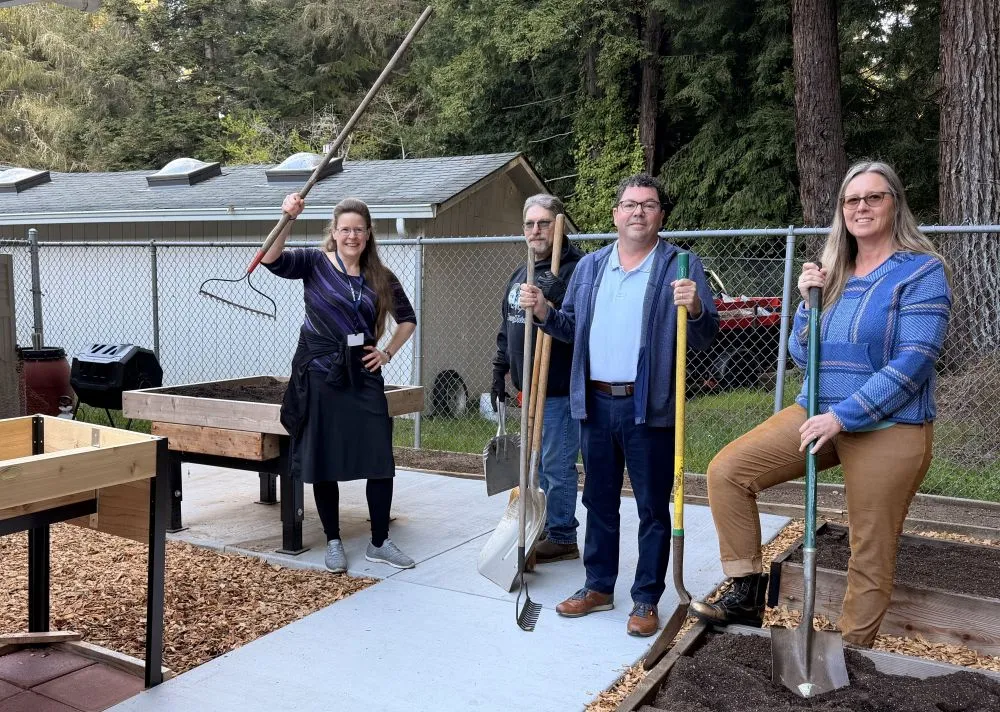
Rachel's goal is to create a garden accessible to all the students. She received a grant to begin the project. The school has also received donations from local businesses. The garden was designed in collaboration with UC Master Gardeners of Humboldt and Del Norte Counties. Many of the teachers at Glen Paul are meeting regularly to customize the garden for all their students, deciding on types of plants, how to provide the garden with regular water, and the way each classroom will use the garden. The ribbon cutting will take place later this Spring.
The new garden sits on the site of a previous garden that had fallen into disrepair and was not wheelchair accessible. The new garden is surrounded by a tall chain-link fence, which will help keep the neighborhood's deer and bears out.
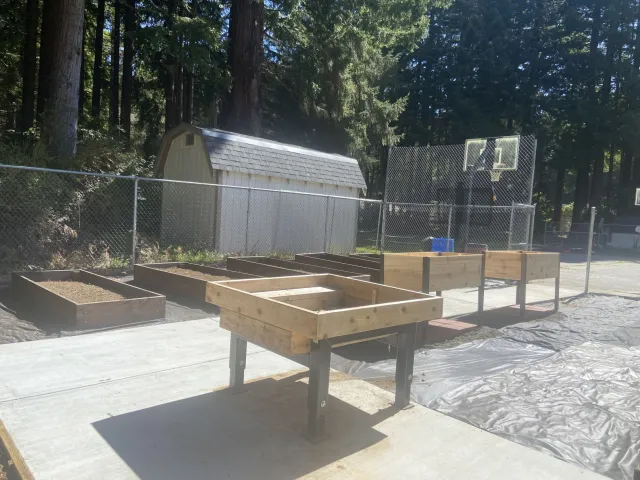
The garden features wheelchair accessible beds and ground-level beds. Some of the tall beds are square, so up to 4 students can use them at the same time. The rectangular beds will allow 2 students to work side by side.
The recommendations for wheelchair-accessible beds include a 24-inch opening under the bed to accommodate leg height. The top height of the planter should be at least 34 inches, which leaves 12 inches of soil depth in the planter. If adapting a space for exclusive adult use, slightly taller beds (+3 inches) might work better. Raised beds that are accessible on multiple sides should be 3 feet or 4 feet wide. Beds against a wall or fence should be no wider than 2 feet.
Other options for accessibility are using large containers accessible from a seated position or placing containers on tables, so they are accessible from a seated position or wheelchair. Plants that grow tall, like tomatoes or sugar snap peas, can be planted lower so that they grow up to reach their seated gardener. Hanging pots can be used for access, including pulley systems if needed to clear pathway space after gardening is complete.
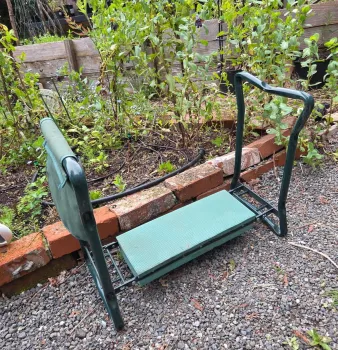
The ground-level beds can be easily accessed by preschool classes and students capable of working in kneeling positions. Rachel plans to add kneelers for students (and others) who need additional help to sit, kneel, or stand up.
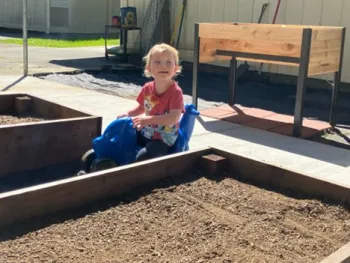
In the Glen Paul garden, there will also be work benches designed at various heights: some for toddlers, some at a seated height, and some for standing. A vertical garden will occupy the north side of the garden, using the chain-link fence to create additional growing space without cluttering the walkways needed for access.
If you are planning a vertical garden, consider unused walls, fences, and overhangs.
The pathways in the garden are concrete, which allows for easy wheelchair access and minimizes the possibility of tripping for students who use walkers or have low vision. In an accessible garden, it is important to create a firm, stable, and slip-resistant surface to minimize obstacles and prevent falls. Recommendations for pathway surfaces include concrete and asphalt, compacted gravel, wood or patio blocks. When deciding on an accessible surface, consider the following: Could a person easily ride a narrow-tired bicycle across the surface? Could a folding stroller with narrow plastic wheels, carrying a small child, be pushed easily across the surface? Could a person using a wheelchair or walker navigate the surface? Drainage should also be considered so that water does not sit on the path and create a slipping hazard.
Accessible Pathways should be at least 3 feet wide to accommodate a single wheelchair. Four-foot-wide paths allow wheelchairs to make ninety-degree turns while five-foot wide paths will allow wheelchairs to make one-hundred-eighty-degree turns without backing up. Curved designs make paths easier to use. Edge guides on paths help keep wheelchairs, canes, walkers, and crutches from going off the paths. Edge guides also assist visually challenged people in navigating pathways.
A railing along the edge of the path further improves access in some gardens. Railing height should be between 34 and 38 inches for maximum use. Railing grip size and shape are important. A rounded handrail should be between a 1 ¼ inch and 2-inch diameter. If the handrail is not rounded, the perimeter should be between 4 inches and 6 ¼ inches, with a finger-and-thumb groove about an inch and a quarter from the top, to provide a graspable railing equivalent to a 2-inch handrail. If you’re installing railing, check your local building code to be sure you comply with local codes.
If ramps are needed to accommodate changes in terrain you should follow ADA (Americans with Disabilities Act) recommendations. For every inch of vertical rise, the ramp should be 12 inches long horizontally, so that the maximum running slope is at most 1:12 or a slope of no more than 8.3%. The lower the slope, the greater the accessibility.
Additional safety concerns:
- Ensure that every planter is secure, stable, and heavy enough, so it won't move, wobble, or tip if gardeners lean on the rim.
- Keep pathways clear to avoid falls.
- Have buckets or another container available to place tools so they stay out of the way.
- Reassess beds, walkways and terrain as needed and allow for changes to the plan to ensure access for all gardeners.
Check your smile, if it’s still on your face, something is going well.
Resources:
Adaptive Gardening power point PDFhttps://my.ucanr.edu/sites/cetrinityucdavisedu/files/280231.pdf
Gardening for Life: a Guide to Gardening Adaptations for Gardeners of all Ages and Abilities WSU Master Gardeners in Spokane County
Grow more in less space with vertical gardening Oklahoma State Universityhttps://news.okstate.edu/articles/agriculture/2018/vertical_gardening.html
Gardens Are For Everyone: Ideas for Accessible Gardening May 2023 C Thomas-Kersting and W Miller, Oregon State University Extension Service
Design Accessibility for Physically Challenged Children and Adults, in Plant a Seed, Watch it Grow. Master Gardener Association of San Diego County
Getting Started With Accessible Gardening The National Center on Health, Physical Activity and Disability, University of Alabama at Birmingham
May Flowers and Accessible Gardening, J Zesski Northeast ADA Center
Guide to the ADA Accessibility Standards U.S. Access Board
Housing: What is Universal Design and Why Does it Matter? Chapman, M July 25, 2021 National League of Cities
Photos of children (parental permission granted), credit Meghan Hodge
All other photos courtesy of L. Condro and used with permission.