
Avocado Tree- A Practice in Patience
Blog by Lorenza Gibson
Most people don’t expect to wait two decades for a result—especially not from something as simple as an avocado seed. But that’s exactly what happened to me. What started as a casual decision to save a pit from a shared office snack turned into a 20-year lesson in patience, persistence, and surprise.
In the early 2000s, a co-worker brought a bagful of avocados from his backyard to share, and instead of throwing away the avocado seed, I placed it in my desk planter with a Philodendron. Lucky for me, another co-worker goes around the office watering other people’s potted plants. Several years later, I moved to another building and decided to bring my philodendron home. Little did I know that the avocado had sprouted, and I’ve transplanted it to its own pot. Another year or two had passed, and I had decided to transplant it permanently to my backyard. The avocado grew to the height of our fence, about six feet. As years passed, it grew and grew, another foot or two or three, and I realized one day, while walking in a store, I saw avocado trees on sale, and realized the trees were much smaller than the one I have, and they already had flowers! At that point, I’ve already had my tree for over 15 years! Another year passed, and still no flowers. And yet another year came and went, still no flowers. Until one day, I saw little pale round buds forming (axillary buds). At first, I thought they were just new leaf buds forming, but a few weeks later, they were clearly not branches but clusters of flowers. After 20 years, I’m finally getting some avocados. I had actually given up expecting the tree to produce fruit. But here they are. There were hundreds of them!
My excitement grew as the tiny pea-sized fruits grew to grape-sized ones, then to large olive-sized ones. One day, I noticed some of the fruit had fallen; the next day, the same, and then within a few weeks, they were gone. It was so heartbreaking to collect them off the ground by the bucketful to put in our compost bin.
The next year, there were not as many fruits; most had fallen, except for a handful that grew into normal-sized avocados. And the following year, after learning about pruning trees (cutting a third off a tree), I decided to try it. The result is dramatic! More avocados were growing to their full size. There were still some avocados with stunted growth— tiny avocados that turn reddish-brown on the branches. I found that the stunted growth, also known as “cukes” due to the shape looking like baby cucumbers, the growth or lack of it, is due to irregular watering, or lack of it, of which I am guilty. The full-grown avocados I harvested closely resemble the Hass variety. Most likely a Lamb Hass, from the description, the fruit is pear-shaped, has pebbly skin, and turns black when ripe, and is most likely a cross between Guatemalan and Mexicola.
Image
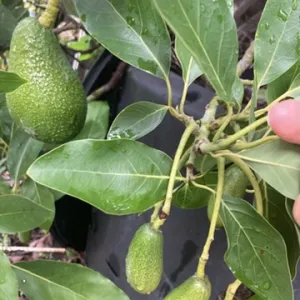
The scientific name of avocado is Persea americana. An evergreen tree, usually multi-trunk or low branching, 30-60 feet tall and 20-30 feet wide, with large, leathery, glossy dark green, oval leaves and clusters of greenish yellow flowers in late winter to early spring. Flowers are followed by green-skinned, pear-shaped fruit. Many cultivars have been selected for quality and season of fruit production. Sun to light shade, most well-drained soils. Sunset: zones vary by variety.
Did you know that avocados have more potassium than bananas? They are a good source of Vitamins K, E, and B, especially B6 and B5. The flesh is about 15 percent oil or fat, much of which is in the healthy, monounsaturated form. The fruit has been studied for its role in lowering cholesterol and limiting certain forms of oral cancer.
Let me save you some time experimenting with growing from seed. You will most likely have a good outcome if you buy an already grafted avocado tree. At least you will not have to wait 10-15 years for the tree to flower and produce. Mine took over 20 years! It’s best to get 2 trees - Type A (flowers opening in the morning) and Type B (flowers opening in the evening) for maximum yield.
As of this writing, my tree is in bloom again, and new, glossy, orange-red leaves are emerging on its branches. This year, I know what to do: consistent watering, proper fertilization, and regular pruning. A few full-sized avocados are still hanging on the tree, waiting to be picked.
Image
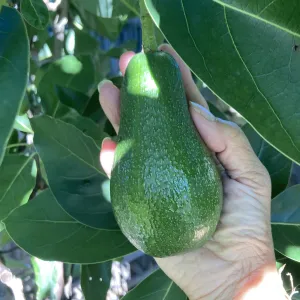
After 20 years of growing my avocado tree, I’ve learned this: good things don’t just come to those who wait- they also come to those who do their research, so you don't have to wait quite as long.
Guacamole, anyone?
References: