
April Gardening Tasks
By Alison Collin, Inyo-Mono Master Gardener Volunteer
April is a good time to look around the garden and tackle issues before they become bigger problems later in the growing season. Some tasks can be dealt with quickly—snipping off rhubarb flower stems or pulling a grass plant before it seeds—while others take more time but save effort in the long run. The following are tasks recently addressed in my own garden.
Fire Blight
The last petals had barely dropped from my Bartlett pear when the first signs of fire blight appeared. Initially, only the stems of one or two developing pears turned black and wilted, but soon entire clusters were affected.
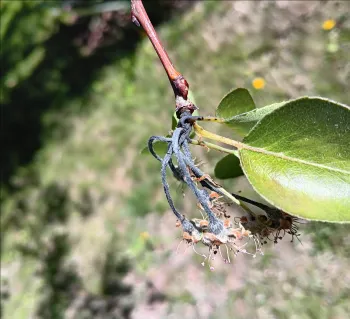
The only effective control is to prune each infected stem well back into healthy growth, at least 12 inches below visible symptoms. Dispose of prunings immediately (do not compost), and sanitize pruning tools—ideally between each cut. Also inspect other susceptible plants, such as pyracantha, and treat as needed.
The UC IPM Program has a lot of information on this common disease.
Cutworms
I observed significant damage to my onions, likely caused by cutworms. These are C-shaped larvae of night-flying moths that live underground or in leaf litter, feeding at night and often cutting seedlings at ground level. Typically, the severed tops are left lying beside the plant.
In this case, the damage was higher up on the leaves. Cutworms can often be found at night using a flashlight, though I have not yet located any despite repeated searches.
One notable experience: a tomato transplant was eaten just above the seed leaves, but it later re-sprouted and produced an excellent yield.
Suggestions for control can be found at the UC IPM program's website.
Fruit Thinning
Peach and other fruit trees have now naturally selected their strongest fruits. Typically, one fruit per twig remains firmly attached, making this a good time to begin thinning.
This is a straightforward and even enjoyable task. Removing excess fruit improves the size and quality of those remaining. At this stage, unwanted fruits can be easily removed by gently rolling them between finger and thumb. Later, thinning becomes more difficult both physically and psychologically.
Rhubarb
Check rhubarb plants for emerging flower spikes, which often appear hidden within the foliage. These should be removed promptly, as flowering diverts energy away from producing the edible stems and leaves.
Weeding and Other Tasks
While desired seeds may be slow to germinate, weeds rarely hesitate. Spotted spurge (a persistent nuisance) has already appeared in decomposed granite paths, along with grasses, yellow oxalis, dandelions, violets, and volunteer seedlings.
It is much easier to hoe weeds while they are small rather than digging them out later. Keeping tools nearby encourages quick, frequent maintenance.
Additional tasks:
- Thin dense rows of seedlings (e.g., lettuce or beetroot) early to minimize root disturbance.
- Tie in fast-growing plants that need support. Keeping ties ready on trellises or supports allows for immediate action.
- Address structural training early—particularly with vigorous or thorny plants like roses.
If these tasks are handled early in the season, there may even be time left to sit back and enjoy the garden.