
Iris Yellow Spot Virus (IYSV) Detected in Imperial Valley Onion Fields
Iris Yellow Spot Virus (IYSV) was a significant problem in bulb and seed fields in the Imperial Valley between approximately 2003 and 2012. Since then, growers and PCAs have reported limited occurrences, although symptoms can easily be misidentified as spray injury or other foliar diseases. In April 2026, symptoms of IYSV were recently observed and confirmed in onion fields in the Imperial Valley, with reports indicating increased incidence and severity this season.
What is Iris Yellow Spot Virus?
Iris Yellow Spot Virus is a member of the Tospovirus genus. This virus is a significant threat to bulb onion production by substantially reducing yield. IYSV is mainly transmitted by onion thrips and cannot be spread through seed or mechanical means.
Current management of IYSV relies on effective management of the thrips vector combined with cultural practices.
Symptoms and Identification
Look for the following symptoms in your onion fields:
- Yellow to straw-colored lesions on leaves and scapes
- Dry, elongated lesions or flecks that resemble severe thrips feeding injury
- Diamond-shaped lesions (more common on scapes than leaves)
- Concentric rings of alternating green and yellow/tan colors
- Necrotic areas on leaves that reduce photosynthetic capacity and can be colonized by secondary pathogens like Stemphylium vesicarium, complicating diagnosis.
- Highest disease incidence typically occurs near field edges.
- Lodging (plant toppling) on seed stalks during seed set
- Reduced bulb size in severe infections
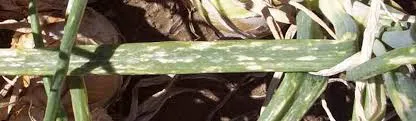
EXTERNAL IMAGE
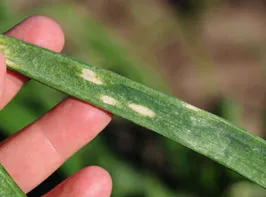
Disease Cycle and Transmission
- IYSV overwinters in volunteer onions and infected host plants
- Onion thrips (Thrips tabaci) acquire the virus as nymphs and transmit it as adults
- Tobacco thrips (Frankliniella fusca) can also transmit the virus
- Virus spreads from infected plants to healthy plants during thrips feeding
- Alternative hosts include various weeds and ornamental plants
- NOT seed-transmitted - transplants can carry both virus and thrips
Management Actions
Cultural Control
- Remove and destroy infected plants and onion cull piles immediately
- Eliminate volunteer onions and wild Allium species in and around fields
- Control weeds in field margins and within production areas
- Maintain good fertility and adequate soil moisture to reduce plant stress
- Avoid excessive nitrogen fertilization - attracts onion thrips
- Plant as densely and uniformly as possible
- Use overhead irrigation when possible, to suppress thrips populations
- Separate seed and bulb production fields
- Maintain crop-free periods between onion plantings
Thrips Management
Disease severity is directly related to the presence of virus-infected onion thrips. Controlling onion thrips will reduce disease incidence and spread within fields.
Variety Selection
No varieties are completely resistant to thrips or IYSV
Conctact Information
For suspected IYSV symptoms or questions about management:
Ana M. Pastrana – Plant Pathology Advisor, UC Cooperative Extension - Imperial County. Contact info: ampastranaleon@ucanr.edu / 442-977-5391