
What to Know About Watering
What to Know About Watering
(Short Answer: It Depends)
by Delise Weir, Master Gardener
How Much Should I Water?
In almost every gardening class I’ve taught or attended, the same question inevitably arises: “How much should I water?”
The answer is always, “It depends.” But what does it depend on?
- Soil: Type, quality, slope, and drainage.
- Plants: The specific species and its current stage of life.
- Weather: Temperature, precipitation, wind, and time of year.
- Culture: Sun exposure, mulch, plant density, and your watering method.
The "Short Report" on Watering:
- Seasonality: A general rule of thumb is to water 2–3 times a week in Summer, 1–2 times a week in Fall and Spring, and usually not at all in Winter.
- Depth: Water deeply and less frequently to encourage deep root growth.
- Soil Health: Add organic matter every year to improve both drainage and water-holding capacity.
- Protection: Always mulch the surface.
While these are great guidelines, they don't fully answer the question. Let’s do a deep dive into the dependencies.
Note: This article applies to in-ground plants only, not container plantings.
Soils and Drainage
You can often identify your soil by look and feel. Water runs straight through sandy soil, while it pools and gets mucky in clay. This is due to the particle size of the native soil. If you are on a slope, water may also run downhill before it has a chance to soak in.
To find your soil’s true drainage rate, perform a percolation (perc) test:
- Dig a hole roughly 12” x 12” x 12”.
- Fill it with water and let it drain for 12–24 hours to saturate the surrounding soil.
- Place a stick across the top of the hole. Refill the hole with water and wait 15 minutes.
- Measure the distance from the stick to the water’s surface. Multiply that number by 4 to calculate how many inches drain per hour.
- Poor Drainage (less than 1"/hour): The fix is adding lots of organic matter (compost and cover crops) and organic mulch.
- Excessive Drainage (more than 4"/hour): The fix is also organic matter, which acts like a sponge to hold particles together. Alternatively, choose drought-tolerant or native species that thrive in dry conditions.
- Ideal Drainage (1–3"/hour): This is desirable for most plants. Continue to maintain it with compost and mulch.
Watch: How to do a Perc Test
Measuring Needs and Delivery
The General Rule: Most plants need 1 inch of water per square foot, per week.
But how do you translate "one inch" into actual gallons or minutes?
- The Math: 1 inch of water = 0.62 gallons per square foot.
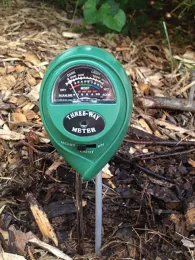
How do I know when to water?
- The Finger Method: Stick your finger 2 inches into the soil. If soil clings to your finger, it’s damp—no need to water. If it comes up clean and dry, it’s time.
- Moisture Meters: These are available for $10–$20 at most garden centers and provide a quick digital or analog reading.
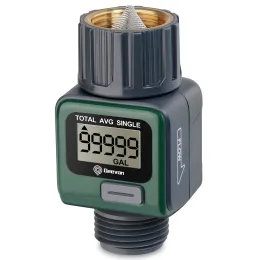
How do I know how much water my hose is delivering?
To create a water budget, you need to know your "flow rate." Use one of these three methods:
- The Bucket Method: Time how long it takes to fill a 1-gallon bucket with your hose.
- The Flow Meter Method: Attach a digital water flow meter ($20–$30) to your spigot or nozzle to see exactly how many gallons you are using.
- The Tuna Can Method: Place empty tuna cans around the watering zone. Note how long it takes for the hose or sprinkler to fill the cans with 1 inch of water.
Watch this very helpful video on measuring the water you apply to your garden by hand or soaker hose https://youtu.be/5TTUWzl889c?si=AuOBATIbXgL8iVmN
Exceptions to the Rule
One inch per week is just a baseline. You must adjust for:
- Extreme heat or unexpected rain.
- Full sun vs. deep shade.
- Thirsty vegetables vs. drought-tolerant natives.
- New seedlings (which need frequent, light watering) vs. mature plants.
Estimated Weekly Needs per Square Foot:
- 6 Gallons: Tomatoes, cucumbers, melons, peppers, beans, cabbage, celery.
- 3–5 Gallons: Broccoli, Brussels sprouts, carrots.
- 2 Gallons: Lettuce, spinach, radishes.
- 10–15 Gallons: Mature fruit trees.
Putting it Together: Two Scenarios
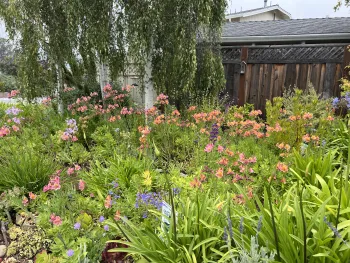
Scenario A: The Sunny Flower Bed
I have a 20 sq. ft. annual bed. It gets 8 hours of sun and has well-draining soil. I know my hose delivers 1 gallon every 15 seconds (the Bucket Method). To give the bed roughly 1 gallon per square foot:
- Calculation: 15 seconds x 20 square feet = 300 seconds (5 minutes).
- Plan: I water for 5 minutes, 2–3 times a week in summer.
Scenario B: The Native Border
A friend has a 20 sq. ft. native plant border in sandy soil. Since native plants prefer "lean" soil, she doesn't use amendments. Her hose delivers 1 gallon every 20 seconds.
- Calculation: 20 seconds x 20 square feet = 400 seconds (approx. 6.5 minutes).
- Plan: Because these are established natives, she only waters once a month during the hottest part of summer for about 7 minutes, targeting the soil around the drip zone.
Geek Out: The SLIDE Equation
For those who want a precise scientific watering plan, try the SLIDE equation (Simplified Landscape Irrigation Demand Estimation). It accounts for Evapotranspiration (ET)—the water lost through soil evaporation and plant transpiration.
The Formula:
Landscape Water Demand (gal.) = ETo × PF × LA × 0.623
- ETo (Reference Evapotranspiration): Check your local County GIS for this number.
- PF (Plant Factor): A multiplier for specific needs. Lawns are high (~0.8), while natives are low (~0.4 or less).
- 0.623: The constant to convert inches to gallons per sq. ft.
- Efficiency: Divide your final number by 0.81 for drip systems or 0.75 for sprayers to account for water loss during application.
Learn more about the SLIDE equation here.