
2.4. Composting
Vegetable Gardening - Handbook for Beginners
Chapter 2.4.
Composting is a method of producing a nutrient rich soil amendment (plant food) by using naturally occurring beneficial fungi and bacteria to break down organic waste. The simple process of composting allows large amounts of household, yard, and/or animal waste (do not use manure from cats, dogs, etc.) to be transformed into smaller piles of natural soil conditioner. The composting process involves controlled biological decomposition of organic material, sanitization through the generation of heat, and stabilization of the final product to make it beneficial to plant growth. As bacteria, yeast and fungi digest the waste, they make nutrients more available. When compost is added to soil, the nutrients are slowly released over time, allowing easy uptake by plants.
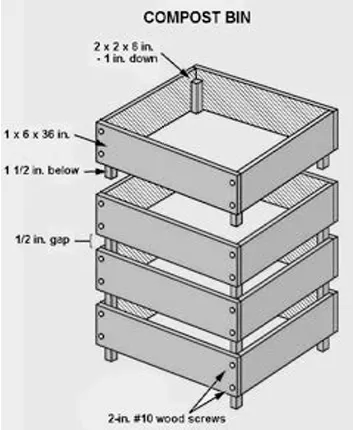
There are many ways to make compost: underground, above ground, in bins, in boxes, in pits, in bags, in barrels, in strips, in sheets, and in trenches. The composting process can take as few as fourteen days or as many as fourteen months, depending on the method. Each method has its own advantages, but they all have the same basic requirements: air, moisture, nitrogen, bacteria, heat, sufficient size, and plenty of organic matter. These elements are critical for the compost pile to heat up correctly.
Hot composting yields compost quickly, in as little as two weeks, and destroys most pathogens and weed seeds. This process relies on frequent turning of the pile, as often as once a day, to ensure even heating. The carbon-to-nitrogen ratio must be controlled with this technique: this means the composition of the pile needs to be approximately 1 part of brown (high in carbon) material, such as dry grass, dry yard trimmings, leaves and shredded paper, to every one part of green (high in nitrogen) material, including food waste, coffee and tea grounds, fresh cut grass and hair.
Cold composting is a much less labor-intensive but more lengthy process, taking three months or longer. Turning is required just once every three to-six weeks, if at all. Materials can be continually added in layers alternating green and brown to the existing pile. Since high temperatures are not achieved, pathogens and weed seeds aren’t reliably destroyed.
Half green (e.g. vegetable scraps, grass clippings), half brown (e.g., leaves, shredded paper). A pile with too much green will smell; a pile with too much brown will take longer to break down. Add a bit of soil to introduce microorganisms that initiate the composting.
Do NOT compost poisonous, diseased, or insect infected plants; weeds, dog or cat manure, meat, fish, dairy products, or anything with fat or oil.
Chop/shred the ingredients into small pieces. The smaller they are, the faster they will break down.
Composting Methods
| Compost Information | Hot Compost | Cold Compost |
|---|---|---|
| Microbial Activity | high | low |
| Brown to Green Waste Ratio | 1 to 1 | not critical |
| Processing Time | short | long |
| Pathogens/Weeds | not a problem | possibly problematic |
| Pile Turning | 1 time per day | once every 3-6 weeks |
Conditions for standard composting:
- Size: large enough to hold heat, but small enough to allow air to reach the center of the pile - 3’ x 3’ to 5’ x 5’.
- Air: turn the pile every 3-7 days for hot composting and every 3-6 weeks for cold composting.
- Water: the pile should be as moist as a wrung-out sponge.
When is the compost done?
- The pile will shrink, losing about 1/3 of its volume.
- The temperature will drop.
- It will be dark brown and crumbly with an earthy smell.
- You should no longer be able to tell what each of the individual ingredients was.
- Allow compost to age for two weeks before you add it to the soil around plants. Or, incorporate but don’t sow seeds or transplant seedlings for two weeks.
Composting Systems
The table below describes several different types of composting systems.
| Type | Advantages | Disadvantages |
|---|---|---|
| Slow outdoor pile | Easy to start and add to. Low maintenance. | Can take a year or more to decompose. Nutrients are lost to leaching. Can be odorous and attract animals and flies. |
| Hot outdoor pile | Fast decomposition. Weed seeds and pathogens are killed. More nutrient-rich because less leaching of nutrients. Less likely to attract animals and flies. | Requires lots of effort to turn, aerate, and manage the process. Works best when you have lots of materials to add right away, as opposed to a little bit at a time. |
| Bins and boxes | Neat appearance. Holds heat more easily than a pile. Deters animals. Lid keeps rain off compost. If turned, decomposition can be quite rapid. | Costs you time to build the bins or money to buy them. |
| Tumblers | Self-contained and not messy. Can produce quick compost. Relatively easy to aerate by turning the tumbler. Odor not usually a problem. No nutrient leaching into the ground. | Tumblers are costly. Volume is relatively small. Works best if material is added all at once. |
| Pit composting | Quick and easy. No maintenance. No investment in materials. | Only takes care of small amounts of organic material. |
| Sheet composting | Can handle large amounts of organic matter. No containers required. Good way to improve soil in large areas. | Requires effort to till material into the soil. Takes several months to decompose. |
| Plastic bag or garbage can | Easy to do year-round. Can be done indoors. Requires no back labor. | Is mostly anaerobic, so smell can be a problem. Can attract fruit flies. Need to pay attention to carbon/ nitrogen ratio to avoid a slimy mess. |
| Worm composter | Easy. No odor. Can be done indoors. Can be added to continuously. So nutrient-rich it can be used as a fertilizer. Good way to com post food waste. | Requires some care when adding materials and removing castings. Need to protect worms from temperature extremes. Can attract fruit flies. |
Compost Troubleshooting Guide
| Problem | Cause | Cure |
|---|---|---|
| Foul odor. | Too wet. | Mix pile or add coarse, dry mate rial (straw, chips, dry leaves) and mix. |
| Foul odor. | Not enough air. | Turn pile. |
| Foul odor. | Too much nitrogen. | Add more brown (high-carbon) materials and mix. |
| Pile not heating. | Pile too small. | Build larger pile. |
| Pile not heating. | Pile too dry. | Mix pile and add moisture. |
| Pile not heating. | Poor aeration. | Mix pile. |
| Pile not heating. | Not enough nitrogen. | Add more green (high nitrogen) material and mix. |
| Pile not heating. | Materials too coarse. | Chop or shred materials. |
| Pile is damp and sweet smelling but will not heat up. | Not enough nitrogen. | Add more green (high nitrogen) material and mix. |
| Pile is damp and warm in the middle, but nowhere else. | Pile too small. | Collect more material and mix with old material to make new pile. |
| Center of pile dry. | Not enough water. | Moisten material while turning the pile. |
| Pile too hot (over 140° F). | Pile too large. | Make a smaller pile. |
| Pile too hot (over 140° F). | Not enough ventilation. | Mix pile. |
| Pile attracting animal or insect pests. | Wrong materials used in pile. | Remove all meat and dairy products. |
| Pile attracting animal or insect pests. | Kitchen waste on surface of pile. | Bury kitchen waste in pile. May want to cover top of pil with one inch layer of garden soil or finished compost. |
Previous ← Chapters → Next or Return to the Table of Contents of this Handbook.