
Ongoing diesel exhaust fluid (DEF) action
Background
Since 2010, most on-road and many off-road vehicles and equipment have used selective catalytic reduction (SCR) systems to inject diesel exhaust fluid (DEF) into exhaust streams with the intended goal of nitrous oxide (NOx) emission reduction. In cases where DEF levels ran low or unexpected mechanical failures, these SCR systems triggered automatic inducements, which caused vehicles to reduce speed or become inoperable, causing operational delays and economic hardship for operators. This deratement strategy was intended to ensure compliance with the Environmental Protection Agency (EPA)’s Tier 4 Emissions Standards.
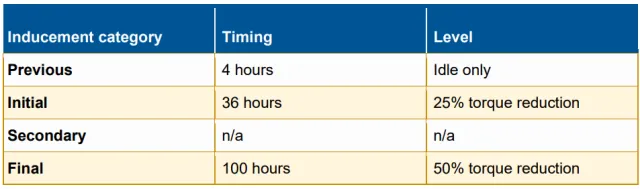
In August of 2025, EPA issued guidance calling on engine and equipment manufacturers to revise DEF system software in existing vehicles and equipment to reverse deratements. A clarification was issued that for agricultural equipment, the allowable inducement period may be up to 100 hours, allowing operators significantly more time to diagnose and resolve issues; previously, the inducement period was 4 hours before the equipment became idle (Table 1). Additionally, requirements were set in place for model year 2027 for manufacturers to engineer all new diesel on-road trucks to avoid sudden power loss after DEF depletion.
Table 1. Nonroad engine deratement schedules under the modified inducement period. Nonroad constant speed engines (e.g., ag pumps) and gensets do not have an initial inducement step as any torque may limit product functionality. Nonroad equipment can be restarted with full power 3 times for up to 30 minutes after inducement.
What’s happening?
On March 27, 2026, EPA issued additional guidance to manufacturers to allow them to remove traditional emission sensors (known as Urea Quality Sensors) and replace them with NOx sensors, with the goal of stopping inaccurate DEF system failures. This falls in line with EPA’s February 2026 Right to Repair guidance, allowing NOx sensor software installation without being treated as illegal tampering under the Clean Air Act. This means that the Department of Justice will no longer pursue criminal charges for tampering with emissions systems.
The EPA cited the need to reduce the frequency of "nuisance shutdowns" caused by faulty sensors rather than actual emissions violations. By shifting the focus to realtime NOx output, the agency aims to maintain environmental standards while increasing equipment uptime. The EPA emphasized that this action does not replace the Clean Air Act rulemakings, but rather is focused on the on-board diagnostic (OBD) hardware and software used to verify the limits. Vehicles must still meet the pollutant thresholds established in prior Clean Air Act rulemakings.
According to data released alongside the guidance, the Small Business Administration (SBA) estimates an annual reduction in operational costs of approximately $6.7 billion for light-duty truck operators, $2.7 billion for heavy-duty truck operators, and $4.39 for agricultural vehicle operators.
While this is that status of current actions, the EPA has indicated that formal rulemakings will be pursued in late 2026 to codify changes and provide a standard deratement schedule for all new diesel engines manufactured in the U.S.
What this means for California
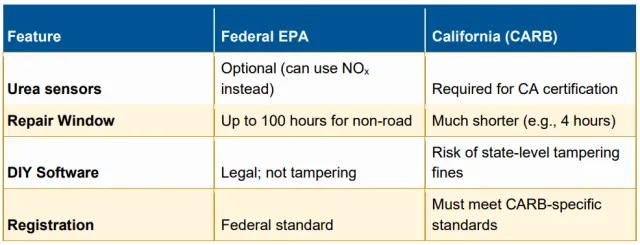
There is confirmed regulatory divergence between the federal EPA and California (Table 2). On March 26, 2026, the California Air Resources Board (CARB) permanently adopted the Emergency Vehicle Emissions Regulations; in short, that California will continue to enforce its own, stricter emissions standards (including hardware requirements) regardless of federal deregulation. This means that a diesel engine that is federally compliant with a NOx sensor may still face registration or enforcement issues in California under the Clean Truck Check (HD I/M) program if it does not meet the CARB specific requirements. Civil penalties remain high (up to $45,000 per violation).
Table 2. Comparison of Federal EPA and CARB DEF regulatory standards for March 2026.
The reality is, there is a lot of misinformation being spread right now. California operators should stick to CARB-certified parts, software, and updates in order to avoid heavy fines or registration blocks.