
There's Still Time to Plant Berries
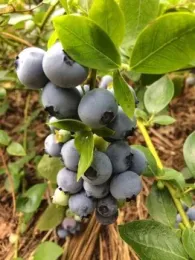
With this cold winter weather, one has a hard time wanting to go outside and dig in the garden, but that is exactly what we should be doing. Bare-root planting season is in full swing: roses, fruit trees, asparagus, rhubarb, but let's not forget the berries. Most likely, you'll need to shop for berries at your local nursery and not the big retail garden centers.
Blueberries are not your typical cane berries; instead, they are bushes. They are bushes that need acid soil conditions (pH 4.8 to 5.5), even more acid-loving than camellias and azaleas. Because of this requirement for optimum growth and production, ground preparation is key. You can't just plop them in the ground, but if you follow our tested procedures, you should have pretty good luck.
In-ground soil preparation
Blueberries should be grown on raised beds that are 3 to 5 feet wide and planted 5 feet apart. Work the ground to a depth of 12 inches, and then thoroughly mix in soil sulfur, 3-6 inches of sawdust or pine wood chips, and a complete fertilizer (like 7-7-7 or 15-15-15). Make sure to spread the fertilizer over the entire area, or you will burn the plants. You will probably need to add more sulfur every third year.
In-ground planting
Blueberries are shallow-rooted, so the planting hole must be wide. Rake the soil into a mound with a one-foot trench down the middle. Soak the bare root or the container-grown root ball before placing it in the trench, and then cover with pine wood chips or other organic material. Make sure that the stem of the plant is above ground level by 1-2 inches (we call that planting high).
Prune bare-root plants at planting time
When planting bare-root plants, you most likely will need to cut the length of the branches by as much as two-thirds so that they are in good balance with the root system. So first, completely remove any small spindly canes and cut the thicker canes to about 6 inches in height. Any flowers should be removed to ensure that the plant's energy is directed into vegetative growth, not fruit development. Believe it or not, this actually increases the success of plant survival.
Container planting
Blueberries can be grown in big pots or half barrels. Blend your own mix. Use a 50% camellia/azalea mix and 50% peat moss. OR use one-third potting soil, one-third peat moss, and one-third small shavings of pine chips. Either blend will need 4 ounces of soil sulfur for a 5-gallon container.
Watering
Whether you grow in the ground or in a container, young blueberry bushes need to be moist so that roots can develop and grow. In the ground, a drip system on a timer might be your best bet. With emitters 12 inches apart and a flow rate of 0.5 gallons per hour, about 15 minutes a day is needed until roots are established.
Blueberry Varieties: Some blueberry bushes are deciduous, and others are evergreen, and only a few of each perform well in our area. Deciduous bushes with the best flavor are 'Southmoon' (large and sweet berries) and 'Reveille' (small and firm berries). Evergreen bushes with good plant vigor and production, and with the best flavor are 'Sharpblue' and 'Misty'. It takes 2-3 years for blueberries to establish and mature. Commercial plantings are not harvested until 3-4 years after planting.
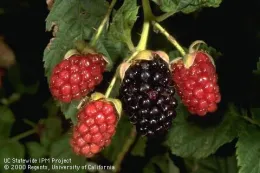
Cane berries (Raspberries, Blackberries, and Boysenberries): Look out, folks - these plants require room to roam and structures to keep them from becoming a thorny berry bramble. Plant cane berries 2-7 feet apart in a row, with rows at least 8 feet apart. There are erect, semi-erect, and trailing berries. Almost all need to be grown between two metal poles (tilted wider at the top than at the bottom, OR not) with six wires (two each strung at 3, 4, and 5 feet heights) down the length of the row. The canes grow up, and you thread them through the two wires for support.
Trailing blackberry varieties: 'Ollalie' is the earliest variety to produce good-tasting berries, and 'Marion' is a little later but has a high standard for flavor. Both of these varieties are much easier to maintain than other trailing blackberries. They have fewer but stronger canes and a lot less brush to maintain.
Erect blackberries: Erect blackberries are a little easier to grow than the trailing blackberries, but they do require maintenance. We recommend that you choose thornless varieties and plant them 3 feet apart. The following are all good producers of tasty fruit and are listed in their order of maturity: 'Arapaho', 'Ouachita', and 'Triple Crown'. If you choose 'Apache' and 'Kiowa' (known for their monster berry size), then be aware that they carry big thorns and need to be planted 5 to 7 feet apart down the row.
Boysenberry: Try the thornless variety appropriately named 'Thornless'.
Raspberries: In our area, raspberries tend to sunburn, so plan on providing a shade cloth if you just have to grow your own. 'Fall Gold' is a yellow variety that doesn't sunburn as easily.