
Home Orchard Pruning
After I began my first training class in Master Gardening, I became fired up about home gardening and decided to plant a small home fruit tree orchard. Now I have peaches, plums, nectarines, apples, pears, cherries, apricots, persimmons, pomegranates, citrus, and avocados to keep me healthy and wealthy with homegrown fruit for the whole year!
I want to discuss the pruning I did of the deciduous fruit trees (trees that lose their leaves in the winter). I will not be discussing the pruning of citrus trees, as they keep their leaves in the winter and require different pruning techniques. A resource I appreciate a lot is the University of California Publication: The Home Orchard, Growing Your Own Deciduous Fruit and Nut Trees, UC ANR Publications
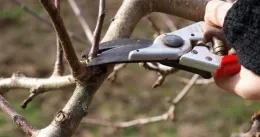
I did the pruning in the winter because most of these trees have their carbohydrates stored in their roots at this time, and it is easier to see the trees' framework without leaves. I pruned most of the trees in December. However, I waited until January to prune the apple trees, since apple trees lose their leaves later.
When these deciduous trees were planted, their main trunks were cut off at 18-24 inches high. The following year, I chose three or four scaffold branches that were evenly distributed around the trunks, and several inches apart vertically. Next, I cut off all the others. I was trying to create an open center in each tree.
This was more challenging on the cherry and apple trees, which seemed to have the tendency for one main branch to grow straight up, compared to the peach and apricot trees, which naturally spread out. I cut the cherry, apple, and plum trees' outside lateral branches to promote tree spread.
On all the trees, I left small lateral branches to lessen sunburn, even though I had already painted the tree trunks with white non-latex paint for this purpose. I pruned my Fuyu persimmon tree very lightly, just cutting at the point of attachment (or thinning) any overlapping branches to enhance sunlight penetration. I also cut the tips (also known as heading) off the few long, vigorous shoots.
Since mine is a home orchard, I keep my trees shorter, so I can reach most of the fruit without a ladder. To maintain a lower height, I will also have to do some pruning in early summer. I also pruned my Rainier and Bing cherry trees, and Imperial Gala apple tree lightly, but pruned my Red Fuji apple moderately, since it grew rapidly. My Santa Rosa plum, Fantasia nectarine, and Royal and Robada apricot trees needed heavy pruning. Usually, it is best to prune apricots in the summer because they are prone to Eutypa dieback.
Eutypa dieback shoot symptoms are always accompanied by a canker, which often appears V-shaped in a cross-section of the perennial wood. Other fungi can cause similar cankers, and canker shape alone is not diagnostic for Eutypa dieback.
The fungus enters the pruning wounds and can be spread in the winter during wet conditions. So avoid pruning when the weather is very wet.
The plum tree had many vigorous upright branches that needed to be thinned. With the apricot and peach trees, I often removed the flatter-angled branches and left the more upright ones. It's important to remember to clean your pruner blades with a solution of 10% bleach in order to prevent the transfer of disease or fungus to another tree or healthy branch.
Keep in mind that adequate pruning of a peach tree lessens the amount of thinning of fruit that is needed later. With the nectarine tree, I thinned about half of the fruiting branches that originated close to the main branches. Of those that remained, I headed them by one-third if they were longer than eighteen inches. I removed or cut back most of the two-year-old fruiting branches. When done, I circled the tree with a rope around the scaffold branches to support the nectarines I hope the tree will bear when the time comes.
The University of California has several free publications about the care of fruit trees. All of these are available online from their ANR Catalog website.
I encourage you to try pruning. Trees are forgiving about pruning mistakes. In addition, pruning, especially of young trees, is fun.