
Daffodils Rarely Disappoint
If you are going to have only one bulb in your garden, daffodils are the world's most popular choice. Why? They are perma
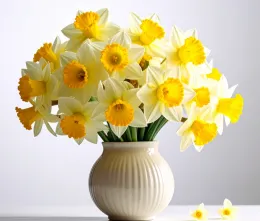
nent and increase from year to year. They are colorful and come in a fascinating array of colors and sizes. Also, they are very hardy, able to withstand hot summers and cold winters. In short, they are the perfect addition to nearly every Tulare-Kings Co. landscape. Right now, when the soil temperature has cooled, is the best time to get your spring bulb garden planted. A good rule of thumb for summer-blooming bulbs is to get them in the ground by Thanksgiving. In our area, where the ground doesn't freeze until January (if at all!), this rule can be pushed back by a week or two.
Daffodils originated in Asia and Southern Europe. The most commonly known is the trumpet flower, distinguished by a long cup or trumpet that is surrounded by six petals, but there are other types available, too. In fact, there are 24,000 named cultivars with different colors and characteristics. They are classified into 12 divisions based on size, shape, and growth height. Bulbs are sized by their noses or tips. Look for the words DN I or DN II when purchasing. This identification tells you that each bulb will produce one or two flowers.
The beauty of this flower is that it will easily fit into your landscape. Line a driveway or walkway, cluster in different areas of the garden, plant around the base of a deciduous tree, place them individually to create spot color, or use pots for a burst of color on your doorstep to announce spring. The main requirement is well-drained soil and moisture in the spring.
How to plant is an often-asked question. Plant daffodils approximately 5" to 8'' deep in loosely packed soil. The depth is determined by the bulb size (place larger bulbs deeper). Leave 2" to 6" between bulbs when planting several in the same hole. The best exposure will be north or east, and the flower will turn to face the sun. If planted in pots, you can crowd them, but make sure there is room for adequate drainage.
It is not absolutely necessary to fertilize, but it will help the development of the bulb, and in turn, plants will be more successful. Use either a special fertilizer for bulbs or a general plant fertilizer. After planting, water well. Moisture is very important since bulbs will not start their growth in dry conditions.
Did you know that when displaying daffodils as cut flowers, daffodils and tulips do not mix well in the same vase? The sap from the daffodils will kill the tulips. To make them compatible, place the daffodils in a separate vase for 24 hours before mixing with the tulips.
To ensure the bulbs' health for the coming years, fertilize after blooming is over, and continue to fertilize every two weeks for three feedings. It is best to leave them alone while the foliage turns yellow and begins to die down. Do not cut foliage before it dies back. Gardeners tend to get impatient and will fold and tie with rubber bands, or braid the greenery. This might damage the bulb for the following year. The daffodil bulb needs all the nutrients from the foliage to feed the bulb and help ensure it blooms each year. This process will usually take about 10 to 12 weeks. You can remove the foliage once it falls away.
After your bulbs have been in the ground for a number of years, you may notice that they are no longer blooming but still have plenty of greenery. This is the signal that it is time to pull up and separate the bulbs because they are too crowded and don't receive enough light and nutrients to bloom.
The time to divide daffodils is in late spring, after they have begun to die back and are starting to turn yellow. Carefully loosen the soil and dig around the clump. Lift the entire clump of bulbs out of the ground. Check each one and discard any soft bulbs. Only replant the hard, firm bulbs. Once separated, immediately replant. You can use the same area if desired.
When choosing your bulbs, remember a naturalizing group will bloom intermittently over a long period of time. If you choose to go with one or two varieties, you will have most of your blooms at the same time. To extend the bloom period, plant Narcissus bulbocodium, one of the first to bloom, and Narcissus tazetta, one of the last to bloom. Colors are numerous, and there are many different combinations to choose from. Look for double daffodils that have extra petals and resemble a rose or camellia when blooming. Whatever your choice, creating a bulb garden filled with daffodils will be the perfect way to usher in next spring.