
Herbicide
Managing Competing Vegetation with Herbicide
Herbicides are well known as an effective and relatively inexpensive method to control vegetation. In fuels management, herbicides have two primary roles:
- To prepare live fuels for burning by either weakening or killing the plant. This allows for impacted plants to be consumed more completely with other dead fuels on site.
- Maintenance. You can reduce or eliminate the ingrowth of undesirable plant species with the use of selective herbicides or directed applications.
In recently disturbed landscapes (e.g. post-fire), controlling or removing competing vegetation can reduce fuels and can ensure the survival of vulnerable tree seedlings. Resprouting species, as well as invasives, often dominate and thrive in disturbed landscapes. Without control, competition for soil moisture, can reduce growth or kill planted trees, as well as harm native herbaceous species. In forest ecosystems, herbicide use can increase native plant species richness in reforested areas, which promotes future forest health and resilience and wildlife habitat.
Herbicides: Pre- and Post-Emergent
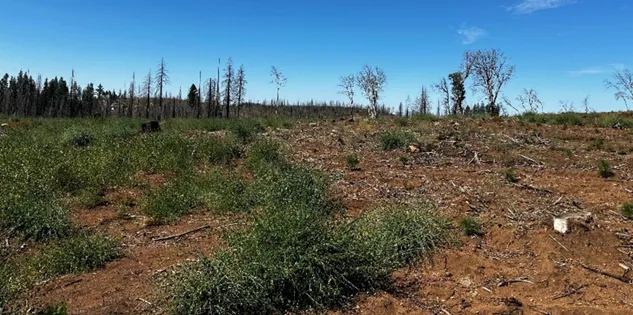
Pre-emergent herbicides are applied extensively to recently-disturbed soils to prevent the germination or emergence of undesirable plant species. In a reforestation context, pre-emergent herbicides are applied before seedlings are planted, so impacts of herbicide on planted trees is not a concern. Post-emergent herbicides kill plants through direct contact with foliage and are applied after the target plant species has already emerged from the soil. These are often applied in post-fire environments, where naturally growing and planted seedlings may be intermixed with surviving and resprouting competing species. Resprouting vegetation is not controlled with pre-emergent herbicides, therefore targeting of oaks and shrubs like greenleaf manzanita, tanoak, and chinquapin, requires use of a post-emergent herbicide.
For both types, pre- and post-emergent, the timing of herbicide application is critical. As more time passes, the target competing species becomes more established therefore harder and more expensive to control.
Mode of Action, Selectivity, and Timing
Other differences between herbicides are based on their mode of action, selectivity, timing, and application method. Herbicides work through various metabolic mechanisms, or modes of action, to disrupt plant growth.
Selectivity
Selectivity refers to the ability of an herbicide to effectively control the desired target species while minimizing impacts to desired plants. The components of an herbicide can influence its selectivity, including the active ingredient, formulation, and application rate. Selectivity can also be influenced by the timing and location of the application. Identifying the desired selectivity of an herbicide is a critical component of a vegetation management plan and determines the herbicide recommended by a licensed professional.
Timing
Timing of herbicide application influences its efficacy. Treatments should be applied during specific growth stages to effectively kill targeted species and to avoid detrimental impacts on the desired species. Applications during the dormant season, or at certain growth stages may help prevent impacts to desired species.
Application
Application methods vary from broadcast or direct foliar spraying, stem injectors, and others depending on desired selectivity. Applying the product directly to undesirable vegetation can safeguard the seedlings you are trying to protect.
Herbicide Use in Reforestation
The type and method of herbicide used will favor the growth and survival of some species over others. Use of pre-emergent herbicides before post-fire tree planting has many advantages. Pre-emergents act before invasive and shrub germination, reducing the effort needed to control them after seedlings are planted. Since pre-emergents are used before planting, potential injury to seedlings is prevented compared to what could occur with spraying after they are planted. Post-emergent herbicides can also be used selectively with directed applications to the target plants’ foliage. To avoid impact on growing conifers, foliar application should ideally occur between late summer and fall after the seedlings’ buds have hardened.
Herbicide selection is dependent on target vegetation species, as well as local environmental considerations in given areas. An integrated approach that combines both pre- and post-emergent herbicides and a mix of herbicides is often needed to control multiple species of plants and ensure continued growth of tree seedlings and thus successful reforestation. The table below outlines common herbicides used for conifer reforestation.
Active Ingredient | Most Common Trade Name | Mode of Action | Application | Considerations - Timing, Location, Reforestation | Directed Use | Relative Toxicity (LD-50 mg/kg)* |
2,4-D ester | Weedone LV-6 | Causes uncontrolled and excessive growth | Foliar | Spring/Fall | Site preparation/directed release | 1380 |
Aminopyralid | Milestone | Causes uncontrolled and excessive growth | Foliar/soil | Spring/Fall | Site preparation/directed release | >5000 |
Atrazine | Atrazine 4L | Prevents photosynthesis | Soil | Pre-emergent/requires rainfall to activate | Site preparation/release | >2000 |
Clopyralid | Transline | Causes uncontrolled and excessive growth | Foliar/soil | Spring/Fall | Site preparation/release | >5000 |
Fluroxypyr | Vista XRT | Causes uncontrolled and excessive growth | Foliar | Spring/Fall | Site preparation/directed release | >5000 |
Glyphosate | Accord XRT II | Prevents plant growth | Foliar | Fall prior to planting or as post-emergent | Site preparation/release | >5000 |
Hexazinone | Velpar DR | Prevents photosynthesis | Soil | Pre-emergent/requires rainfall to activate | Site preparation/release | 1310 |
Imazapyr | Polaris AC | Stops root and shoot growth | Foliar/soil | Pre-emergent/requires rainfall to activate | Site preparation | >5000 |
Sulfometuron-methyl | Oust XP | Stops root and shoot growth | Soil | Used for coastal species primarily | Site preparation/release | >5000 |
Triclopyr ester | Forestry Garlon XRT | Causes uncontrolled and excessive growth | Foliar | Spring/Fall | Site preparation/directed release | 2966 |
Overview of common herbicides for conifer reforestation, adapted from Reforestation Practices for Conifers in California. *Relative Toxicity LD-50 is the lethal concentration required to kill 50% of sample group and is one way to measure toxicity. It’s expressed in milligrams of substance per kilogram of body weight. A lower number indicates higher toxicity.
Regulations, Safety, and Compliance
The use of herbicides is subject to regulatory oversight to ensure their safe and responsible application. The California Department of Pesticide Regulation (DPR) regulates the licensing, sale, and use of pesticides under state laws, which are often more restrictive than regulations of the federal government and most other states. California regulations require that a licensed pest control advisor (PCA) provides a written recommendation based upon strict adherence to product guidelines and restrictions, and in consideration of local ecology. Only certified PCAs and DPR certified applicators may apply herbicides, wearing personal protective equipment. Regulations and permitting may vary by county, so be sure to contact your local County Agricultural Commissioner for regulatory information, as well as technical assistance. For an informed conversation with a PCA, look up herbicides via the Herbicide Resistance Action Committee.
Additional Resources
Much of the information above was borrowed from the Post-Fire: Managing Competing Vegetation with Herbicide factsheet by UCCE's Nic Dutch, Thomas Getts, Ricky Satomi, and Camila Quintana Del Carpio. For more information about the use of herbicides, please visit UCCE's Forestry Research and Outreach website.
Below is a list of other resources about managing competing vegetation with herbicide. Please note these materials are not maintained by UC ANR and may not meet current accessibility standards. If you need assistance accessing this content or require an accessible format, please contact the website owner or organization listed after the link provided below.
- Herbicides in California forestry peer-reviewed article (DiTomaso, J.M. 1997. Herbicides in California forestry. In: Weed Science - in search of excellence. Proc. 49th Ann. Conf. Calif. Weed Sci. Calif. Weed Sci. Soc., Fremont, CA p. 113-117.) (Western Society of Weed Science)
- Peer-reviewed article about the impacts of post-fire herbicide use on plant diversity (DiTomaso, J., E. Healy, D. Marcum, G. Kyser, M. Rasmussen. 1997. Post-fire herbicide sprays enhance native plant diversity. California Agriculture 51(1). https://doi.org/10.3733/ca.v051n01p6.) (California Agriculture)
- Peer-reviewed article about the impacts of shrub removal in reforested areas post-fire (Bohlman, G.N., M. North, H.D. Safford. 2016. Shrub removal in reforested post-fire areas increases native plant species richness. Forest Ecology and Management 374: 195-210.) (Forest Ecology and Management).