
Coral Bells are Sure to Delight
Coral bells (Heuchera) are an excellent border plant and an old favorite of many gardeners. The plants are compact, bushy, and grow in tufts; the flower stem grows 1½ or 2 feet high. You've probably noticed their delicate, wand-like flowering stalks lined with small, bell-shaped red, pink, or white flowers waving almost a full foot above the plant.
Description
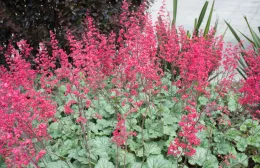
Coral Bells is a member of the Saxifragaceae family and is native to New Mexico and Arizona. It is an herbaceous, evergreen perennial that forms clumps up to 16 inches across but less than 8 inches in height. Its leaves are about 2 inches across, rounded, toothed, or scalloped, and borne on 4-inch-long petioles. In spring, coral bells produce 18-inch-tall, open panicles bearing an array of dainty, bell-shaped flowers. Although the waving flower wands are a very desirable characteristic, the variety of their leaf colors and shapes is possibly their most notable feature. Leaf colors range from lime green to peach, gray, green, or deep purple, and many also have variegated leaves with contrasting veins.
Growing Conditions
Heucheras do best in moist, rich, organic, amended soils. While they are somewhat drought-tolerant, attention to a consistent watering schedule will give better performance, especially during the San Joaquin Valley heat of July and August. Plant crowns slightly above soil level to allow for fast drainage.
Partial shade rather than dense shade is best for intense leaf color, plant growth, and flowers. Our valley requires shade during the hot summer months, and finding just the right amount for the specific variety of Heuchera requires some trials and lots of advice from growers. Generally, I've found morning sun and afternoon shade are best for most varieties.
Planting
Fall is the perfect time in Tulare and Kings Counties to plant perennials. By the time spring comes along, you'll have a well-established plant ready to light up your garden with cheery blooms or colorful foliage. A fall planting allows your plants time to establish their roots all winter and spring before the summer heat comes along. Heucheras can be used in rock gardens or as border plants in flower beds, but they are a natural and superb performer in containers. Combination plantings give the designer varying leaf shapes and color, and their growth habits provide height, fullness, and a draping effect over the edge of the container.
Maintenance
Beyond favoring deep watering, especially during summer heat, coral bells need very little maintenance. Remove the old flower stems after bloom. During winter or early spring, cutting off the older brown or wilting leaves will encourage new growth.
Pests
Huecheras are relatively pest-free; however, when winters are mild, mealybugs can attack the base and stems. Forcefully wash plants with water and a mild detergent or insecticidal soap regularly. This will dislodge and discourage the mealybugs. Diseases can occur with poor air circulation from overpopulation or from planting new plants too deeply and overwatering. Space plants to prevent overcrowding by following planting directions.
Propagation
Although the plants grow for a long time in one place, the larger plants tend to grow weakly. These should be removed, divided, and replanted every 2-3 years. Be sure to replenish the site with fresh compost after planting.
Divide the mature plants in the fall. To divide, simply dig up the plant with a trowel or hand shovel and use your fingers to gently pull the plant apart into divisions. You can also use a sharp knife to cut through the old crown, retaining some of the roots. Plant these divisions as soon as possible with the crown at ground level or slightly above.
Coral Bells can be propagated with leaf cuttings. Take healthy mature leaves with a short segment of the petiole (the stalk that joins a leaf to a stem); dip them in rooting powder, place them in sterile media (a mixture of peat moss and perlite), and use a clear polyethylene cover to keep the humidity high.
A Few of the Many Varieties:
'Lillian's Pink': California native plant; bright pink flowers attract bees and hummingbirds; excellent groundcover for small shady areas or borders.
Heuchera maxima (island alumroot): California native plant; a good informal groundcover for dry shade; tolerates heavy clay soils; frilly green leaves look good all year.
'Rosada': California native plant; one of the best flowering perennials for dry shade; introduced to the nursery trade by the UC Davis Arboretum.
'Dressed Up® Prom Dress': a 2025 Proven Winners Top Pick. Each pewter leaf is heavily ruffled and accented with dark charcoal veins. The newest leaves are flushed with violet, matching the undersides of the leaves.
'Marmalade': Shiny russet to amber foliage, with hot pink undersides and reddish-brown flowers. Drought and heat-tolerant.
'Dressed Up® 'Ball Gown': Large chartreuse, heavily ruffled leaves with creamy white flowers.
Huecheras are wonderfully diverse plants that provide winter interest with their colorful foliage and plenty of blooms in spring. With new varieties and hybrids being developed, you're sure to find a Huechera that will delight you and your garden.