
Nature Journaling: Through the Eyes of Children
Article and photos by Tree Justensen, UC Master Gardener of Placer County
What is nature journaling?
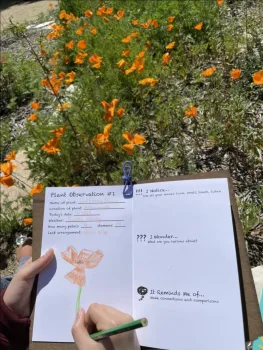
Nature journaling has been described as a “mindful practice that invites us to record what we see, feel, and wonder about the natural world.[1]” John Muir Laws, popular nature-journaling guru, defines nature journaling as “collecting and organizing your observations, questions, connections, and explanations on the pages of a notebook using words, pictures, and numbers. Nature journaling will enrich your experiences and develop observation, curiosity, gratitude, reverence, memory, and the skills of a naturalist..”[2] Fiona Clare Gillogly was introduced to nature journaling at the age of 13, based on John Muir Law’s mentorship, and adds the following to the journaling definition: “[It’s] taking a notebook and some simple art supplies out into nature…to describe what you notice, what you wonder about and what things remind you of.”[3] Is nature journaling a tool for self-enrichment and mindfulness? Does journaling instill a passion for the pursuit of science-based research of our environment? Or is it simply a new way to connect and appreciate nature?
The origin of the nature journal.
Journaling nature is not a new concept and its earliest form was cave paintings, petroglyphs and pictographs. “Naturalists” such as Charles Darwin, John James Audubon, John Muir and Henry David Thoreau traditionally kept journals to note observations, to keep field notes, and to study the earth and its mysteries, as well as plant and animal life. The more educated and/or wealthy society members in Edwardian and Victorian times also chose to journal and sketch nature as an accepted recreational pastime. Lewis and Clark and other renowned explorers often used journals to describe newly encountered fauna and flora and to document their journeys. Published nature journals and diaries surged in the 1970’s and 1980’s, some of which had been written around the turn of the century or earlier. “How-to” books on nature journaling surfaced in the 1990’s and have enjoyed a growing popularity ever since, as well as recent articles which may be found online.
Nature journaling in education.
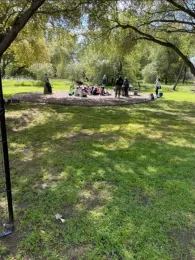
The focus on nature journals has shifted to include an educational aspect. The introduction of environmental curricula to K-12 level school children has opened the door for children to participate in nature journaling to serve as a science education component. In addition to educators in the classroom, many groups of UC Master Gardeners have sponsored children' s events connecting children with nature and have used nature journaling as a vehicle to explore nature and plants. In April 2025, the UC Master Gardeners of Placer County hosted nature journaling activities for approximately 80 children, supervised by three teachers from the Crocker and Riverside school districts. It was a record turnout for a children’s event hosted by the UC Master Gardeners!
The journal.
The children gathered at the Loomis Veteran’s Memorial Hall to view slides presented by two UC Master Gardeners of Placer County. Each student received a handmade book bag with a printed nature journal entitled “My California Native Plants Journal,” along with a magnifying glass to encourage close observation of small details. The journaling was intended to peak their curiosity, and the students were reminded that “pretty” drawings should not be the primary goal. Different pages focused on specific aspects of nature journaling, such as drawing plants, noting how leaves were arranged on the plant, or drawing what was viewed with the magnifying glass. The most important outcome was to understand, measure, and record observations to further a connection with the natural environment.
Native plants and keystone species.
After the slide presentation, the students walked over to the UC Master Gardeners of Placer County Demonstration Garden, located on the grounds of the Loomis Library and Community Learning Center, where activity stations highlighted California native plants and keystone species. The station exploring keystone species emphasized how the removal of a single species could trigger a cascade of negative effects throughout the ecosystem! The students also produced art made from leaf and bark rubbings at this time.
A “Walk and Talk.”
Each class participated in a “Walk and Talk” session led by a UC Master Gardener docent, who introduced them to the native species in the demonstration garden. The docents taught the students with a “place-based” approach utilizing the local environment in the demonstration garden. The students were then allowed time to journal, independently, and began to draw plants in their journals, adding an artistic interpretation to their observations and measurements.
A lasting tool.
At the end of the event, the students were encouraged to continue using their journals as a lasting tool to explore and connect to the natural spaces around them. Maintaining a nature journal will offer the student the freedom to examine nature on a personal level and to discover the importance of their role in their environment. Children and adults, alike, will benefit from nature journaling which serves to establish a lifelong bond with nature and a respect for oneself.
References:
Boon, Alex. What Is a Nature Journal? 2024. alexboonart.com.
https://alexboonart.com/what-is-a-nature-journal/
Gillogly, Fiona Clare. Falling in Love with Nature Through Journaling. June, 2021. childrenandnature.org.
https://www.childrenandnature.org/resources/falling-in-love-with-nature-through-journaling/
Hennessey, Angela. What is Nature Journaling? History and Origins Part 1. May 31, 2924. angelahennessey.co.uk
https://www.angelahennessy.co.uk/post/what-is-nature-journaling-history-and-origins-part-1
Laws, John Muir. Nature Journaling: Get Started and Grow! 2017. johnmuirlaws.com.
https://johnmuirlaws.com/nature-journaling-starting-growing/
Laws, John Muir. John Muir Laws, Nature Writer and Artist. (video format). ucanr.edu. https://lecture.ucanr.edu/mediasite/Play/4e5c0fdfdd0f4842a27efd54660a4eb11d
UC ANR. Get Outside: Environmental Education for Kids/The Real Dirt. Nov. 29, 2019. ucanr.edu.
https://ucanr.edu/blog/real-dirt/article/get-outside-environmental-education-kids
Wade, Rob. How Nature Journaling Helps My Students Feel at Home. Feb. 11, 2025. greatergood.berkeley.edu.
https://greatergood.berkeley.edu/article/item/how_nature_journaling_helps_my_students_feel_at_home
Walker, J.B. Nature Journaling: A Mindfulness Activity. March 26, 2020. csuchico.edu
https://as.csuchico.edu/blog/2020/03/nature-journaling-a-mindfulness-activity