Good Morning, Mourning Cloak
"Good morning, mourning cloak! Fancy meeting you here."
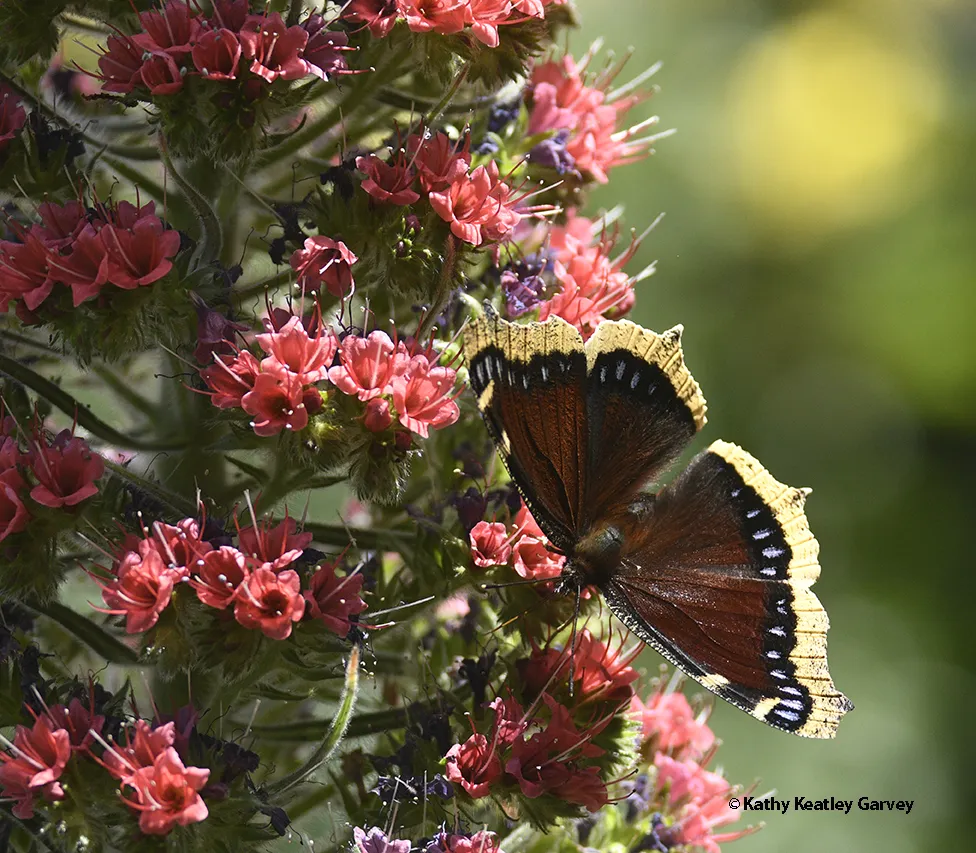
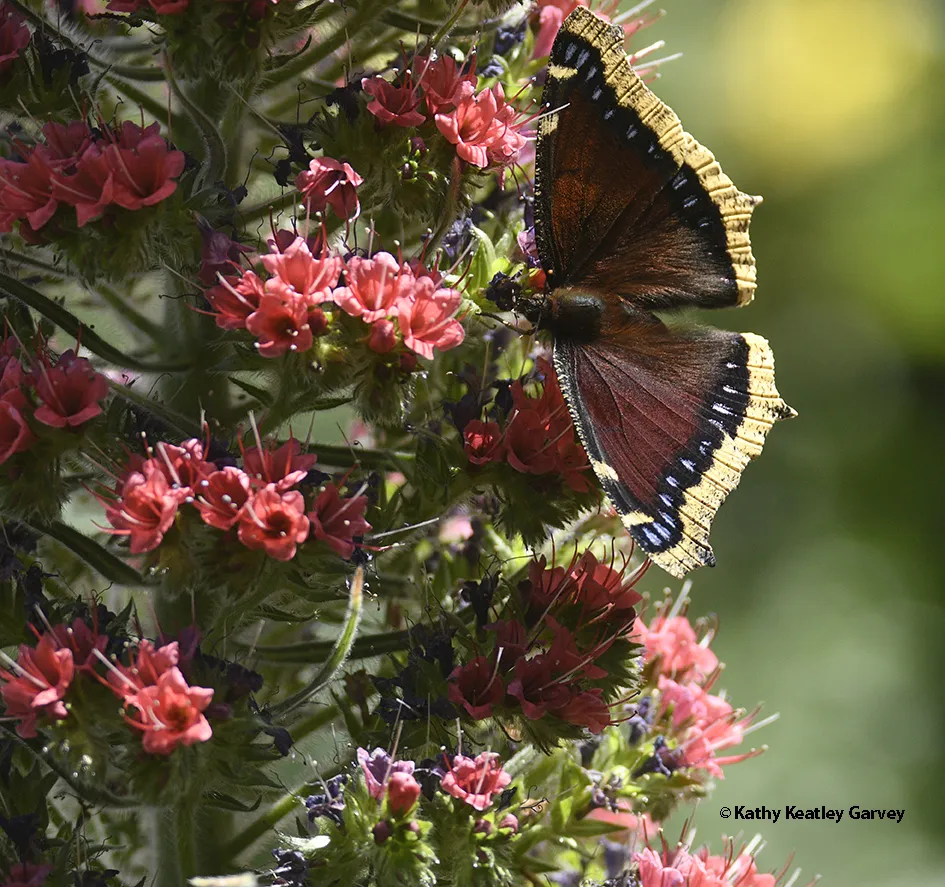
The mourning cloak indeed chose a fancy meeting place. It touched down on our Tower of Jewels (Echium wildpretti) and began to nectar.
"I'm trying to get an image of you," I whispered. "Open your wings." And magically, or sort of magically, it did. Its wingspan measures about four inches.
How did the mourning cloak get its name? It wears a dark "funeral dress or cloak" edged with a yellow petticoat. Blue dots on its wings add to its beauty.
The mourning cloak is one of the longest-lived butterfly species in North America, as records show its lifespan can reach 11 to 12 months.
UC Davis Distinguished Professor Emeritus Art Shapiro says on his website, "Art's Butterfly World," that the mourning cloak, Nymphalis antiopa, is "a very distinctive and charismatic butterfly, best known for its conspicuous activity in late winter, flying and acting territorial before any trees have leafed out or any wildflowers are active. It hibernates as an adult. In the Sacramento Valley there appears to be only one brood (in spring); the resulting adults migrate upslope and breed in the mountains. There is a reverse downslope migration by the next generation, in late September-October. It is not obvious why this seasonal altitudinal migration occurs, but both the California and Milbert's tortoiseshells, its closest relatives, do it too."
Shapiro says the eggs are "laid in clusters and the spiny black larvae, marked dorsally with red, feed communally in the open on willows (many species, including cultivated weeping willow, S. babylonica) and occasionally on hackberry (Celtis) or elm (Ulmus) in cultivation. The pupae are grayish-violet, finely dotted with black, and tend to be formed as clusters."
Have you heard of "hygiaea?" Says Shapiro: "There is a very dramatic aberration, named 'hygiaea,' in which the yellow border expands to obliterate the blue spots and cover the entire outer 40% or so of the wings. It has been taken or seen a few times in our area, most recently in Rancho Cordova in 2006."
For us, this was the first mourning cloak nectaring on our Echium. "In recent years populations of this butterfly have collapsed regionally; it disappeared from West Sacramento for several years and has been very scarce and erratic at other low-altitude sites; there was some improvement in 2005 and numbers of hibernators at low altitude were up in 2006, but very bad weather may have prevented much if any recovery," Shapiro says.
"Adults are more likely to visit sap, injured fruit, dung or mud than flowers, though spring indivuals often nectar at wWillow catkins and autumn ones tank up at Rabbitbrush. In autumn one often sees adults 'hanging out' within willow trees in the high country. It is not obvious what they are doing and why. Some adults overwinter even at Donner. They emerge just after snowmelt, which often coincides (late May-June) with when immigrants from the new brood arrive there from downslope!"
In his research, Shapiro has monitored the butterfly populations in central and northern California, encompassing some 115 species, since 1972. His data set, known as the largest butterfly monitoring data set in North America and one of the largest in the world, runs parallel to Interstate 80, with 10 sites distributed from the inner Coast Range, across the Sacramento Valley and the Sierra Nevada, to the western edge of the Great Basin. His sites span a wide range of climates and vegetations, from sea level to treeline at 9000 feet.
Welcome, mourning cloak. And goodbye, mourning cloak.
Off it fluttered, under the watchful eye of a California scrub jay.