
Student teams from across California and around the world win Farm Robotics Challenge awards
Cornell University takes Grand Prize in 2026 contest organized by UC ANR Innovate, partners
An autonomous, pulsed electric weeding robot for orchards and vineyards took the Grand Prize in the fourth annual Farm Robotics Challenge awards ceremony on May 21 held at Plug and Play Tech Center in Sunnyvale, California. Watch a recording of the livestreamed ceremony and view the winning projects at farmroboticschallenge.ai/2026results.
The 2026 Farm Robotics Challenge, hosted by UC ANR Innovate (the innovation arm of University of California Agriculture and Natural Resources) and the AI Institute for Next Generation Food Systems (AIFS), engaged students at many levels of the educational pipeline to tackle critical on-farm challenges including weed management, pest pressure, harvesting, irrigation, scouting and labor shortages.
This year’s competition grew by leaps and bounds, with 96 teams from 13 countries taking part across three divisions: Division I for four-year universities, the new Division II for two-year colleges, and the Farm Robotics Academy for grades 7 through 12. International entries came from Australia, Bangladesh, Brazil, Canada, Egypt, Ghana, India, Lebanon, Peru, Tunisia, Turkey and the United Kingdom.
“The judges consistently remarked that this year’s finalists represent some of the strongest work they have ever seen in this competition, with multiple projects described as investment-ready and commercially viable,” said Kelly Scott, Farm Robotics Challenge director. “These students are not just solving problems; they are building the next generation of agricultural technology.”
Winners were announced across five award categories spanning all three divisions, with more than $100,000 in prizes and awards on the line, including the $50,000 Grand Prize; major division awards for Amiga Innovation, Specialty Crops, Drone Applications and AI; plus travel stipends to the FIRA USA 2026 robotics/automation conference and an opportunity to pitch at Plug and Play. All winning teams and finalists’ videos can be viewed at farmroboticschallenge.ai.
2026 Farm Robotics Challenge Grand Prize
The Grand Prize, $50,000 SAFE Investment sponsored by Innovation Partner, Reservoir
Rootline Robotics, Cornell University, Ithaca, New York
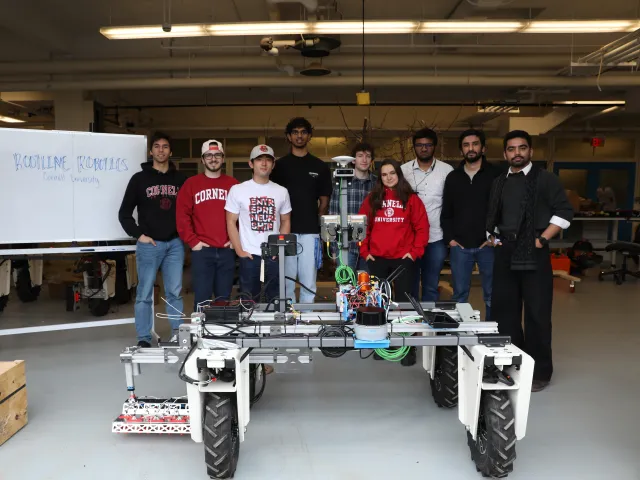
The Cornell University team developed an autonomous, perception-driven robotic weeder that delivers pulsed high-voltage microshocks to eliminate weeds in orchards and vineyards. Built as an arm-mounted attachment on the Amiga platform from Bonsai Robotics, the system pairs computer vision, machine learning and depth sensing with a two-degree-of-freedom mechanical arm and a comb-based electrode array that conditions plant geometry before treatment.
The team partnered with Crist Bros Orchards, a 500-acre commercial apple operation in Orange County, New York, and is already advancing toward commercialization through Cornell’s Center for Technology Licensing, the Rev: Ithaca Startup Works Hardware Accelerator Program, and continued field validation with grower partners this summer.
Team advisors: Manoj Karkee, Professor, Biological and Environmental Engineering; Dawood Ahmed, Ph.D. Candidate, Biological and Environmental Engineering; Usama Bin Sabir, Ph.D. Candidate, Biological and Environmental Engineering
Students: Andrew James, Michael Neiss, Neil Morrison, Harrison Sachs, Rohan Alapati, Nidhish Kumar and Natalia Kurz
2026 Farm Robotics Challenge Division Award Winners
Bonsai Robotics Amiga Innovation Award
Top Amiga Innovation Award, $10,000 prize, Division I:
The Fire Blighters, Carnegie Mellon University, Pittsburgh, Pennsylvania
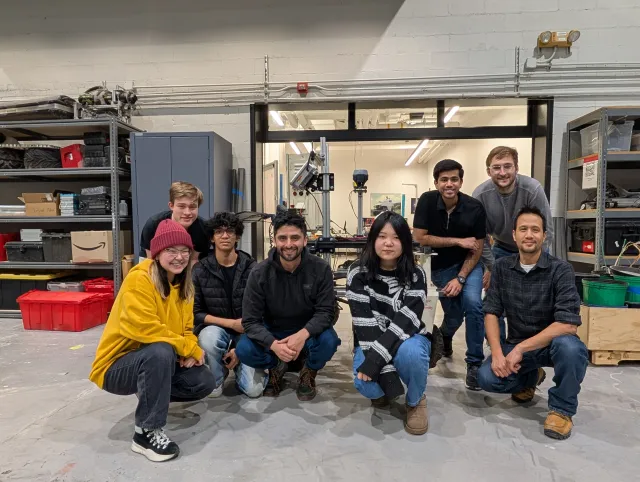
The judges praised this team for exceptional robotics integration, bringing navigation and perception together with an articulating camera system that reaches occluded parts of the apple canopy. The system detects and maps fire blight infections using LiDAR localization and a 6-DOF robotic arm, then physically marks infected trees to guide targeted pruning.
Team advisors: Francisco Yandun, Senior Project Scientist, Robotics Institute; Abhisesh Silwal, Systems Scientist, Robotics Institute; George Kantor, Research Professor, Robotics Institute
Students: Jack Nelson, Daniya Nussipbek, Sarthak Jain, Hayden Feddock, Sandeep Zachariah and Yi Wu
Amiga Innovation Award, Division II:
Tiger Ag-Botics, Reedley College, Reedley, California
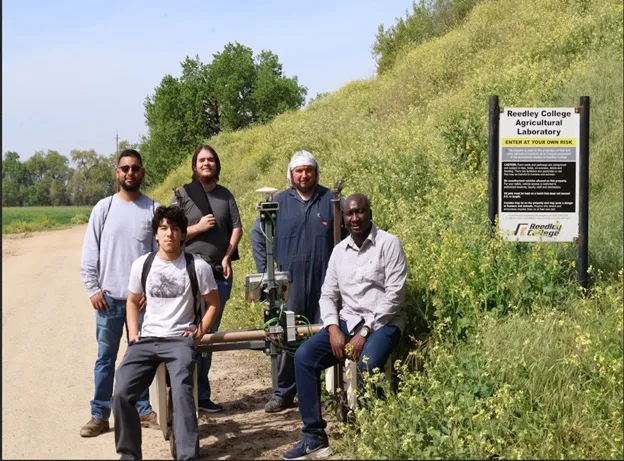
What this team accomplished was remarkable – they independently built object detection and follow-me capability for the Amiga, functionality not yet released commercially, as part of a solar-assisted nighttime sprayer that combines a 200-gallon tank, dual canopy cameras, variable-rate PWM nozzles, and a rooftop drone pad for reconnaissance and spot-spraying.
Team advisors: David Clark, Dean, Agricultural Technology; Abiodun Emmanuel Abioye, Engineering Instructor, Physical Science/Engineering; Kaomine Vang, AgTech Director, Agricultural Technology
Students: Analiz Moreno Gonzalez, Marylynn Moreno Gonzalez, Peter Gutierrez, Joseph Heinrich, John Heredia, Raul Salazar and Bryan Cisneros
Amiga Innovation Award, Academy:
MRC Farm Robotics, Mark Richardson CTE Center & Agricultural Farm, Santa Maria, California
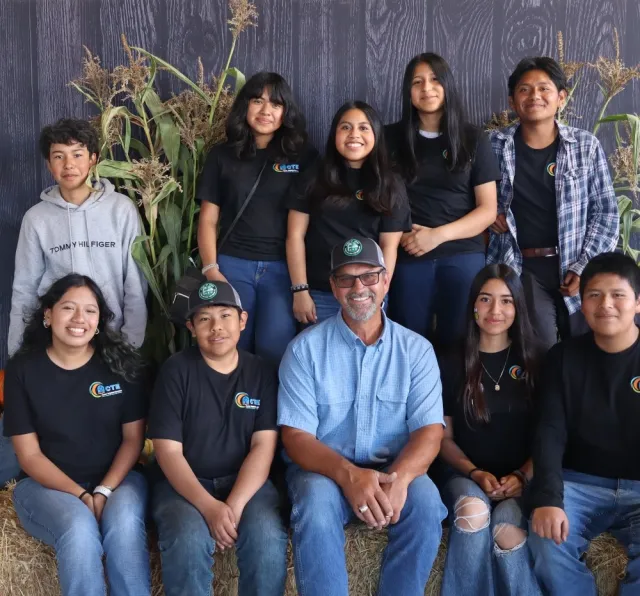
This team of FFA students integrated a custom autonomous sprayer with the Amiga platform, featuring a 10-gallon adjustable-height tank, dual-nozzle boom and path-planning routines along 38-inch beds, to reduce labor and improve precision for small vegetable growers.
Team advisors: Steve Gambril, MRC Ag Teacher; Ty Lamica, MRC Computer Teacher
Students: Andrea Galvez Baltazar, Maximilian Herrmann, Melissa Rubio-Solano, Jaime Rubio and Miguel Angel Hernandez Reyes
Western Growers Award for Excellence in Specialty Crops
Excellence in Specialty Crops, Division I:
Aggie Aerial-Ground Robotics, UC Davis, Davis, California
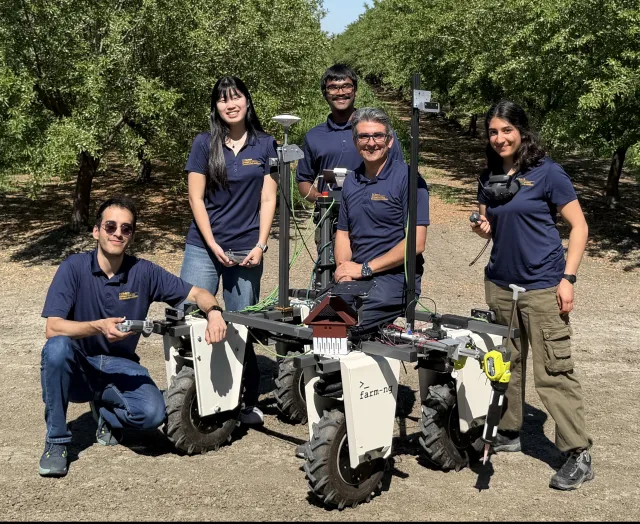
The judges recognized this team for addressing a major industry need with sophisticated AI and 3D reconstruction work: Project BloomSense fuses orchard-scale UAV mapping with multi-angle in-canopy imagery from an Amiga ground robot to estimate bloom density and inform pollination, nitrogen and yield-potential decisions.
Team advisor: Ali Moghimi, Assistant Professor, Biological and Agricultural Engineering
Students: Mohammadreza Narimani, Inseon Kim, Krishna Aggarwal and Negar Agah
Excellence in Specialty Crops, Division II:
Red Scout, Hartnell College, Salinas, California
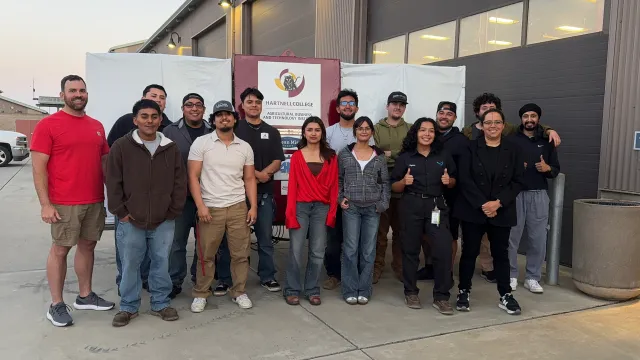
A Farm Robotics Challenge veteran since the program’s first year, Red Scout continues to refine an AI-driven Amiga-based monitoring system that tracks artichoke growth, soil conditions and plant counts across the full 120-day season using 2D and 3D imaging.
Team advisors: Richard Chapman, Professor, Agricultural Engineering; Edlin Hernandez, Program Coordinator, Career and Transfer Hub; Andrea Tinajero, Program Coordinator, USDA NextGen Grant
Students: Christopher Talavera, Tomas Calusdian, Marc Anthony Jimenez, Denise Regalado Ramos, Alondra Garcia Bejarano, Diana Ruby Espinoza-Morado, Adolfo Ramirez, Socrates Figueroa, Victor Manuel Ortiz, Arshdeep Cheema, Kaylene Cervantes, Erick Oviedo, Grant O’Callaghan and Geo Munoz
Excellence in Specialty Crops, Academy:
CTEC Titans, Career Technical Education Charter High School, Fresno, California
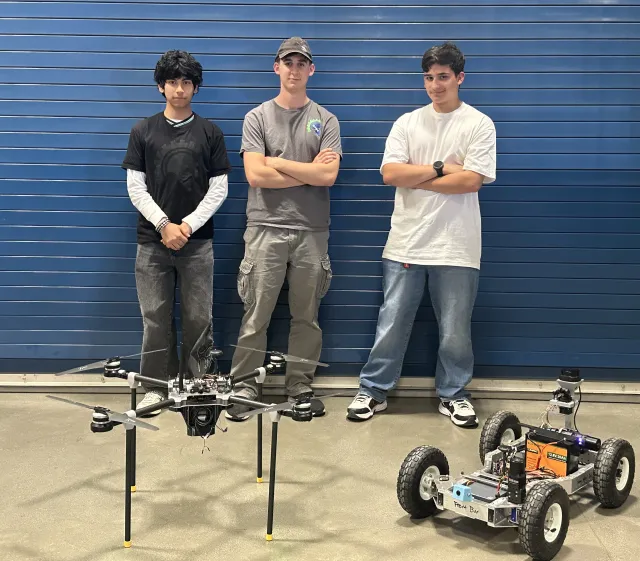
The only team to receive two awards this year, the CTEC Titans partnered with Joel Coelho of Coelho Farms and the American Pistachio Growers Association to tackle pest and orchard diagnostics in pistachios, one of California’s top tree-nut exports.
Team advisors: Kim Calderon, Physics Teacher; Brian Emerson, Engineering and CTE Specialist
Students: Donovan White, Serafin Quintanar and Julian Lombrana
Excellence in Drone Applications Award
Excellence in Drone Applications, Division I:
Olin College Robotics Lab, Olin College of Engineering, Needham, Massachusetts
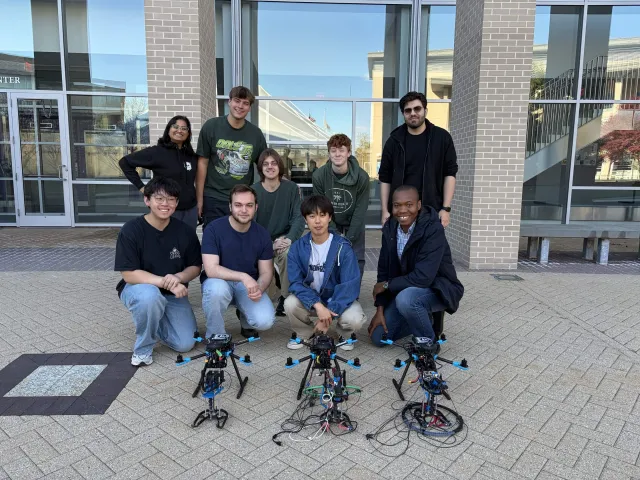
The judges called this the most engineering-mature project they reviewed. HydroFleet uses an autonomous drone equipped with a custom soil-moisture probe and a swarm coordination system with sophisticated routing optimization to collect quantitative measurements across dynamically assigned sampling points for irrigation planning.
Team advisors: Kenechukwu Mbanisi, Assistant Professor of Robotics; Harvey Merton, Graduate Student Mentor, Robotics & Autonomous Systems
Students: Dokyun Kim, Dexter Friis-Hecht, Zaraius Bilimoria, Heesung Han, Cian Linehan, Swasti Jain, Mehmet Firat, Benjamin Ricket, Grant Rechtin, Pia Swarup and Kilan Rougeot
Excellence in Drone Applications, Division II:
CTEC Titans, Career Technical Education Charter High School, Fresno, California
This team began in the Farm Robotics Academy, but its project was so strong that the judges moved it up to compete with college teams. Their coordinated air-ground architecture pairs a fixed-wing VTOL drone for 3D and NDVI mapping with a 4WD rover for close-range imagery and soil probing in pistachio orchards.
Team advisors: Kim Calderon, Physics Teacher; Brian Emerson, Engineering and CTE Specialist
Students: Donovan White, Serafin Quintanar and Julian Lombrana
Excellence in Drone Applications, Academy:
DM & HAS, Mission Oak High School, Tulare, California
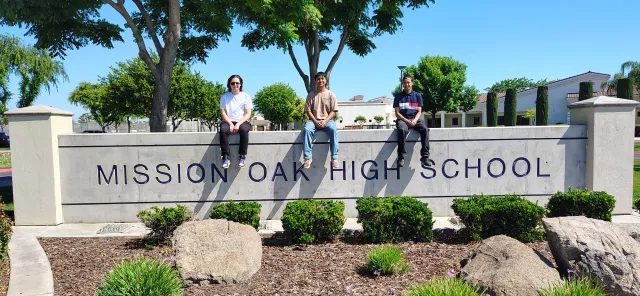
This team developed a drone-based herd health monitoring system that uses wide-area aerial coverage to detect cows showing signs of illness, injury or distress in California’s top agricultural commodity, dairy.
Team advisor: Andrew Duffek, Teacher, Engineering
Students: Jayden Alexandre, Benjamin Bocenegra, Matthew Vega Sanchez and Arie Velasco
Excellence in AI Award
Excellence in AI, Division I:
UD Blue Hens, University of Delaware, Newark, Delaware
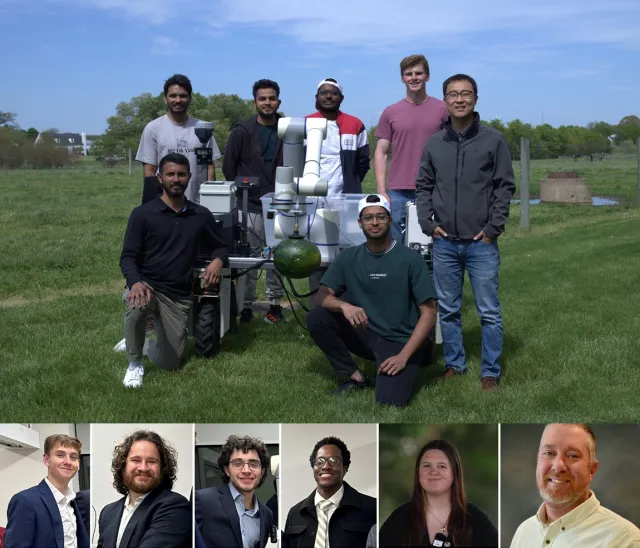
This team built a vision-guided watermelon harvesting system that combines YOLO-based machine vision, a compliant vacuum end-effector and a vine-cutting mechanism mounted on the Amiga platform to locate, grip and transfer melons with minimal damage.
Team advisors: Yin Bao, Assistant Professor of Digital Agriculture, Plant and Soil Sciences & Mechanical Engineering; James Adkins, Director of CARVEL Research and Education Center, Cooperative Extension
Students: Michael Acevedo, Thomas Nicosia, Katlego Matsipane, Colin Coope, Joseph Farley, Ekaterina Hampton, Annamalai Muthupalaniappan, Karthikeyan Mohan, Dharun Rajasekaran and Ashish Reddy Mulaka
Excellence in AI, Division II:
VARD, Shunji Nishimura College of Technology, Pompéia, São Paulo, Brazil
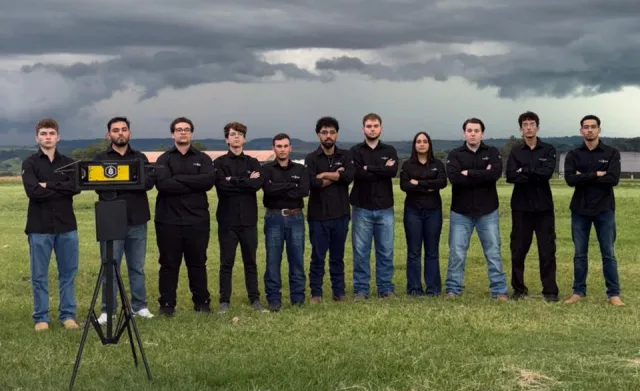
The judges recognized this team for strong technical execution and investment potential in their AI-enabled smart trap, which uses dual high-resolution cameras and image analysis to identify and quantify key cotton pests, replacing fixed-schedule insecticide applications with data-driven, targeted pest management.
Team advisors: Antonio Augusto de Arruda Silveira Neto, Project Manager, Administration and Precision Agriculture; Willy Kevin Corrêa da Rosa, CTO, AI and Software Development; Fernando Sanhueza Salas, Scientific Advisor, Entomological Sciences; Renata Coscolin Favan, Scientific Advisor, Agronomical Sciences
Students: Luis Felipe Begosso de Genova, Helen Albino Lopes, Pedro Orcílio Ferrari de Oliveira, Maycon Douglas Gonçalves Leal, Yuri Nitcipurenco Dias, Felipe Takayuki Tanaka Takahashi, Hadryan Fortinis de Oliveira Lima, Raul Carvalho Matsunaga, Matheus Vinícius Bertoni Silva and Lucas Hilário
Excellence in AI, Academy:
Almond Robotics, Modular Learning, Inc., Davis, California
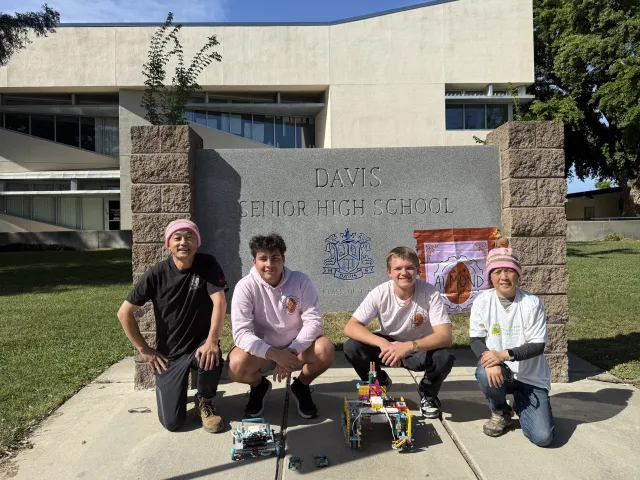
This team developed plans for an AI-enabled weed management robot that uses image recognition and growth-pattern sensing to identify and remove weeds with precision, paired with multispectral drone mapping to support organic and regenerative farmers.
Team advisors: Yan Guo, Director; Dawei Lin, Coach
Students: Jackson Pesmark, Dante Ottaviani and Prithviraj Yevle
Judges Choice Award
Judges Choice Award, Division I:
The Nexus, German International University, Cairo, Egypt
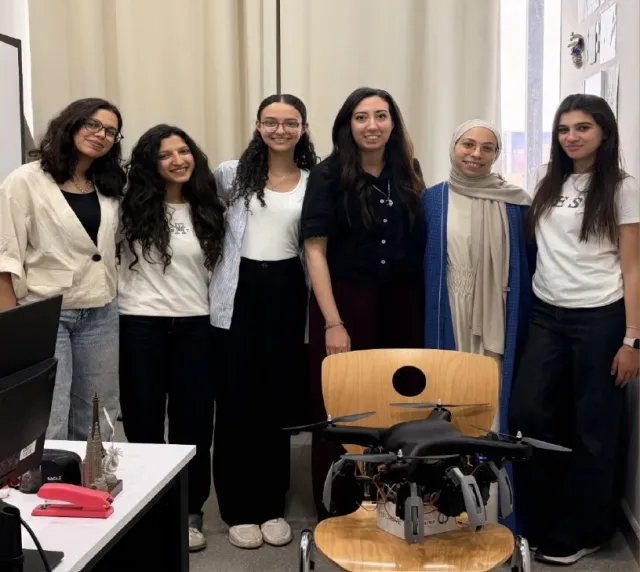
This all-female international team developed AeroSense AgriBot, a hybrid hexapod-and-quadrotor field robot that integrates early plant disease detection and autonomous precision pollination in a single coordinated system. The platform combines a six-legged ground rover, an autonomous aerial unit, and an octopus-grip electrostatic pollination appendage with VOC sensing, thermal imaging, GPS disease mapping, and a custom NEXUS mobile application for on-farm operation.
Team advisor: Lobna Aboserre, Assistant Professor, Mechatronics Engineering
Students: Aesha Abdelmonem, Nour Atallah, Maryem El Naggar, Habiba El Naggar and Jana El Masry
Looking forward to next year
The program extends its congratulations to all teams who participated this year, from first-time entrants to long-time competitors who have grown with the Challenge since its inception.
“Whether you advanced to the finals, refined your prototypes through field testing, or built foundational skills in robotics and AI, your work is helping shape the future of agriculture,” said Kelly Scott, the Challenge director.
Riding on the success of this year’s Farm Robotics Challenge, the competition will open registration for the 2027 program on August 3. The Challenge invites returning teams to build on this year’s momentum and welcomes new participants at every level, from middle school through university, to join a global community solving real problems for real farms.
To view a recording of the 2026 Farm Robotics Challenge awards ceremony, visit https://www.youtube.com/live/WrDGcwv7XSw.
The full list of competitors is displayed on the competition website at farmroboticschallenge.ai/2026participants.
About the Farm Robotics Challenge
The Farm Robotics Challenge is a student design competition focused exclusively on real-world, on-farm solutions in robotics, artificial intelligence and automation. Open to secondary students (grades 7–12) and students at two-year colleges and four-year universities, the program challenges teams to work directly with farmers, identify pressing agricultural problems, and design, build and field-test solutions. Organized by UC ANR Innovate and the AI Institute for Next Generation Food Systems, the competition is supported by a coalition of industry, academic and ag sector partners committed to building the next generation of agricultural innovators.
The 2026 program was supported by a coalition of partners including: Innovation Partner, Reservoir and Technology Partner, Bonsai Robotics.
Builder-level sponsors include Morrison Foerster, Western Growers Association, Plug and Play, Google.org and F3 Innovate.
Leader-level sponsors include Beck’s Hybrids, Linak and Bluewhite. For more information, including how to participate or sponsor, visit farmroboticschallenge.ai.
About UC ANR Innovate
UC ANR Innovate is the innovation arm of University of California Agriculture and Natural Resources. It connects people, ideas and resources to move agricultural innovation from research to adoption, bringing together startups, researchers, farmers and policymakers to tackle real world challenges in agriculture, food and biotechnology. Learn more at ucanr.edu/site/innovate.
About the AI Institute for Next Generation Food Systems
The AI Institute for Next Generation Food Systems (AIFS) is a USDA-National Institute of Food and Agriculture-funded research institute leveraging artificial intelligence to solve the world’s biggest challenges to crop and food production: ensuring a sustainable, nutritious, efficient and safe food supply while mitigating the impacts of changing conditions. For more information, visit https://aifs.ucdavis.edu.
About Reservoir
Reservoir is a startup incubator and venture capital fund focused on helping ag tech startups succeed where agriculture happens, in the field. Reservoir Farms is the world’s first on-farm robotics incubator, starting in the Salinas Valley and expanding to other key regions including the Central Valley. Reservoir Ventures backs startups solving real problems in high-value crops. By combining R&D space, hands-on grower input and early-stage capital, Reservoir helps turn promising ideas into tools for the growers who feed the world. Learn more at reservoir.co.
About Bonsai Robotics
Bonsai Robotics is reimagining the agricultural industry with its AI-first platform that makes autonomous farming affordable, easy to use and deployable across all farm equipment – whether retrofitted onto existing machines or built into next-generation solutions. Its 2025 acquisition of farm-ng combines leading vision-based autonomy software with modular, electric robotics to deliver machines adaptable for a wide range of crops, tasks and environments. Learn more at bonsairobotics.ai.
About Western Growers
Founded in 1926, Western Growers represents local and regional family farmers growing fresh produce in Arizona, California, Colorado and New Mexico. Western Growers members and their workers provide over half of the nation's fresh fruits, vegetables and tree nuts, including nearly half of America's fresh organic produce. As the 2026 Farm Robotics Challenge sponsor of the Excellence in Specialty Crops Award, Western Growers continues to champion innovation, workforce development and the adoption of advanced technology across specialty crop agriculture. For more information, visit wga.com.
About Plug and Play Tech Center
Plug and Play Tech Center is one of the world’s leading innovation platforms, connecting startups, corporations, venture capital firms and government agencies to accelerate technology development and commercialization. For more information, visit plugandplaytechcenter.com.