
California Red Scale Degree-Day Update: 2026 Season Running Significantly Ahead than Previous Seasons
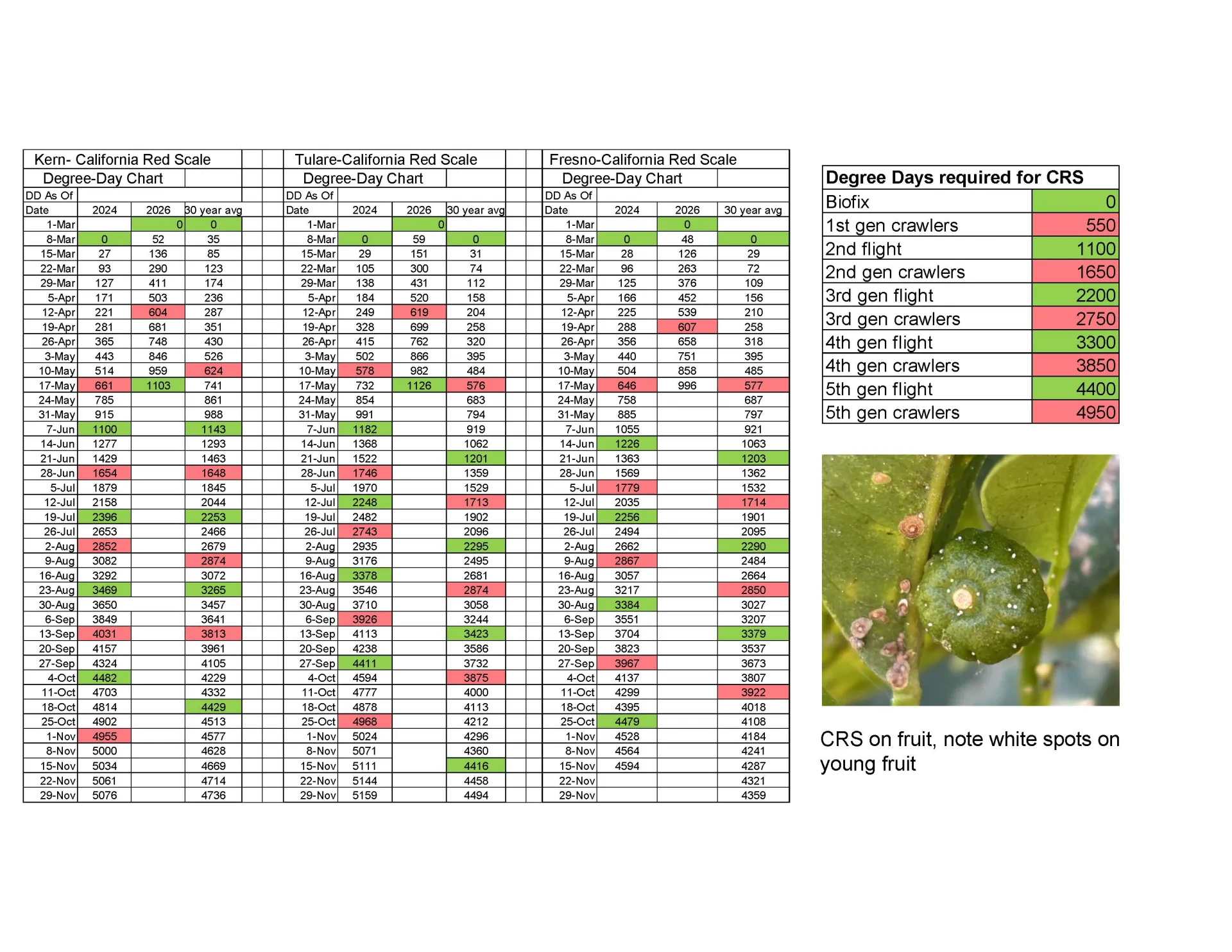
California red scale (CRS) season this season is developing much earlier than what growers and PCAs are accustomed to seeing across the San Joaquin Valley. Degree-day accumulations from multiple California counties are showing a clear trend: crawler emergence and generation timing are advancing well ahead of both recent seasons and the 30-year historical average.
Based on current cumulative degree-day tracking, the second-generation crawler emergence, which typically begins around the first week of July in many citrus production areas, is projected to occur nearly three weeks earlier this season.
This shift has important implications for monitoring programs, treatment timing, and overall management success.
📈What the Degree-Day data shows?
Although CRS biofix was similar to previous seasons, warmer temperatures in March seems to have pushed season to begin early, with second male flight recorded 3 weeks earlier than historical averages. The accelerated development means California red scale populations are moving through generations earlier than expected, with second generation crawlers expected nearly 3 weeks earlier, beginning as early as first or second week of June in warmer spots.
Key observations from the current degree-day summaries:
- First-generation crawler emergence occurred ~4 weeks earlier
- Second-generation flight is development occurred ~3weeks earlier
- Heat unit accumulation is consistently ahead of historical averages
- Counties are showing similar early-season trends despite regional variation
- Calendar-based timing will be unreliable this season
This season highlights why relying solely on “typical timing” can lead to missed treatment windows.
🍊Why this season’s weather pattern matter for CRS management?
California red scale management depends heavily on properly timing insecticide applications around crawler emergence. When the season shifts earlier:
- Treatments applied on a traditional schedule may occur too late to target susceptible life stage, especially for IGRs.
- If mating disruption is part of the program, flights may have already happened.
- Additional applications may become necessary if windows are missed
The second generation is particularly important because populations often increase rapidly during summer conditions. Missing this timing can create management challenges later in the season and increase fruit infestation pressure approaching harvest.
🔍Monitoring is more critical when weather is unprecedented.
Because development is progressing unusually early, field monitoring becomes especially important in 2026.
Growers and PCAs are encouraged to:
- Increase scouting frequency in known hotspot blocks
- Deploy or closely monitor pheromone traps
- Check crawler activity using tape monitoring or twig inspections
- Prioritize monitoring in historically problematic orchards
- Avoid depending entirely on historical calendar dates
Field observations should always be used alongside degree-day models to guide decisions.
🍊Important reminders for 2026 CRS season.
- The 2026 CRS season is running significantly earlier than normal!
- Degree-day accumulations are ahead of previous seasons and 30-year averages!
- Second-generation crawlers may emerge nearly 3 weeks earlier than expected. Similar trend is expected for 3rd and 4th generations.
- Traditional calendar timing may not be reliable this year.
- Intensive monitoring is essential for proper treatment timing.
- Degree-day models should be checked frequently throughout the season
As temperatures continue to accumulate, staying proactive will be critical to maintaining effective California red scale management in 2026.