
Ask a Master Gardener
This column is written by the UC Master Gardeners of Yolo County each month. It provides answers to selected questions recently asked by Yolo County gardeners.
Question: What landscape plants should I avoid planting because they are invasive or have other negative qualities, even though I might find them in a nursery?
Answer: You’ve touched on the horticultural equivalent of the idea that “just because something can be done doesn’t mean it should be done.” Despite the efforts of California horticultural organizations and occasional cooperation from big-box stores and nurseries, some invasive plants are still sold in California. You’re more likely to find them at smaller, local nurseries than at chain retailers, and many are also available online. Although they may look attractive, these plants crowd out native species and can spread into nearby open spaces, where they become difficult to eradicate.
These problem plants fall into different categories. Some are classified by the California Department of Food & Agriculture (CDFA) as “noxious weeds” and are illegal to sell or propagate (though owning them is allowed). Others are known to be invasive and are still legal to sell, but are not recommended for landscape use. (This discussion focuses on California, where invasiveness varies by region.)
Examples of noxious weeds illegal to sell in California include tree of heaven (Ailanthus altissima), giant reed (Arundo donax), purple loosestrife (Lythrum salicaria), Scotch broom (Cytisus scoparius), and artichoke thistle (Cynara cardunculus). These have largely been phased out of legal sale.
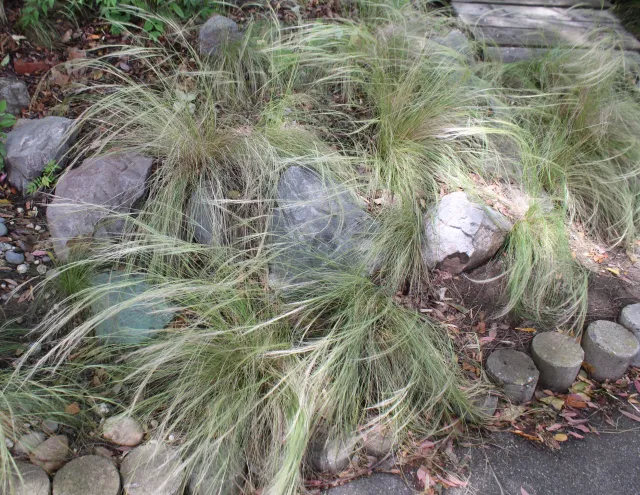
Other commonly sold plants that are invasive and not recommended include English ivy (Hedera helix), periwinkle (Vinca major), Mexican feathergrass (Stipa/Nassella tenuissima), pampas grass (Cortaderia selloana), highway iceplant (Carpobrotus edulis), and water hyacinth (Eichhornia crassipes).
Fortunately, there are good alternatives. Ivory star jasmine (Trachelospermum asiaticum) can replace English ivy, evergreen currant (Ribes viburnifolium) can substitute for periwinkle, and blue grama grass (Bouteloua gracilis) is a better choice than Mexican feathergrass. New Zealand flax (Phormium tenax) can replace pampas grass, trailing iceplant (Delosperma cooperii) can substitute for highway iceplant, and water smartweed (Polygonum amphibium var. stipulaceum) may be used instead of water hyacinth.
While contaminated cargo and livestock feed introduce some invasive plants, horticulture and landscaping are the primary pathways for their spread in California.
Organizations such as the California Invasive Plant Council (Cal-IPC) and the Plant California Alliance are working with nurseries to reduce the availability of invasive plants. Still, for homeowners, selecting landscape plants in California can feel like the Wild West. This overview can serve as a helpful “wanted poster” of species to avoid.
Have a gardening question? Send it to jmbaumbach@ucanr.edu, with “Ask MGs” in the subject line. Include as much detail as possible and pictures if you have them.