
Central Sierra: It's June Bug Season
June bugs are among the most familiar insects of early summer. Although people commonly call them “bugs,” they are actually scarab beetles in the genus Phyllophaga. These beetles are usually brown, oval-shaped, and active at night, often flying clumsily around porch lights. Their larvae, known as white grubs, live underground and feed on roots. In the Tahoe region, however, the term “June beetle” can refer to several different scarab beetles depending on elevation. Because the Sierra Nevada is a transition zone, the mix of species changes noticeably between South Lake Tahoe, Truckee, and the lower foothills and valleys.
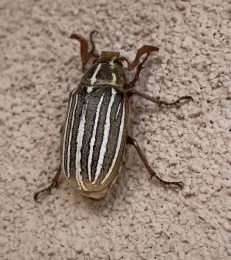
Around Lake Tahoe, at roughly 6,200 feet, the Ten-lined June beetle (Polyphylla decemlineata) is the species people are most likely to encounter. These beetles are closely associated with pine forests and sandy soils, and they are hard to miss because of their large, heavy bodies and faint white stripes on their wing covers.
View images on iNaturalist: https://www.inaturalist.org/taxa/84612-Polyphylla-decemlineata
Whether June bugs are friends or foes depends largely on their numbers and where they are found. Adult beetles usually cause only minor leaf damage, but large populations can become destructive. According to the UC IPM Pest Management Guidelines, adult June beetles may completely defoliate young trees by feeding on leaves night after night. Their grubs can also damage lawns, crops, and ornamental plants by chewing roots underground. UC IPM also notes that June beetles have one generation per year, and adults hide in soil or leaf litter during the day before feeding again at night.
Even so, June bugs are not entirely harmful. Birds, bats, raccoons, and other wildlife feed on both adults and grubs, making them an important part of the food chain. Their digging activity can also help aerate the soil. In most home gardens at our elevation, they are more of a seasonal nuisance than a serious threat.
The name “June bug” comes from the insect’s habit of appearing in late spring and early summer, especially during June in much of North America. The term dates back to the early 1800s, when people noticed these beetles emerging in large numbers during that month. In warmer regions, they are sometimes called “May beetles” because they appear earlier in the season.
Keep your eyes open tonight—you may spot one clumsily bouncing against your porch light.