
Creating Your California Native Habitat Garden: Building Around the California Buckeye
Have you ever thought about creating your own native habitat garden? If so, you’ve come to the right place! But are you new to the idea of creating a native habitat garden, or just curious about what a native habitat garden is? You’ve also come to the right place! For those of you who may be reading this series for the first time, and those who simply would like a refresher on what exactly a native habitat garden is, let’s take a moment to review.
A native habitat garden is a landscaped area that utilizes native plants to create a functional ecosystem that supports local wildlife. What wildlife, you might ask? A native habitat garden is likely to support birds, bees, butterflies, and more by providing food, water, shelter, and nesting sites. When building your own native habitat garden, something to keep in mind is that the most successful habitat gardens are built around a keystone species. Today, the keystone that I want to propose to you is the California Buckeye, or Aesculus californica.
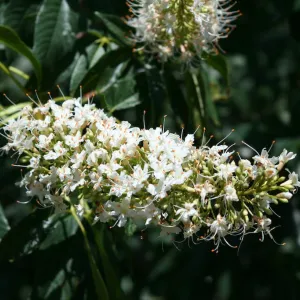
The California Buckeye is a fast-growing, small tree or large deciduous shrub that can reach between thirteen and thirty-nine feet (4 - 12m) in height. A typically multi-trunked tree, the Buckeye is covered with a gray colored bark that is often coated with lichens and mosses. Buckeye is a plant that grows during the wet, late winter and spring months while being dormant in the drier summer months. While blessed with sweet-scented, white to pink colored flowers, the buckeye also bears a large, fig-shaped seed.
However, its large orange-brown shaped seeds are both the largest known of any temperate plant species and are poisonous. Although the seeds are toxic, scientists think that prehistoric California creatures like woolly mammoths and giant ground sloths that once roamed our landscape were able to consume them.
California Buckeye is widely distributed across California, growing from the central coast to the lower elevations of the Sierra Nevada and Cascade mountains. It is also found growing as far north as the Rogue Valley in Oregon and in a wide range of conditions. Buckeye is known to grow alone and intermingled with various native oaks and the bay trees. This widespread adaptability to the various climates of California makes the California Buckeye a beautiful native that could be grown in a variety of different climate zones.
If you decide to utilize the California Buckeye as a centerpiece for a native habitat garden, it is important that you never forget its toxicity. The bark, leaves, and fruits, along with the seeds, contain neurotoxic glycosides that cause hemolysis of red blood cells. Because of this, caution is recommended when handling or working with this tree. Despite the toxicity, however, many species of wildlife will still graze on new shoots of the Buckeye, which are lower in toxins. The flowers of the tree are also a rich nectar source for multiple species of butterflies.
A strikingly beautiful ornamental, native tree, California Buckeye is planted for its architectural silver branches, its striking leaf buds and lime green foliage, and its fragrant white flowers. It can easily be pruned to fit into a space in your yard, potentially serving as a visual screen. In hilly environments, it can act as a soil binder to help prevent erosion. In June and July in Yolo and Solano counties, the leaves of the buckeyes will turn golden, then brown and then fall to the ground. The seeds will continue to develop on a mostly leafless tree.
California Buckeye is a wonderful tree with which to build a native habitat garden with proper care. Would you consider putting on your gloves to prune the tree or handle any fallen seeds? If so, the California Buckeye may be the tree for your native habitat garden.
Do you think that you’ll want to plant your own California Buckeye to start your native habitat garden? There’s no better time to start one than the present. But whether you decide to start your native habitat garden now or simply continue to cultivate the garden you already have, good luck and happy growing!