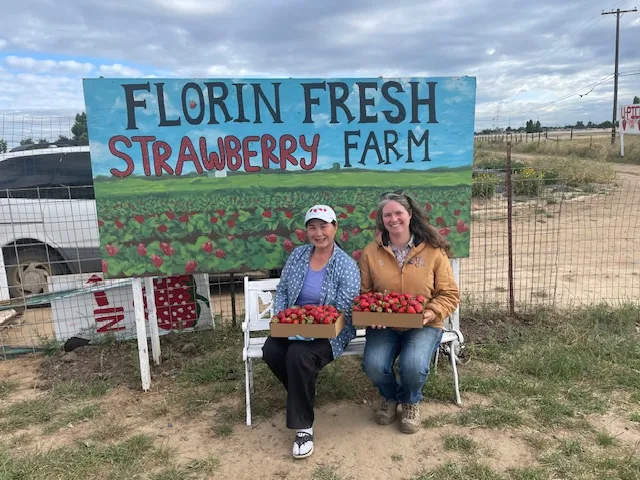
Lee: Seeing Iu Mien strawberry farmers’ success ‘makes my heart sing’
UC ANR Small Farms educator’s journey took her from a refugee camp in Thailand to the Sacramento area
In working with the more than 50 Iu Mien strawberry growers across the Sacramento region, it helps that Fam Lee knows their unique culture and history of resilience and perseverance. She has lived it.
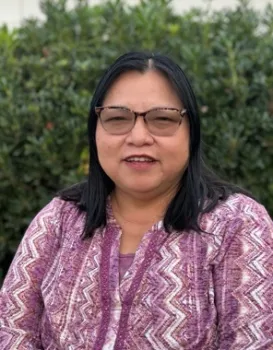
Lee, a community educator with the University of California Agriculture and Natural Resources’ Small Farms Advisor Margaret Lloyd and the Small Farms Network, was a strawberry grower herself. Born in Laos, Lee was a young child when her family had to flee political persecution after the Communists took control of the country. The Iu Mien, an ethnic group that originated in southern China and settled in the mountainous regions of Southeast Asia, were allied with the U.S. during the Vietnam War and “Secret War” in Laos.
Lee’s family settled in Oakland, and she drew on her family’s agricultural background when she and her husband operated her uncle’s strawberry farm in the Sacramento area from 2013 to 2019.
She began with UC ANR in July 2021 and, over time, established herself as a trusted contact in the Iu Mien grower community. Busy this spring conducting strawberry variety trials in partnership with a local Iu Mien farmer, Lee took a break recently to share her work, background and journey.
As a member of the Capitol Corridor Small Farms team, please tell us about how you work with the Iu Mien farmers.
FAM LEE: I do farm visits and provide growers with resources. If there is a grant opportunity, I will reach out to the growers, make an appointment, and have them come to our office, where we have staff who can help them fill out the grant application.
We provide information on weed management, pest management, soil health, cover cropping and more. We host a training class for those who want a private applicator certificate to use certain pesticides. We make sure growers renew their Operation Identification Numbers yearly and remind them to get their scale certified to meet regulations. I also help them with strawberry jam permit applications with Olivia Henry [UC Cooperative Extension regional food systems area advisor].
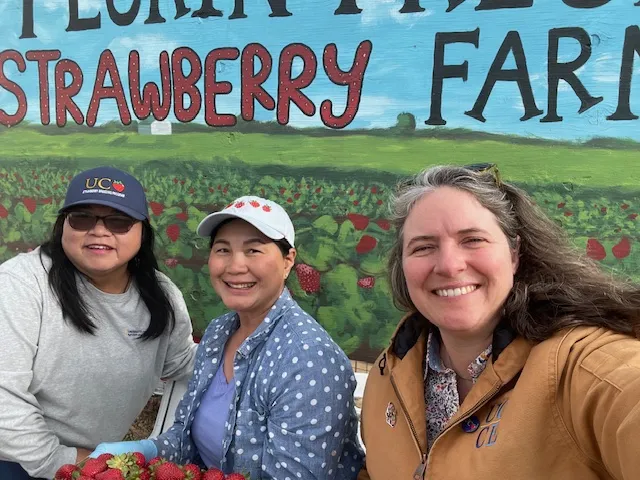
Strawberry growers have both my phone number and email; they know they can call or text me anytime – I am here for them!
I love working with my team and I have a great supervisor, Margaret Lloyd, who has worked with the Iu Mien strawberry growers for a very long time. The strawberry growers are honored to have her in our community.
Building that trust is so important; what has that process been like?
FAM LEE: The Iu Mien strawberry growers are very good with their hands, very skilled. But the language part is really challenging for many of them because they were not born in this country. When they come over, they’re in their 40s, kind of late for them to study. Also they have to work to support their families, so they don’t have time to go to school. As they work on the farm and at the farm stands where they sell their strawberries, they talk with customers and get to practice English.
So, it can be hard to reach out to these growers. Some speak English better than me, and some speak only a little, and some speak in between. If you have a staff member on board that speaks the language, that makes everybody’s life easier – for our Small Farms team and for the grower.
I knew some of the growers from before I joined UC ANR. Our community is small; everybody knows everybody. You really have to build that bond and that trust, because if you don’t have that, it’s really hard to get the work done.
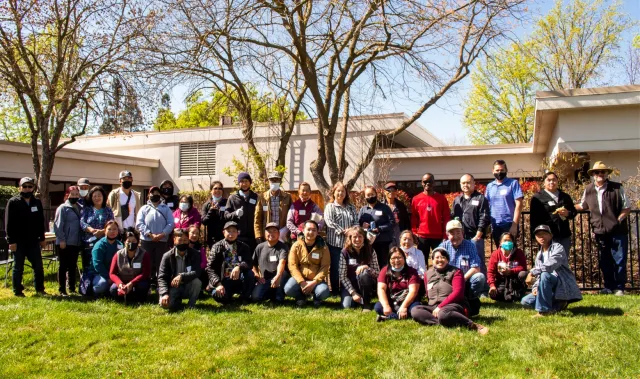
I have been fortunate; many of them, they respect me. They know that if they need help, they can call me. I am always very upfront with them, and I say I will do my best. I don’t know what the outcome will be, but I will get back to you. Please give me some time to work on it, and I will have the answer for you one way or another – I appreciate your patience!
What have you enjoyed most about your job?
FAM LEE: What makes my heart sing the most is when I visit the growers and I see them happy.
I'll give you a story. There’s a couple who run a farm stand very close to our UC Cooperative Extension Capitol Corridor office in Sacramento. Every time I go to visit Penny, who is Thai, and her husband, who is Iu Mien, I always check in with her.
This is a young couple who just started their farm three years ago, taking over a family member’s farm. The husband had experience with farming but Penny was just learning, because she had her nine-to-five job. But one person running the farm was not easy – there were limited funds and not enough help.
They had been having a hard time; she had to leave her job to support her husband in this farming business, and it wasn’t doing very good. She used all her retirement funds to support the farm.The wind blew off the roof of their farm stand; their fields flooded and all their strawberry plants died. It was just one thing after another.
Our team tried to support them as much as possible. We provided soil health tests, gave them recommendations, helped them apply for a grant. It didn’t take care of all the problems, but the grant money helped so much.
I also asked Penny if she had got her name on the list for being at farmers markets. My colleague Ge Moua is a farmer and a staff member on the UC ANR Small Farms team; she has been to various farmers markets in San Francisco and Sacramento. I shared with Penny that Ge did really well at farmers markets.
So Ge and I, we told them to get on farmers market wait lists. They were reluctant, and they said they cannot even handle the farm stand. But we pushed them and we encouraged them and shared others’ examples and experiences. I said, “You can do it!”
Then they said the wait list is too long. So I said, “Look, the longer you wait, the longer the wait list will be – just get on it!” It took a lot of encouraging for them to do it.
But then they got into the farmers market a few weeks ago. When I visited them, their faces just lit up, they were so happy. I said, “You believe me now?” And Penny said, “Yes, you got me through a lot.”
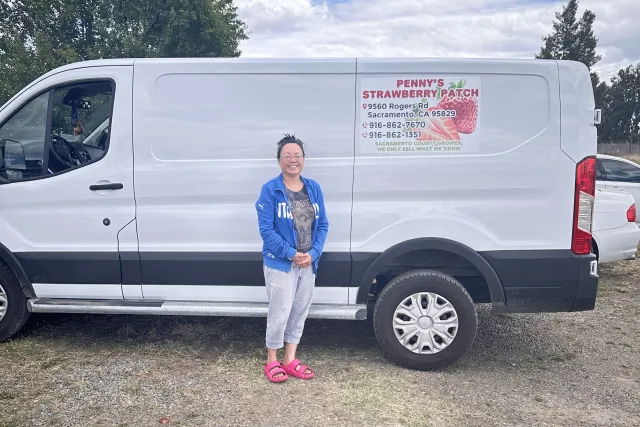
And then they got into two farmers markets! Now they’re pushing to get into a third. They also bought a cargo van, and on the side of the van they wrote “We Only Sell What We Grow.”
It obviously helps that you not only speak the language and know the culture – you’re a farmer yourself. I know you farmed for a couple years in Petaluma, worked on your uncle’s strawberry farm for about six years, and have been farming a small plot in Stockton for the past year.
FAM LEE: Yes, my great, great grandparents were farmers in Laos, and so were my parents. I am a farmer as well! Being a farmer is really hard, but I enjoy being outside. I learn more about farming every day. I have my own freedom and schedule. It’s a great stress reliever; I get vitamin D for free. As a farmer, I feel I don’t get sick and depressed as much. And when I meet new people and get to know them, I am happy.
Right now, my husband and I are trying to do organic vegetable farming on our good friend’s property in Galt. We are working on the lease agreement now and FarmLink is helping me with that. We want to train our children to farm and be involved as much as possible, so they know where their food is coming from and eat healthy vegetables. And some day when we are gone, they can grow the vegetables themselves, and hopefully they can pass those skills on to their children.
What are some of the difficulties you have faced in starting a farm?
FAM LEE: Funds are very limited. When you are a new farmer, you can’t get a loan to start up your farm. I wish there was someone out there who can help beginner farmers. I basically stopped farming in 2019, so now banks and agencies consider me a “new farmer” – not an experienced farmer. Some of them require three years of experience for them to consider loaning me money.
We need a trailer on our land for taking breaks; we need T-tape for the irrigation, mulch, pipe, many other things. We need a vegetable washing station – it doesn’t need to be brand-new, but it’s still very expensive. We need to have tools to work on the land, but we don't have the money to buy them. We use what we have, and our 10 fingers.
Growing in a greenhouse would be best. So we were very grateful for a grant from CCOF [California Certified Organic Farmers]; we bought a greenhouse with our own money first, $4,000, and then submitted the receipt to CCOF. They reimbursed us six months later. We were working to get ready to put the greenhouse up, but then someone stole all the materials last Thanksgiving.
CCOF said we could buy another one and they would reimburse us, but we don’t have money to buy it right now. We still want to get another one, we’re just not sure when yet.
That’s such a terrible setback, but I know you will overcome it. You’ve been overcoming challenges ever since you were a young child. Can you talk about your life in Laos and Thailand?
FAM LEE: I was born in Laos, but I’m not Laotian. We are Iu Mien; we don’t have our own country. Due to the Secret War, we were forced to move out. If you didn’t flee and got caught, you were finished.
We escaped, like a lot of people, by crossing the Mekong River at night. A lot of people died; it wasn’t safe. We settled in northern Thailand, at the Chiang Khong Refugee Camp, a primary intake and holding center for the Laotian refugees.
We were in a refugee camp for five years. Life in the refugee camp was challenging and hard for the adults. My mom told me that there was not enough water for everyone, so they had to fight for water. For food, they struggled but they had enough because they were farming outside of the camp.
For me as a kid, I didn’t feel and see any difference because I was young – all I knew was to play with dirt and hang out with friends. I had food to eat every day, and I didn’t see the struggles of my parents. They hid their feelings from me; my folks had five children – I am the third daughter – and they just made sure we were fed.
I didn’t get to attend school in the refugee camp. The school was only for Thai people and we are not Thai. We were excluded, but I was curious. We kind of poked a hole through the wall to try to see and hear what they were teaching. But if they saw us, they would chase us with a ruler and hit us, because we were not allowed to study.
The school didn’t belong to us – we had nowhere to go; we had no home, no school.
How did you eventually leave the refugee camp and settle in the U.S.?
FAM LEE: We never met our sponsor; I heard from my dad that our sponsor was in Alabama. I asked my dad if we knew who they are, so we could send them a thank-you letter. But my dad said we didn’t know who they are. It could be an individual family or a church. We felt bad that we never got to meet them. We really appreciate our sponsor for bringing us to America so we all can have better lives, education and freedom. We will never forget them.
In 1980, we finally arrived in the U.S. My uncle was living in Richmond, California. He petitioned for us to stay in California so his siblings could all live close by.
None of us spoke any English, so we were grateful for the Hmong caseworker, who spoke Thai, Lao and Mien, and who helped us get settled in Oakland.
I was about 13 at the time. I didn’t know the ABCs, colors, numbers, you name it. They put me in a special class, and boy, did I struggle. But I just did the best I could. I struggled with every single class and was scared; I had never even seen white people or Black people in Laos or Thailand. It was a big culture shock to me and my family. We had to learn everything and learn it fast so we could survive.
My dad and mom had to go to ESL class at Laney College, but the level was just too hard so they ended up going to study at Harbor House Ministry, a nonprofit in Oakland. My parents are smart; they picked up English very fast. I am very proud of them; they tried very hard, but it was very, very difficult. I don’t know how they did it.
As I get older, I realize now how much they struggled for us. They sacrificed a lot for us kids. At Harbor House Ministry, where my dad was taking English classes, they gave him a job as a custodian part-time. Then, as more people started enrolling in the ESL classes, they appointed him to be a teacher assistant, too. He did it all; they also trained him to drive a big passenger van. He later got a job as a delivery driver for an auto parts company, and he did that until his retirement.
Speaking of jobs, how did you end up joining UC ANR?
FAM LEE: I met Margaret when she came up to my uncle’s strawberry farm stand in Elk Grove and introduced herself. Then in late 2020, early 2021, she sent out the job description for this job to an Iu Mien community agency, and then she reached out to me personally. She said: “Do you know if anyone wants to work a part-time job?”
After I read the job description, I was actually hesitating about the position; I didn’t really think that UC ANR would hire me. I’m good at what I do, but I don’t have any agriculture degrees like they do.
My husband was the one who kept pushing me to apply; he said, “It’s the skills you have, and you already know all these growers.” And then I got the job – maybe I was the only who applied! I started in July 2021, and I have loved working for the UC ANR Small Farms program.
During this International Year of the Woman Farmer, what advice do you have for other women farmers?
FAM LEE: Continue with what you are doing – and teach other women to farm, share your experience and knowledge. The more people know about farming, the better. People need to know where the real vegetables came from! We women can do it.