
Drip Irrigation 101: How to Save Water and Grow Healthier Plants
If you had the opportunity to garden more sustainably, conserve our environment, and improve the viability of your plants by making one relatively easy and inexpensive change, would you do it? Many people use traditional spray-head irrigation, or even hand-water outdoor plants, but there are a myriad of reasons to convert to, or install, a drip irrigation system.
Benefits of Drip Irrigation Over Traditional Watering Methods
Thoughtfully designed drip irrigation systems ensure that plants receive the ideal amount of water at the proper rate. The soil retains crucial air and water balance and plants avoid the stress and shock of the drench-and-dry-out cycle associated with conventional watering methods. According to the US Environmental Protection Agency, drip systems use between 20 and 50 percent less water than conventional spray sprinkler systems, thereby saving a typical home more than 25,000 gallons of water per year. In addition to saving water, drip irrigation:
- Reduces or eliminates water runoff; the slow application means that nearly all the water soaks into the soil
- Reduces weed growth; water is delivered directly to plants at their root system
- Saves water lost to evaporation
- Can be installed as a DIY project, saving money
- Minimizes fertilizer and nutrients lost due to water runoff
- Eliminates watering foliage, reducing disease risk
- Protects local water bodies such as streams, lakes, and rivers by reducing runoff associated with spray irrigation
- It is adaptable to oddly shaped yards or those with uneven topography or soil texture
- Can be configured to deliver fertilizer along with the water
What is Drip Irrigation?
Drip irrigation is a highly efficient watering method that delivers water directly to the plant's root zone through a network of tubes and emitters. The method of slowly releasing water directly to a plant has been utilized since ancient times. The use of buried, unglazed clay pots to slowly release water into the soil was practiced in ancient China. Modern experiments began in 1860’s Germany, using clay pipes to combine irrigation with drainage, followed by an Australian inventor who developed the first plastic pipe systems for water distribution. The systems we use today were developed in 1959 by an Israeli engineer in an effort to irrigate food crops in the desert.
Mechanics of Drip System Irrigation
Drip irrigation works by transforming high-pressure, high-volume water from a source into a slow, precise, and uniform release at the plant’s root zone. The basic parts of a drip system include:
- Water Source: Hose bib.
- Backflow Device: A backflow preventer is the first line of defense, ensuring that irrigation water (which may contain fertilizers) does not siphon back into the clean drinking water supply.
- Pressure Regulation: Most water sources (municipal or well) operate at 30–60 pounds per square inch (PSI), which is high enough to blow apart drip components. A pressure regulator uses an internal spring and diaphragm to reduce the incoming pressure to a stable 15–30 PSI. This consistency ensures that emitters across the entire system—whether at the start or end of a line—release water at the same rate.
- Filter: All drip systems must have a filter to prevent emitters from plugging.
- Timer/Controller: An optional but highly recommended battery-operated timer for automation.
- Tubing: A polyethylene “main line”, usually 1/2” diameter, in-line emitter tape, and/or smaller distribution lines (known as spaghetti tubes) or soaker hoses.
- Point-Source Emitters: These plug directly into the tubing to deliver water to a specific plant. Common flow rates are Red = 1/2, Blue or Black = 1, Green = 2 gallons per hour (GPH).
- Tools and Fittings: Punch, female hose connector, couplings, elbows, tees, 1/4" fittings for distribution tubing, goof or end plugs, end piece or figure eight, reduction coupler, PVC cutter, and stakes.
How and Where to Set the System Up
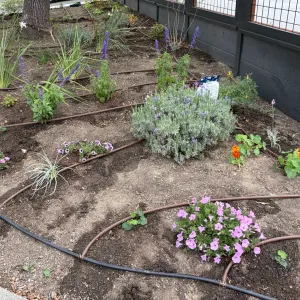
Before installing the drip system, evaluate your garden. It’s essential to group plants with similar watering needs into specific zones. This is easily done if you are starting a new garden, but not as difficult as it may seem for existing gardens. A current garden setup probably groups plants with similar light/heat needs together. Drought-tolerant/heat-loving plants grow where they receive afternoon sun, heuchera and creeping fig where there is some shade, etc. Set water-loving plants (fruit trees, Japanese maples/Acer palmatum, vegetables), medium water users (Western redbud/Cercis occidentalis, California fuchsia/Epilobium canum) and drought-tolerant plants (California poppies/Eschscholzia californica, salvias, most native plants) together. Ideally, each group will be on its own circuit.
A rough sketch of your yard will assist in evaluating your plant groupings and designing your new system. Note the location of the water source.
When you are ready to install the system, attach the components to the faucet in the following order: 1) backflow preventer, 2) pressure regulator, 3) filter, 4) timer, 5) main tubing. Hand-tight is usually enough—no tools needed. Run the ½" main line along your planting areas and secure it with stakes. Keep it above ground at first; you can bury it later if you like. Punch small holes into the tubing and insert emitters, and/or attach a thin “spaghetti” tubing line to the main line and install an emitter at the end.
Set up a watering schedule dependent upon your plant groupings' needs. How often to water and how much to water depends on your plant groupings, soil type, and time of year. Watering in the morning or evening is best – although drip irrigation reduces evaporation, our hot northern California sun can still cause some water loss. Turn the system on and check for leaks, make sure each emitter is dripping (not spraying) and adjust the flow or placement as needed.
Regular Maintenance of Drip Irrigation System
Similar to traditional irrigation systems, drip irrigation requires regular maintenance. Inspect the system every week or two. Look for dry, stressed plants, which could mean a clogged emitter. Make sure to flush out the system to clear blocked emitters. Look for puddles, listen for spraying, which likely means a popped emitter or tubing leak. UV damage is common in sunny areas. Look for cracks in the tubing from sun exposure, tighten loose fittings, and replace brittle tubing sections.
Your filter is the first line of defense, and should be cleaned monthly, or as needed. Unscrew it and rinse out debris. Do this more often if you have hard water or sediment.
As plants grow, add more emitters for larger root zones, and move emitters outward as roots expand. Update your timer seasonally. California's water needs vary widely. You may not need to turn the system on until mid-spring. Increase the duration or days of watering during the hot summer months. Turn the system off in winter if we receive enough rain.
Why Do We Want to Save Water?
According to Dr. Benjamin Cook, in his blog for the Public Policy Institute of California, “In the West, there are droughts all the time. Everyone’s worried when it’s going on, but as soon as it ends, people feel they have nothing to worry about. I always say that when a drought ends, it’s time to start preparing for the next one.”
Climate change has caused erratic weather patterns. We can swing from nearly dry winters to extreme flooding year after year. The one thing we can be absolutely sure of is that Northern California will never have an ongoing abundance of water. It’s incumbent upon all of us to do our part to conserve this precious resource.
For those of us living in Solano County, the Solano County Water Agency (SCWA) offers residents and businesses rebates for water-saving upgrades, primarily focused on turf replacement ($1.50 per sq. ft., up to $1,500 max) and irrigation efficiency (https://scwa2.com/residential-rebates/). Eligible projects include replacing lawn with water-efficient landscaping, installing smart controllers, and adding mulch. People living elsewhere should check in with their local municipality or water agency to see what programs are available.
Drawbacks of a Drip System
Drip irrigation isn’t a miracle solution to our watering needs and comes with some limitations. First of all, it is usually inappropriate for lawns, which need a wider broadcast of water. As mentioned previously, the emitters can clog and the sun's UV rays may deteriorate the tubing. Buried tubing can conceal problems such as over/under watering. Rodents, garden tools and even foot traffic can damage the tubing. It’s important to install the system clear of pedestrian traffic.
However, even with these limitations, drip system irrigation really shines when you care about efficiency, plant health, and reducing wasted water. On an individual level, these systems lower your water bill and reduce the need for weeding. That, in and of itself, makes this water delivery system indispensable.
Resources
University of California Department of Agriculture and Natural Resources: https://ucanr.edu/sites/default/files/2021-03/346810.pdf
Oregon State University: An introduction to drip irrigation.
US Environmental Protection Agency: www.epa.gov/watersense
Public Policy Institute of California https://www.ppic.org/blog/is-california-getting-drier/
California Water Watch: https://cww.water.ca.gov/
Solano County Water Agency: https://scwa2.com/residential-rebates/
Drip Watering Made Easy – Rain Drip Guide, Second Edition. 1983-1992