
Redbud Trees Provide Year-Round Interest
Have you ever noticed or wondered about the small trees with dark magenta blossoms found in home yards, along streets, and in our foothills in March through April? You are seeing the Western Redbud tree. It is a deciduous shrub or small tree growing up to 23 feet tall. The showy flowers, described as similar to pea flowers, appear before leaves emerge. The flowers grow in clusters all over the shrub, making the plant very colorful and noticeable in the spring landscape.
Adaptable and dependable, these trees provide year-round interest--but are especially attractive in early springtime. "Few trees herald spring as exuberantly as a redbud tree. With its profusion of brilliant, magenta flowers, a redbud tree is a welcome sight after winter for many people." (Julie Christiansen)
Redbud trees belong to the large genus Cercis, with five main species: C. canadensis (Eastern Redbud), C. chinensis (Chinese Redbud), C. occidentalis (Western Redbud), C. reniformis (Oklahoma Redbud), and C. siliquastrum (Judas Tree). This article will focus on the Western Redbud.
Interesting Facts
- The genus name Cercis comes from the Greek word kerkis, meaning weaver's shuttle, in reference to the shape of Redbud's flattened seed pods.
- Hummingbirds, goldfinches, butterflies, and bees are attracted to the Redbud flowers.
- New stems, cut in winter, are used to add color to Native American baskets.
- Redbud made it on the Arbor Day Society's short list of candidate trees to be considered as our national tree. (However, the oak tree won the title!)
- History recounts that the Redbud tree is called "the Judas Tree" because it is related to the type of tree on which Judas Iscariot hung himself. Supposedly, it became a softwood tree with gentle branches to prevent a repeat of the same tragedy.
Description
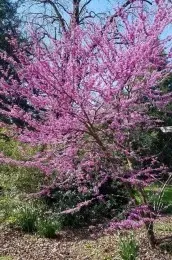
The Redbud is usually grown as a multi-trunk tree with a rounded crown and interesting heart-shaped leaves. It provides yellow fall color with the first frost, and is deciduous, so it drops all of its leaves in one season.
In early spring, before leaves emerge, an abundance of petite, sweet pea-shaped, magenta to rosy pink flowers bloom on bare twigs, branches, and sometimes the main trunk. These flowers generally last for two to three weeks. Clusters of flat, beanlike pods follow the blossoms and persist into winter. If the sight or sound of these natural wind chimes is bothersome, they can easily be removed with a few gentle swats from a badminton racket.
Western Redbud (C. occidentalis) is native to California, Arizona, and Utah, but predominantly grows in the California foothills below 4,000 feet. Its native habitats include foothill woodlands and chaparral, growing near stream banks in dry foothills and lower canyon slopes below 3,600 ft. It grows frequently in crevices and pockets where seeds are well covered with mineral soil. Cercis occidentalis flowers bloom in spring from February to April. As is the case with other legumes, it is a nitrogen-fixing plant because of the presence of root nodules, allowing symbiotic bacteria to produce nitrogen. They grow singly and in shrubby clumps alongside California buckeye, Ceanothus, manzanita, and other chaparral brush.
It is noted for attracting birds and other wildlife. The leaves are harvested by native leafcutter bees for their nests, resulting in perfect half-circles cut from the leaves – but don't worry, this doesn't harm the tree's growth at all. The flowers are an important nectar and pollen source for native insects and hummingbirds.
It can be susceptible to occasional tent caterpillar infestations, but these can be controlled. It is also known to be susceptible to other caterpillars as well as crown rot, phytophthora, root rot, and scales. It is resistant to oak root fungus and Armillaria.
This multi-trunked tree or shrub (10-18 feet tall and wide) is more densely twiggy than its eastern relative. The rounded leaves have heart-shaped bases with notched tips that emerge apple green--thin and delicate, then aging to a leathery texture with a bluish-green color. The magenta blossoms line the bare, silvery gray branches and are soon accompanied by young leaves. The best floral display comes from plants grown in full sun and with some winter chill. The 1½ to 3½ inch long, flattened seedpods change color from lime green to eggplant purple before drying to a dark brown or charcoal gray. Western Redbud is very drought-tolerant, and its smaller size makes it an attractive choice for most cities' smaller backyards. Like most California native plants, it prefers good drainage. Several varieties are available in local nurseries.
Care
Plant trees in fall through spring in full sun or light shade. Redbud is tolerant of most soil types and various climates, including the extreme cold and heat of high desert gardens. Flowering is more intense with winter chill. No fertilizer is needed. Redbud is ordinarily pest-free. Although Western Redbud is resistant to oak root fungus and Armillaria, avoid overwatering it, especially in heavy soils.
The Water Use Classification of Landscape Species (WUCOLS IV) rates Western Redbud as a "very low water use" native tree. The WUCOLS project was initiated and funded by the Water Use Efficiency Office of the California Department of Water Resources (DWR). The University of California Cooperative Extension directed work. WUCOLS IV provides evaluations of the irrigation needs of over 3,500 plant groups used in California landscapes on the WUCOLS website
Pruning should be done in winter or directly after bloom. For a tree shape, limit redbud to three upright trunks (for multi-trunk) or one trunk. To keep the Western Redbud in robust condition, annually thin out the oldest trunk. Or, an unpruned tree can be rejuvenated by cutting the entire clump to the ground. (Several California tribes use this technique to encourage the growth of straight new stems, which are desired for basketry.)
Cultural significance
Cercis occidentalis is important to the ethnobotany of multiple native groups, being used in basketry, and has different names in their respective languages. Botanist Victor Linkg Chestnut gave the name for the tree in various north California indigenous languages; according to him, the Yuki call the tree Chā'ā, the Koncow call it dop or tal'k, the Ukiah (cited as Yokia) call it Kälā' ä kälã'.
It has been described as being worthy of notice for foresters only because of their use in "forming a scanty cover along dry, rocky borders of streams," and the wood has been described as being of no economic or domestic use.
Design Tips
Cercis occidentalis is cultivated as an ornamental plant and tree, for planting in parks and gardens, and as a street tree. It is also used in drought-tolerant, native plant, and wildlife gardens. The handsome Redbud looks great in groupings, shrub borders, or as a featured focal point. In winter, the leafless branches form an interesting silhouette against a wall. Avoid the color of companion plants clashing with the vibrant magenta-colored bloom of the Redbud.
Plant the native Western Redbud with other natives such as California lilac, flannel bush, California buckeye, native iris, coral bells, saffron, and sulfur buckwheat. The Western Redbud tree will make a great addition to your drought-tolerant or native plant garden.