
Congrats, Pallavi Shakya! Well Done!
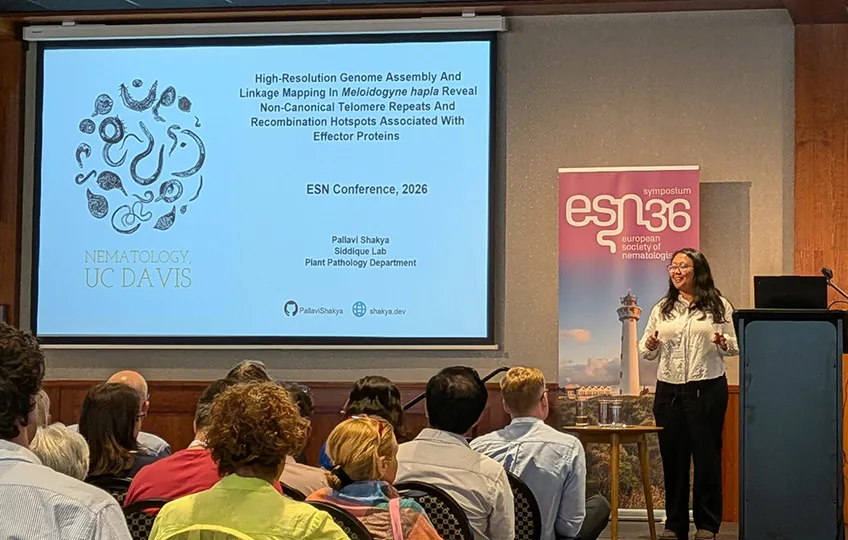
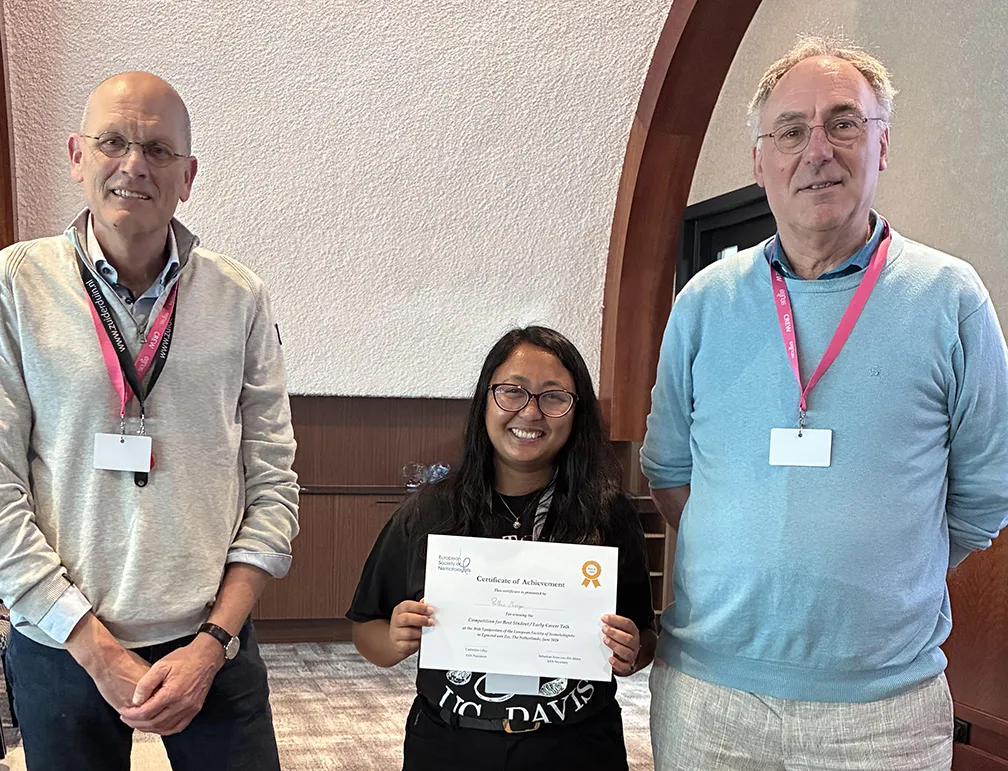
Congratulations to UC Davis doctoral candidate Pallavi Shakya of the lab of nematologist Shahid Siddique, who won “Best Student/Early Career Talk” at the 36th Symposium of the European Society of Nematologists, held June 1-5 in Egmond aan Zee, The Netherlands.
Well done! UC Davis is proud of you!
The global competition drew 41 participants. Another student, Beth Molloy from the Crop Science Centre at the University of Cambridge, also scored a first, the only two awards presented.
Shakya's abstract: “Root-knot nematodes (Meloidogyne spp.) are among the most destructive agricultural pests that cause significant yield losses across a wide range of crops. Meloidogyne hapla is a valuable model for studying root-knot nematodes due to its parasitic diversity, small diploid genome, and a reproductive strategy that facilitates genetic analysis. Here, we report the most contiguous genome assembly to date for any plant-parasitic nematode built using PacBio HiFi, Oxford Nanopore, Illumina, and Hi-C sequencing. Genetic linkage analysis of F2 populations derived from crosses between M. hapla strains validated the assembly but also revealed anomalies indicating chromosome structure differences between parental isolates such as fissions, fusions, and rearrangements.”
"Strikingly, we identified sharply delimited zones with extraordinarily high recombination on most chromosomes,” she wrote. “Notably, several of these high recombination zones were significantly enriched for genes encoding secreted proteins, many of which contribute to parasitism. These findings suggest that meiotic recombination facilitates effector diversification and offer insight into how these parasites diversify their effector protein repertoire to change or expand their extraordinary host range. We further report the discovery of a novel 16-nucleotide tandem repeat and lack of canonical telomere repeats at chromosome ends. The localization of this 16-nt repeat at chromosome ends highlights a potentially divergent mechanism of chromosome-end maintenance in this nematode group. Overall, our study integrates high-resolution structural genomics, genetic mapping, and functional inference to uncover links between genome architecture, recombination landscapes, and host–parasite interactions.”
'Great Experience'
“I truly had a wonderful time at the conference, talking about the weird and fascinating world of nematode genomes and biology,” Shakya said. “It was a great experience, and I felt very privileged to speak among some of the greatest minds in nematology.”
Shakya, a nematologist and computational biologist based in the UC Davis Department of Plant Pathology and advised by Siddique, received her master of science degree in biotechnology in 2020 from Wageningen University, The Netherlands, and her bachelor’s degree in biotechnology in 2016 from SANN International College, Purbanchal University, Nepal. She speaks four languages fluently, English, Nepali, Hindi and Nepal Bhasa, with intermediate proficiency in Dutch,
Shakya is the first-author of a highly acclaimed research paper published by a 15-member international team in November, 2025 in PLoS Pathogens. The paper, titled "High-Resolution Genome Assembly and Linkage Mapping in Meloidogyne hapla Reveal Non-Canonical Telomere Repeats and Recombination Hotspots Associated with Effector Proteins,” is co-authored by associate professor Siddique; UC Davis professor emerita Valerie Williamson; UC Davis doctoral candidate Alison Blundell; UC Davis postdoctoral researcher Dadong Dai, and UC Davis researchers Jacinta Gimeno and Adam Taranto. Several scientists from The Netherlands, France and Croatia contributed as co-authors.
Shakya presented an invited talk in July on her research to the Society of Nematology Conference, Baltimore.
She emceed the speakers' presentations--and was one of four speakers--at the 15th Annual UC Davis Biodiversity Museum Day, held Feb. 21. Her topic: "Into the Nematode World." She also chaired the nematology project displayed that day in the Katherine Esau Science Hall.
BioDiv Day, free and open to the public, featured 12 museums and collections, including the Bohart Museum of Entomology, UC Davis Bee Haven, and the Nematode Collection, all part of the UC Davis Department of Entomology and Nematology.