
Ryan Hill

Peer-reviewed publications:
Davy, J., Hill, R.J., & Forero, L. (2025). Herbicide Applications in California Dryland Perennial Grasses Improve Forage Yield and Crop Coverage. Rangeland Ecology & Management, 103, 78-82. https://doi.org/10.1016/j.rama.2025.07.009
Hill, R.J., Nackley, L., Moretti, M.L. (2025). Mustard Seed Meal and Mulches for Weed Control in Greenhouses. Journal of Environmental Horticulture, 43(1), 41-48. http://doi.org/10.24266/0738-2898-43.1.41
Hill, R.J. & Moretti, M.L. (2024) Herbicide Formulation Affects Weed Control and Crop Tolerance in Greenhouse Ornamentals. HortScience, 56(11), 1629-1633 http://doi.org/10.21273/HORTSCI18159-24
Hill, R. J., King, D. R., & Moretti, M. L. (2024). Evaluating tiafenacil and tolpyralate for weed control and basal foliage removal in hops. Crop Science, 64(6), 3541-3551. https://doi.org/10.1002/csc2.21322
Hill, R.J., King, D.R., Moretti, M.L. (2023). The prevention of injury to hazelnut trunks. Acta Horticulturae. 1379, 499-502.
Hill, R.J., King, D.R., Zollinger, R., Moretti, M.L. (2021). 1-Naphthaleneacetic Acid (NAA) Reduces Sucker Growth in European Hazelnut (Corylus avellana L.). HortScience, 56, 1594–1598. https://doi.org/10.21273/HORTSCI16176-21
Hill, R. J., Baldassi, C., Snelling, J. W., Vining, K. J., and Mehlenbacher, S. A. (2021). Fine mapping of the locus controlling self-incompatibility in European hazelnut. Tree Genet. Genomes 17:6.
B.S. Biology, George Fox University. 2014
What pre-emergent activity does rimsulfuron have on established johnsongrass?
To provide better recommendations on how to best use rimsulfuron and other residual herbicides to target johnsongrass I established a set of trials in Shasta and Tehama county prune and walnut orchards in winter and spring of 2025. I had two primary goals: first, to test if early spring rimsulfuron applications were effective for control of johnsongrass and second, to determine whether treatments were primarily affecting seedlings or established populations.
In winter (early February) I applied pre-emergent herbicides including either fluridone (Brake On!, 43 fl oz/A [not registered in CA]) or oxyfluorfen (Goal 2XL, 5 pt/A), along with an untreated control, to account for any seedlings that might germinate through the duration of my trials. In spring (early March) I applied either rimsulfuron (Revolt, 2 or 4 oz/A) or glyphosate (Roundup Powermax 3, 2 pt/A) just before or after shoot emergence from underground rhizomes. Glyphosate was used as a control treatment to account for any post-emergent activity of rimsulfuron on emerged shoots in order to evaluate only the soil residual effects of rimsulfuron. Very little plant material was available for direct absorption of herbicide through leaf tissue at the spring timing, so this is not a preferred use of glyphosate but was simply used as a more suitable control than untreated johnsongrass. Glyphosate can be very effective in the spring but requires adequate leaf material for absorption into the plant. All together four trials were installed, at three different locations. All treatments were accompanied by a half inch of rain within a week of application, washing the herbicide off thatch and leaves and down into the soil.
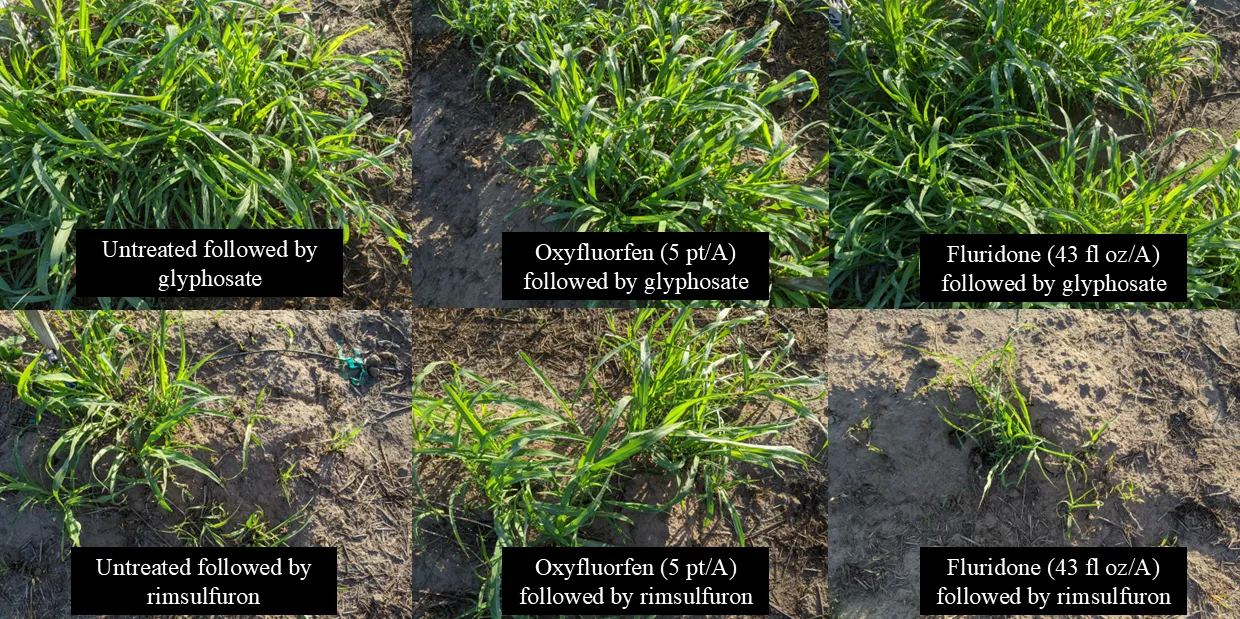
In all cases the rimsulfuron treatments were responsible for most of the weed control in my plots. Plots that received winter preemergent treatments were only marginally different from plots that were untreated in the winter, if followed by glyphosate in the spring. Only plots that received rimsulfuron in spring had any significant reduction in johnsongrass coverage or biomass. This suggests that the effects of rimsulfuron observed on johnsongrass populations were not primarily from soil residual effects on seedlings but that the perennial rhizomes themselves were affected. Winter treatments added additional johnsongrass control when combined with rimsulfuron only in two of my four trials, and this effect was seen later in the spring as seedlings began to germinate.
The primary takeaway from this research was that rimsulfuron applications in early March resulted in a 40-90% reduction in johnsongrass weed coverage and biomass that lasted past the end of the study, which was in early May. This was a reduction relative to the control treatment with glyphosate alone, suggesting that post-emergent absorption of rimsulfuron is likely not the primary mechanism of control, but rather activity in the soil. Rates of 4 oz/A were much more effective than 2 oz/A and the addition of glyphosate to the tank mix seemed to slightly increase efficacy.
Further reading on my research:
Progressive Crop Consultant: click here
Sac Valley Orchards: click here
Weed control during pollinator habitat establishment.
Introduction:
Pollinator insects are essential to produce many economically and nutritionally important crops grown in the western USA. These crops include blueberries, almonds, sunflowers, cucurbits, and many others. Almond pollination in California plays a vital role in the apiary industry, driving beekeepers to haul huge numbers of bee colonies to California for the few weeks in late winter when almonds bloom. Bees are selective of the pollen and nectar they forage, and diverse floral resources can allow bees to forage according to their nutritional needs (Leponiemi et al. 2023). Planting pollinator habitat in natural areas, gardens, and agricultural land is one method of supporting bee health. Irrigated agricultural land in the western USA can be an excellent resource for bees during the dry summer when flowers are rarer. However, the resident weeds in these settings are often not of high nutritional quality for hungry pollinators. To make matters worse, pollinator habitat in agricultural fields can be choked out by competition from weeds. Our control plots from these studies (Figure 1) demonstrate that point effectively.
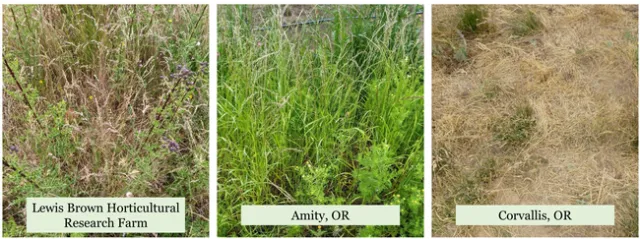
Figure 1: Control plots at all three experimental sites were extremely weedy. This sometimes meant that none of the planted species could grow, as seen in the pictures above.
Objective:
The studies described here attempt to use herbicides to improve the chances for success in pollinator habitat establishment.
Methods:
Three locations in Oregon's Willamette Valley were selected for studies. Two were hazelnut orchards watered with drip irrigation, and one was a field plot set up for sprinkler irrigation. Each location received different soil preparation. The first orchard location (Corvallis) was not tilled, and soil compaction issues were present. The second orchard location (Amity) was power-harrowed, so the top two inches of soil were loosened. The third location (Lewis-Brown Research Farm) was plowed and disked.
All three locations were seeded in the fall with a set of flowering species with potential for pollinator habitat (Table 1).
|
Table 1: Species and seeding rates used for pollinator habitat establishment in Oregon's Willamette Valley. |
||
|
Common Name |
Scientific name |
Lb/Acre |
|
Hairy vetch |
Vicia villosa |
60 |
|
Lacy Phacelia |
Phacelia tanacetifolia |
12 |
|
California poppy |
Eschscholzia californica |
8 |
|
Farewell to spring |
Clarkia amoena |
2 |
|
Globe Gilia |
Gilia capitata |
2 |
|
Sweet alyssum |
Lubularia maritima |
2 |
These species were planted in rows, and herbicide treatments were applied over the top perpendicular to planting rows (Table 2). Four herbicides were applied post-emergence, and the rest were applied one day after planting (pre-emergence). Glyphosate treatments were only included in the orchard trials. Experimental plots were set up as a randomized complete block design with four replicates, and each species was treated as a separate experiment. A crop oil concentrate at 1% v/v was included for Motiff (mesotrione) and Basagran (bentazon), while a nonionic surfactant at 0.25% was included for Matrix (rimsulfuron) and Quinstar 4L (quinclorac). All post-emergent treatments (and glyphosate) included ammonium sulfate (AMsol 1% v/v).
|
Table 2: Trade name, active ingredient, and rate of herbicides applied to pollinator habitat species. Pre-emergent herbicides were applied at planting, and post-emergent herbicides were applied 30 days after crop emergence. |
||
|
Trade name |
Active Ingredient |
Rate (product/A) |
|
Pre-emergent treatments |
||
|
Cornerstone Plus |
Glyphosate |
3 qt |
|
Alion |
Indaziflam |
4 fl oz |
|
Trellis SC |
Isoxaben |
21 fl oz |
|
Devrinol 2XT |
Napropamide |
8 qt |
|
Chateau SW |
Flumioxazin |
6 oz |
|
Prowl H2O |
Pendimethalin |
6.3 pt |
|
Princep |
Simazine |
4 qt |
|
Motiff |
Mesotrione |
6 fl oz |
|
Post-emergent treatments |
||
|
Motiff |
Mesotrione |
6 fl oz |
|
Matrix |
Rimsulfuron |
4 oz |
|
Quinstar |
Quinclorac |
12.6 fl oz |
|
Basagran |
Bentazon |
2 pt |
In Amity, competition from perennial grasses resulted in poor stand establishment. A grass-selective herbicide (clethodim) was used, and the site was reseeded six months after the initial planting when soil conditions were appropriate.
Results and discussion:
Site differences.
Drastic differences were seen between sites. Table 3 shows how crop coverage differed between the three sites for each species.
Coverage at the Corvallis site was deficient for all species except hairy vetch.
Several species did very well at the Amity location. Phacelia in the glyphosate plots was exceptionally well established due to glyphosate's good control of perennial grasses that were not killed by the power harrow.
Lewis-Brown (LB) plots had the best crop establishment initially. However, this location had intense pressure from perennial weeds, so the initial crop establishment did not translate to superior pollinator habitat. The plots at LB where Alion was applied produced a good stand of Canada thistle (Cirsium arvense) by the end of the trial, which the bees loved.
|
Table 3: Crop Coverage for each species at each location is shown here. The values reported are from the treated plots with the highest coverage. |
|||||||
|
% Crop coverage (Best treatment) |
Site |
Vetch |
Phacelia |
Poppy |
Gilia |
Clarkia |
Lobularia |
|
Plowed and Disked |
Lewis-Brown Research Farm (LB) |
100 |
100 |
75 |
84 |
97 |
98 |
|
Power harrow |
Amity |
55 |
81 |
47 |
47 |
34 |
47 |
|
No tillage |
Corvallis |
89 |
11 |
28 |
0 |
15 |
0 |
Pre-emergent treatments
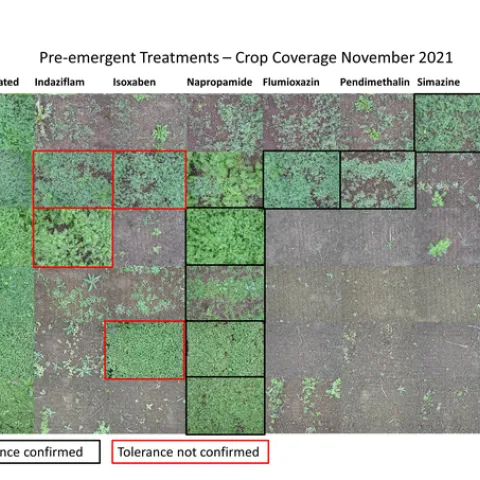
Pre-emergent herbicides often had inconsistent pollinator species safety; however, several combinations seemed safe. Napropamide was safe for Phacelia, Gilia, Clarkia, and Lobularia, while flumioxazin and pendimethalin were safe for poppy (Table 5). All five species only had adequate crop establishment at two of the three locations. Hairy vetch establishment was improved by simazine applications at all three locations, but crop coverage was not significantly different from the untreated control for this species (Table 5). Figure 2 shows the treatment by species combinations that were sometimes safe versus the combinations that were consistently safe for the planted species.
At the two orchard sites, glyphosate treatments were the best for Gilia, Phacelia, and poppy establishment (Table 5).
All three trials were conducted on fine soils with organic matter content ranging from 2-7% (USDA-NCSS soil survey). The safety of pre-emergent herbicides for pollinator species establishment may vary depending on soil characteristics.
Post-emergent treatments
Post-emergent (POST) applications were challenging to evaluate for safety. Weed control efficacy was inadequate, and so often, crop establishment was not good enough to confidently assess crop injury.
One exception was hairy vetch. This species exhibited good tolerance to a post-emergent application of Basagran, a result seen at all three locations. The results from two trials suggest that Clarkia tolerated POST applications of Quinstar. Not enough data were collected to conclude the other four species. See Table 4 for crop coverage data.
Conclusions
Site preparation was an essential consideration in our study. Soil compaction and perennial weed pressure must be addressed to have a successful pollinator habitat planting. It was also clear that pre-emergent herbicides can improve habitat establishment, but safety must be adequately established. This is especially true of different soil types and environments. In California's Central Valley, pendimethalin has been seen to occasionally cause injury in poppy plantings, which is in contrast with this study.
|
Table 4: Spring crop coverage (%) from plots treated with post-emergent herbicides one month after planting, which happened the prior October. Missing data from Phacelia and Lobularia at LB is due to crop loss from frost injury. |
|||||||
|
Crop coverage (%) |
|||||||
|
Corvallis |
Amity |
LB |
Corvallis |
Amity |
LB |
||
|
Hairy Vetch |
Gilia |
||||||
|
Untreated |
29 |
28 |
98 b |
Untreated |
0 |
8 |
54 b |
|
Mesotrione |
21 |
3 a |
0 a |
Mesotrione |
0 |
0 |
0 a |
|
Rimsulfuron |
18 |
1 a |
0 a |
Rimsulfuron |
0 |
4 |
78 b |
|
Quinclorac |
34 |
0 a |
28 a |
Quinclorac |
0 |
0 |
6 a |
|
Bentazon |
50 |
26 b |
94 b |
Bentazon |
0 |
7 |
47 b |
|
Phacelia |
Clarkia |
||||||
|
Untreated |
0 |
53 ab |
Untreated |
3 a |
0 |
83 b |
|
|
Mesotrione |
0 |
42 ab |
Mesotrione |
0 a |
0 |
34 b |
|
|
Rimsulfuron |
5 |
17 a |
Rimsulfuron |
4 ab |
0 |
55 b |
|
|
Quinclorac |
5 |
64 b |
Quinclorac |
15 b |
0 |
77 b |
|
|
Bentazon |
2 |
48 ab |
Bentazon |
6 ab |
0 |
0 a |
|
|
Poppy |
Lobularia |
||||||
|
Untreated |
2 |
11 |
2 |
Untreated |
0 |
0 |
|
|
Mesotrione |
3 |
11 |
0 |
Mesotrione |
0 |
0 |
|
|
Rimsulfuron |
6 |
0 |
0 |
Rimsulfuron |
0 |
0 |
|
|
Quinclorac |
2 |
5 |
3 |
Quinclorac |
0 |
0 |
|
|
Bentazon |
2 |
9 |
0 |
Bentazon |
0 |
0 |
|
|
Table 5: Spring crop coverage for pre-emergent herbicide treatments applied just after planting, which happened the prior October. Phacelia and Lobularia experienced winter kill at the LB location, so reported data is coverage from December for that location. |
||||||||
|
Crop coverage (%) |
||||||||
|
Corvallis |
Amity |
LB |
Corvallis |
Amity | LB | |||
|
Hairy Vetch |
Gilia |
|||||||
|
Nontreated |
29 |
28 ad |
98 b |
Nontreated |
0 |
8 a |
54 c |
|
|
Glyphosate |
23 |
46 bd |
Glyphosate |
0 |
47 b |
|||
|
Indaziflam |
6 |
3 d |
79 b |
Indaziflam |
0 |
3 a |
36 bc |
|
|
Isoxaben |
11 |
17 ab |
83 b |
Isoxaben |
0 |
5 a |
31 ac |
|
|
Napropamide |
8 |
19 ab |
91 b |
Napropamide |
0 |
38 b |
56 c |
|
|
Flumioxazin |
5 |
36 bd |
90 b |
Flumioxazin |
0 |
18 a |
2 c |
|
|
Pendimethalin |
6 |
38 bd |
98 b |
Pendimethalin |
0 |
0 a |
13 ab |
|
|
Simazine |
34 |
55 d |
98 b |
Simazine |
0 |
44 b |
6 ab |
|
|
Mesotrione |
6 |
25 abc |
0 a |
Mesotrione |
0 |
3 a |
8 ab |
|
|
Phacelia |
Clarkia |
|||||||
|
Nontreated |
0 a |
53 bc |
96 b |
Nontreated |
3 |
0 a |
83 b |
|
|
Glyphosate |
11 b |
92 c |
Glyphosate |
5 |
34 b |
|||
|
Indaziflam |
0 a |
13 ab |
90 b |
Indaziflam |
0 |
0 a |
74 b |
|
|
Isoxaben |
0 a |
0 a |
82 b |
Isoxaben |
0 |
8 a |
88 b |
|
|
Napropamide |
2 a |
81 c |
98 b |
Napropamide |
0 |
25 b |
86 b |
|
|
Flumioxazin |
0 a |
30 ab |
57 ab |
Flumioxazin |
0 |
5 a |
20 a |
|
|
Pendimethalin |
0 a |
0 a |
15 a |
Pendimethalin |
0 |
2 a |
67 b |
|
|
Simazine |
0 a |
75 c |
56 ab |
Simazine |
0 |
30 b |
0 a |
|
|
Mesotrione |
2 a |
54 bc |
99 b |
Mesotrione |
0 | 0 a | 25 a | |
|
Poppy |
Lobularia |
|||||||
|
Nontreated |
2 a |
11 |
2 a |
Nontreated |
0 |
0 a |
70 c |
|
|
Glyphosate |
30 b |
42 |
Glyphosate |
0 |
21 ab |
|||
|
Indaziflam |
2 a |
8 |
8 a |
Indaziflam |
0 |
0 a |
16 ab |
|
|
Isoxaben |
2 a |
3 |
69 b |
Isoxaben |
0 |
0 a |
0 a |
|
|
Napropamide |
6 a |
14 |
0 a |
Napropamide |
0 |
47 c |
98 d |
|
|
Flumioxazin |
2 a |
31 |
63 bc |
Flumioxazin |
0 |
15 a |
34 b |
|
|
Pendimethalin |
2 a |
40 |
64 b |
Pendimethalin |
0 |
0 a |
0 a |
|
|
Simazine |
0 a |
46 |
28 ac |
Simazine |
0 |
44 bc |
5 a |
|
|
Mesotrione |
0 a |
7 |
8 a |
Mesotrione |
0 | 3 a | 3 a | |

Figure 2: Crop coverage pictures from two months after planting the Lewis-Brown research farm show that the planted species (rows) tolerated several pre-emergent herbicides (columns). A black outline surrounds successful combinations seen in at least one of the other two trials. Combinations that were never seen to be successful again are surrounded by a red outline.
References:
Leponiemi, M., Freitak, D., Moreno-Torres, M. et al. (2023). Honeybees' foraging choices for nectar and pollen revealed by DNA metabarcoding. Sci Rep 13, 14753. https://doi.org/10.1038/s41598-023-42102-4
Soil Survey Staff, Natural Resources Conservation Service, United States Department of Agriculture. Web Soil Survey. Available online at the following link: http://websoilsurvey.sc.egov.usda.gov/.
Protecting hazelnut trunks from herbicide injury
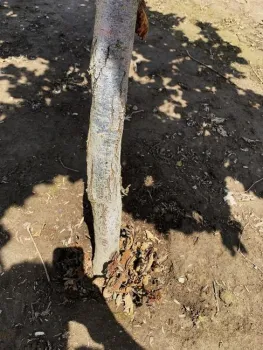
Sucker control practices place very young orchards at risk of herbicide injury, because trees from zero to three years old are more susceptible to herbicide damage (Figure 1). Trunk guards and latex paint are used to shield hazelnut trunks from sunburn, but it has remained unclear whether latex paint protects young trees from herbicide injury. Carefully weighing the pros and cons of each option must be considered before adopting either of these practices.
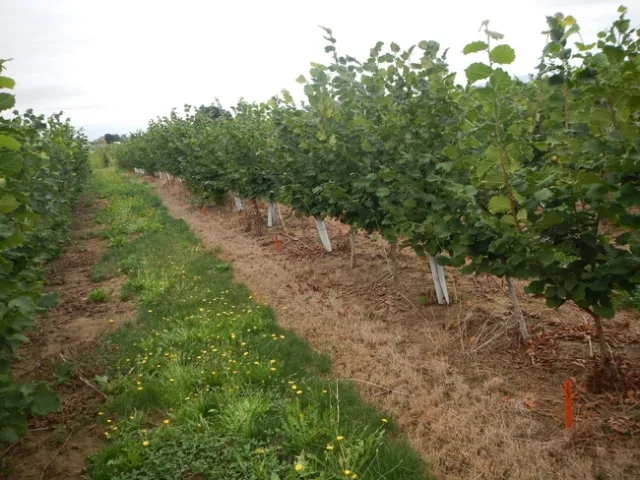
Many postemergence herbicides are used for sucker control in hazelnuts. We studied the effects of glufosinate (Cheetah, Forfeit 280, Reckon 280 SL, Rely 280, and others) on layer-propagated ‘Jefferson' hazelnuts 0, 1, and 2 years after planting to understand how to better protect young trees from herbicide injury. While the activity of other herbicides can also induce trunk damage, we focused on glufosinate alone to determine its potential for young hazelnut injury from this commonly used herbicide. Tree trunks were unshielded, painted, or shielded by an opaque plastic trunk guard (Figure 2). Trunks were painted once or had trunk guards installed at planting. In addition, we studied the effect of herbicide rate and the number of applications. We applied glufosinate at the label (56 fl oz/acre, 1x), at double the legal label rate (2x), or at quadruple the legal label rate (4x). Each rate was applied one, two, or three times per season. All treatments were repeated the following year. Trees were cut down to evaluate any damage to the tree cambium in the third year. We included off-label rates (2x, 4x) to compare the effect of trunk protection.
In our trials, the 1x label rate stunted the growth of newly planted trees (<1 year-old). We expected this negative response as the label warns against treating plants less than one year old with glufosinate. As the trees matured, they tolerated higher application rates; one-year-old trees suffered trunk injury only at the 4x legal label rate. Trunk injury as applications increased from one to three times per year only occurred at applications above the label rate, suggesting that herbicide rate is more important than the number of applications. At any age, no trunk damage was observed at the label rate. This finding underscores the importance of proper sprayer calibration to deliver the correct herbicide rate and reduce trunk damage.
The bark confers protection.
An additional treatment was included where the bark was scraped prior to herbicide application at the 1x rate. The newly planted trees (<1-year old) all died when subjected to this treatment and injury was detected consistently at older ages as well. This was the only instance when the injury was detected when following the herbicide label, suggesting that bark integrity is essential to the prevention of herbicide injury.
Latex paint.
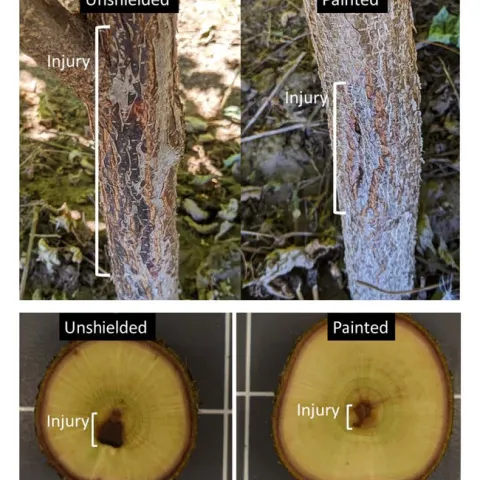
Latex paint effectively protects trees of any age. Paint reduced stunting in newly planted trees compared to unshielded trees at the 1x and 2x legal label rates. Painted trees survived the 4x legal label rates (85%) more than unshielded trees (41%). Across all ages painted trees were 12% greater in trunk cross-sectional area than unshielded trees. Latex paint halved the injury of 1- and 2-year-old trees, when measuring external and internal injury (Figure 3). Tree injuries were photographed one year after the final herbicide exposure.
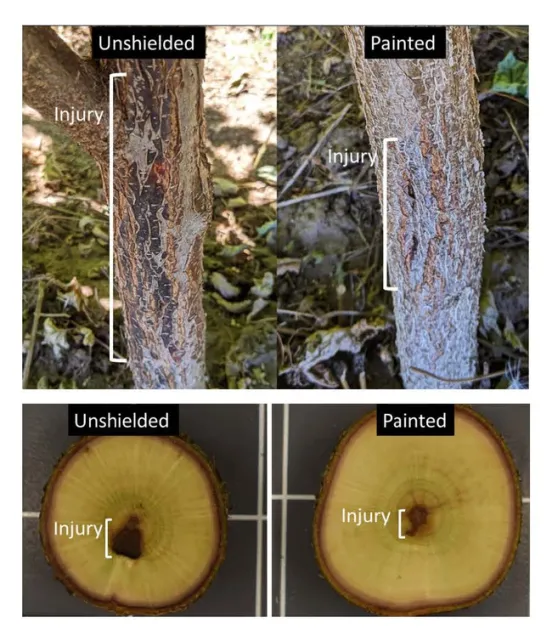
A tree can recover from trunk injury and produce for many years. Still, injury affecting trunk heartwood and pith can leave a tree structurally unsound and may reduce its longevity.
Trunk guards.
On average, trees with painted trunks were 12% larger than trees with unshielded trunks, but trees with trunk guards surpassed the growth of painted trees by a further 10%. The trunk guard prevented any herbicide injury to trees.
In our study, hazelnut trees grew well in trunk guards, although concerns have been raised about the quality of the wood and bark following trunk guard use. Wood density was reduced in our trunk guard treatment compared to the unshielded and painted trees. We cannot predict whether reduced wood density will recover as the trees mature. In general, greater wood density indicates stronger wood.
Removing trunk guards.
Bark grown under trunk guards may be more sensitive to sunburn and herbicide injury when the guard is eventually removed, compared to painted or unshielded trees. In the fourth year of this study, we removed the trunk guards. Herbicide applications after the trunk guard removal doubled the injured surface area compared to trees that were grown with unshielded trees (Figure 4). The depth of these injuries was not doubled, however, likely due to the increased size of the trees. Herbicide injury following the removal of trunk guards only occurred at high rates (2x or 4x legal label rates).
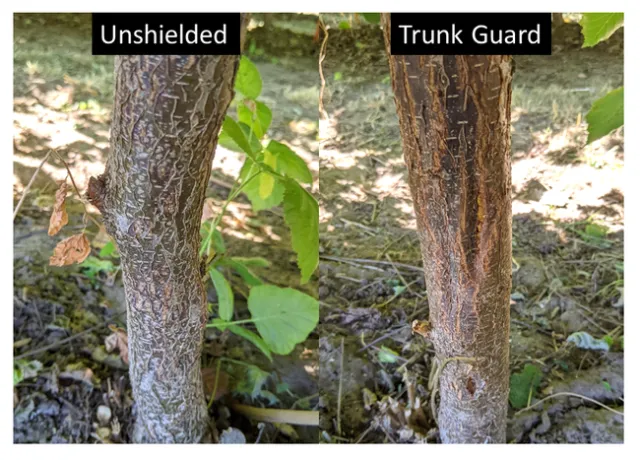
Our results clarify the role of trunk protection in protecting young hazelnut trees from herbicide injury. Following label recommendations and proper sprayer calibration are important factors in reducing herbicide injury to tree trunks. In this study, 1- and 2-year-old trees were injured only when off-label rates were applied to them. Older trees are more tolerant of herbicide as a sucker control strategy.
Trunk guards and latex paint effectively protected young hazelnut trees from herbicide injury and increased tree trunk growth. The reduced wood density and increased bark sensitivity resulting from trunk guard use may reduce their use in young hazelnut plantings, but their benefits cannot be ignored. Latex paint is a promising alternative to trunk guards and effectively reduces herbicide injury and encourages growth in all cases observed.
DISCLAIMER: The information contained in this article is for experimental purposes only. You must not rely upon the material as a basis for making a pesticide recommendation. Follow the label instructions!
We thank the Oregon Hazelnut Commission, Christensen Farms, Birkemeir Nursery, and OO Agriculture for collaborating and providing financial support to this project.
Ryan Hill and Marcelo Moretti are with the Department of Horticulture at Oregon State University.
Original source: Weeders of the West blog :: Jan. 26, 2023