
2017 Impacts: Expanded Food and Nutrition Education Program in the Butte Cluster
EFNEP HISTORY & FUNDING
The Expanded Food and Nutrition Education Program (EFNEP) began as an Alabama pilot project in response to the United States Department of Agriculture (USDA) poverty and hunger concerns. Under the Smith-Lever Act, Congress authorized $30 million in funding in 1969, EFNEP's inaugural year. Initially, EFNEP was delivered by 1862 land-grant universities. This was expanded to 1890 land-grant universities in 2006. Today, the University of California is one of the 76 institutions delivering this $67.9 million program, receiving the 2nd highest amount of funding at $3.6 million.
Since 1969, EFNEP has successfully addressed critical societal concerns by employing paraprofessional staff and influencing nutrition and physical activity behaviors of low-income families, particularly those with young children. Through a community-based, relationship-driven, hands-on educational approach, EFNEP has directly impacted economic, obesity, and food insecurity challenges that hinder the health and well-being of this nation. EFNEP uses a holistic nutrition educational approach. When the program is implemented successfully, participation should result in individuals and families experiencing improvements in four core areas; 1) Diet quality and physical activity, 2) Food resource management, 3) Food safety, and 4) Food security.
In 2017, EFNEP in Butte, Colusa, Glenn, Sutter, and Yuba Counties reached 364 families with 337 individuals graduating from the program. This was a 15.4% increase in the number individuals graduating from the program from 2016.
337 of the 364 individuals graduated from the program in 2017 which yielded a 93% graduation rate

93% of participantsimproved their food resource management practices, exceeding the national average of 84%
96% of participantsimproved their nutrition practices, exceeding the national average of 89%

89% of participantsimproved their food safety practices or knowledge, exceeding the national average of 49%

68% of participants made positive changes in their physical activity practices or knowledge, exceeding the national average of 40%

EFNEP FUNDING IN Butte County
- In 2018, EFNEP will bring $164,121 into the county to support EFNEP programming in Butte, Colusa, Glenn, Sutter, and Yuba Counties
FUN FACTS ON CALIFORNIA SAVINGS
- Every $1 spent on CA EFNEP saves $8.34 in health care costs
- EFNEP graduates reported an average of $38.20 monthly food costs savings, which collectively saved California EFNEP families an estimated $2,916,340.80
EFNEP IN ACTION
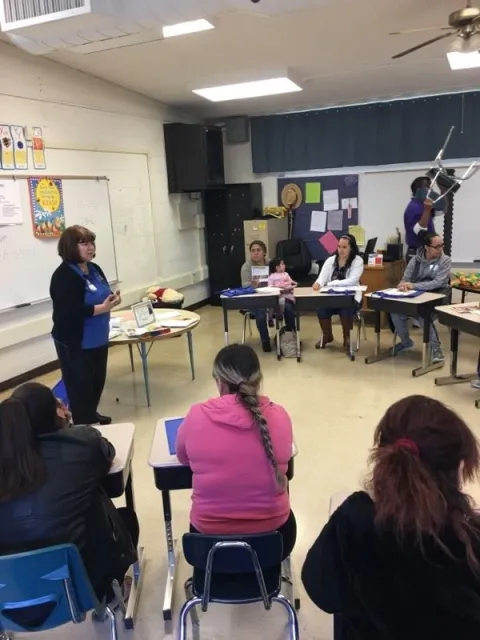
EFNEP Educator, Sonia Rodriguez leading a nutrition education class for parents at King Avenue Elementary in Yuba City, CA.
EFNEP PARTICIPANT TESTIMONIAL
“I try to cook healthier for me and my family with more fruits and vegetables, meats low in fat, and prepare water with fresh fruits and vegetables instead of soda.”
EFNEP IN ACTION

EFNEP Educator, Sonia Rodriguez leading a nutrition education class for parents at Cedar Lane Elementary in Olivehurst, CA.
EFNEP PARTICIPANT TESTIMONIAL
“Since the class I started to compare prices and I have bought healthier food like fruits and vegetables, eat less fast food and prep food with less salt, sugar and oils.”
EFNEP IN ACTION

EFNEP Graduates from the Migrant Farm Housing facility in Williams, CA
EFNEP PARTICIPANT TESTIMONIAL
“I always make a list of what I am going to buy and compare prices in the store, I teach my kids the importance of eating healthy and exercising.”