
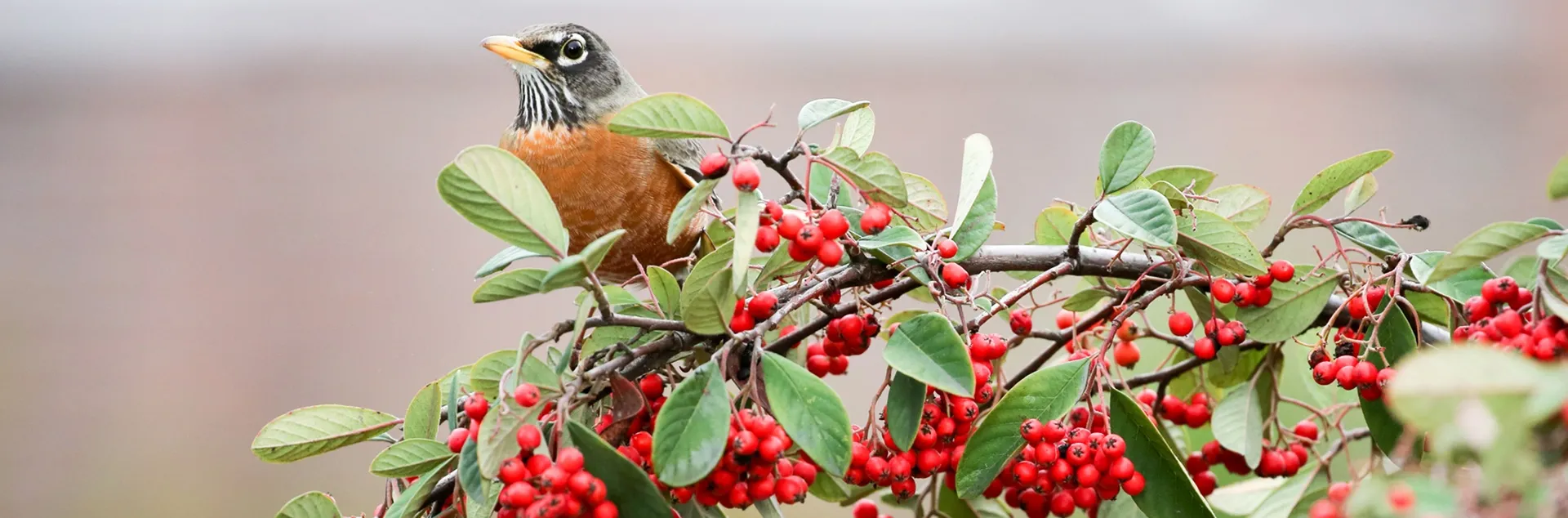

A handsome and distinctive shrub, Heteromeles arbutifolia seems quintessentially Californian. As legend goes, its distinctive holly-like red berries visible in hillside chaparral in Los Angeles gave rise to the name for Hollywood.
A Stalwart California Native
Common names are toyon, from a Native American term, and the even more descriptive Christmas berry and California holly for the bright red, berry-like fruits that ripen in December.
- Toyon is considered a 4-season species, valuable in the landscape for year-round good looks as an anchor plant. It commands a dynamic presence when surrounded by ample space as a specimen feature.
- Mature size normally reaches 8-12 ft. tall by 4-6 ft. wide, which makes toyon most suited for large gardens. In some situations, it may reach as large as 15-20 ft. tall.
- When regularly pruned from a young age, however, it can be accommodated in a typical home garden.
- With careful attention in removing lower branches, it may also be trained into a multi-stemmed small tree. Pruning, however, stimulates shoots to appear at the base, resulting in a return to shrub form if pruning does not continue.
Garden Placement
Toyon tolerates most soil types as long as the planting area drains easily in winter.
- Sites in full sun initiate prolific blossoming that attracts bees in summer and subsequent berry production in winter, an important food source for numerous birds and other wildlife.
- Overhead dappled shade is tolerated in gardens as it is natively in mixed woodlands.
- Growth is a bit leggier in heavy shade as stems reach for sunlight and flowering and berries are reduced.
- A moderately slow grower in the first years after planting, toyon may require some protection from browsing deer.
- In maturity deer are less attracted to the leathery leaves but may nibble on branch tips.
- By removing lower branchlets, exposing lower main stems, and thereby raising foliage several feet above ground, deer damage is negligible.
Toyon Appearance and Garden Care
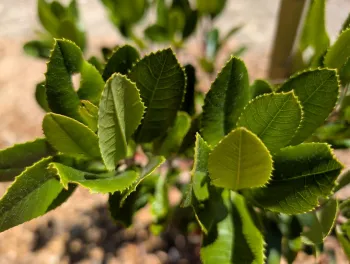
Toyon bears rosettes of glossy, dark green leaves finely serrated along margins; foliage is carried densely year-round.
- Summer bloom brings abundant flat-topped clusters of small, creamy white flowers.
- Berry development begins with bountiful pale green berries before turning bright red in early winter.
- ‘Davis Gold’ is an unusual selection whose berries are golden yellow.
- Fruits persist for several weeks until devoured by birds and other wildlife, often fermenting before all are eaten.
- In unripe fruits, berry flesh contains toxic cyanide that later concentrates in seeds when fruits are ripe. Unripe fruits and all seeds are poisonous and should not be consumed.
- Toyon is naturally drought tolerant during the dry season when it does not want much summer water after it’s established.
- It tolerates some supplemental moisture in hot summers, especially in hot inland areas, and actually thrives most beautifully when lightly irrigated.
- Toyon is the only species in its genus, closely related to the Asian Photinia. It is a member of Rosaceae family, and like pyracantha, apples, and pears, can be susceptible to
Updated October 2026