
Supply in the Sky: Rainwater Harvesting for the Win
If you had a desire to plant a garden that not only grows veggies in raised beds, but also nurtures 5,000 seedlings for a plant sale and features a pollinator garden to help those veggies thrive, would you choose a site that has no piped-in water and no electricity? It’s improbable that you would even give it a second thought.
This is the story of how the Water Conservation Garden in the El Cerrito hills went from improbable to surprising to astonishing in the span of just a couple of years.
In March of 2022, UC Master Gardener volunteers Liv Imset and Liz Rottger proposed a plan to the program's leadership teams to use such an improbable site for a new demonstration garden. Their vision was to devise, implement, and test strategies for capturing and storing rainwater. These strategies needed to be simple enough for home gardeners to implement in their own gardens and also support all of the planned plantings for the garden.
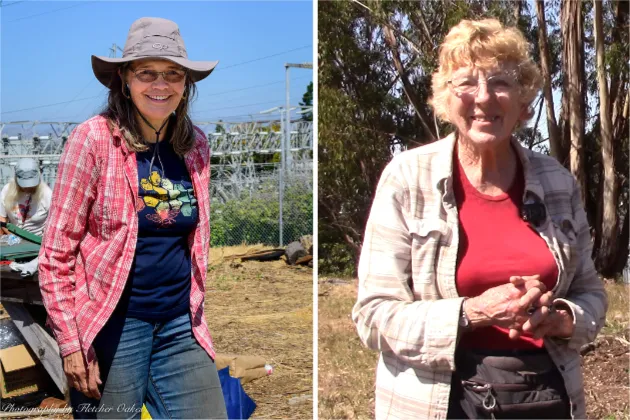
California was in a deep drought at the time. El Cerrito had received only 8 inches of rain that winter and 10 inches the year before. Note that the average rainfall for El Cerrito is 22 inches a year. We were in a state of drought emergency. Water restrictions were plentiful, and we were anticipating another scant water year for the coming winter. It was a bold move to take over this site of an underutilized community garden and demonstrate to the community how we could all use techniques and solutions that conserve and preserve two of our most precious resources: water and electricity.
Building Sub-Irrigated Planters
For the rest of that year, the garden team built three 8’ x 4’ raised veggie beds with water reservoirs beneath the soil. Two of the beds used a newly pioneered method of using reclaimed PET plastic water bottles as a substitute for gravel for the water storage reservoirs, thus “Plavel.” Norman Hantzsche and Matt Woll of Questa Engineering Corporation in Richmond, CA, had developed this heretofore untapped opportunity to recover and convert single-use plastics (AKA waste products) into viable and useful building materials. And our very own Liv Imset had worked at Questa Engineering with Norman and Matt. The three of them worked hard along with the garden team on implementing the first two sub-irrigated planters (SIPs). These first two beds were appropriately named Alpha and Beta.
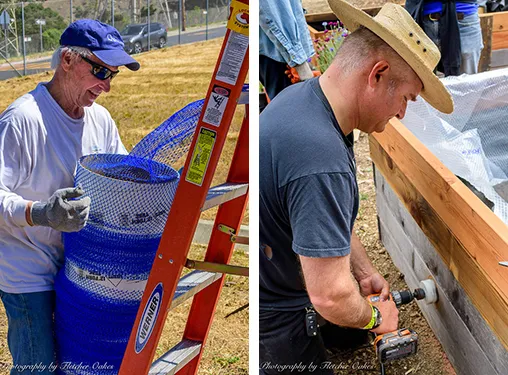
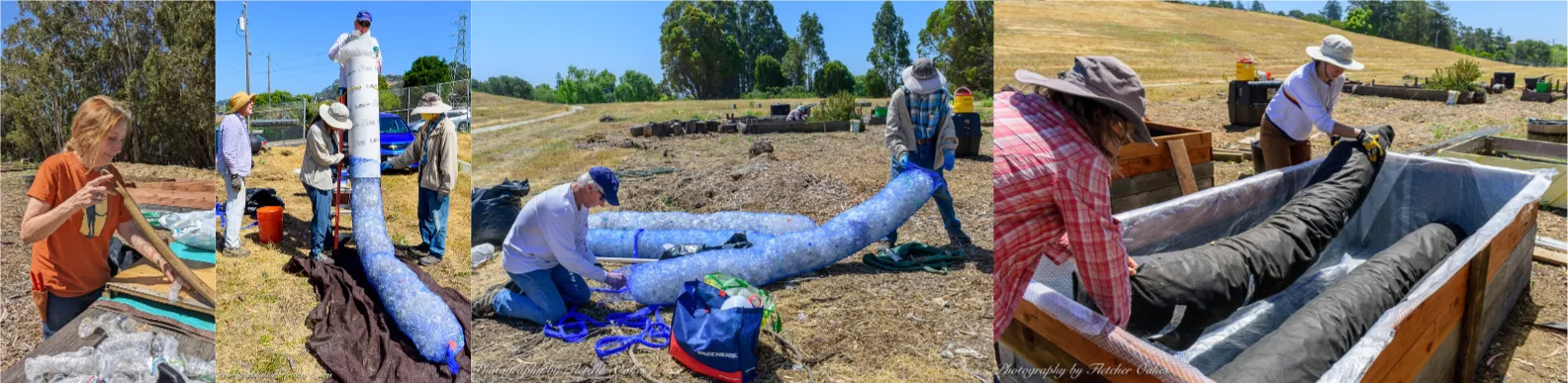
The extraordinary thing about these two 8-foot-by-4-foot beds is that each has a built-in reservoir that holds 239 gallons of water. The beds fill up with rainwater, then act as self-watering systems during the dry season. Here’s the math for calculating reservoir capacity, in case you’re curious.
8 ft. x 4 ft. x 1 ft. x 7.48 gal. per cubic foot = 239-gallon reservoir
Dr. Pepper Bed
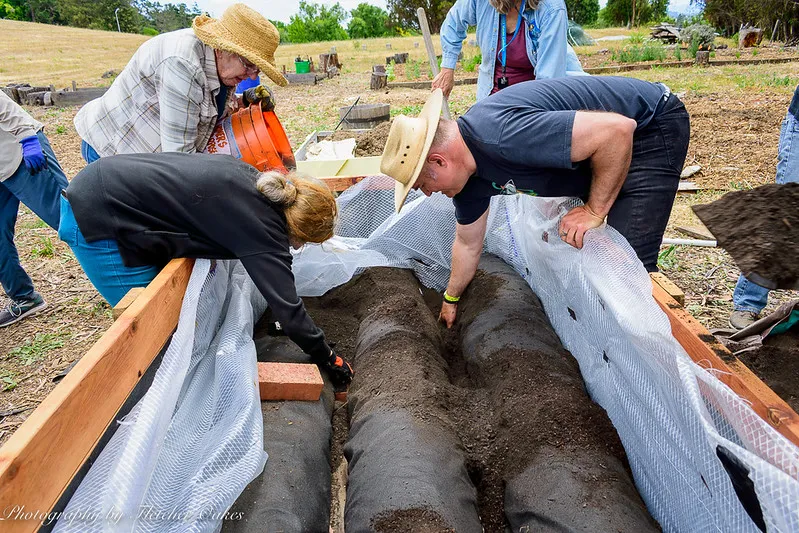
A third raised bed, dubbed Dr. Pepper, was built that year as well. It was named after the “Albopepper” blog and YouTube channel, where a fellow named Al Gracian explains in great detail how to construct various types of sub-irrigated planters. His technique for using corrugated drainpipe was used for this bed. https://albopepper.com/SIP-raised-bed.php
This bed was a bit different in its construction. Having built two Plavel beds, the team felt these were a bigger project than many DIYers would be willing to tackle. So, instead of using recycled PET plastic water bottles as the structure for the reservoir of the Dr. Pepper bed, a 4-inch black corrugated drainpipe, normally used for drainage, was utilized for the reservoir. This bed has one-third the water-storage capacity of the Plavel beds, since the drainpipes only stand 4 inches tall, as opposed to one foot tall. Here’s the math for calculating the storage capacity for this bed.
8 ft. x 4 ft. x 0.33 ft. x 7.48 gal. per cubic foot = 79-gallon reservoir
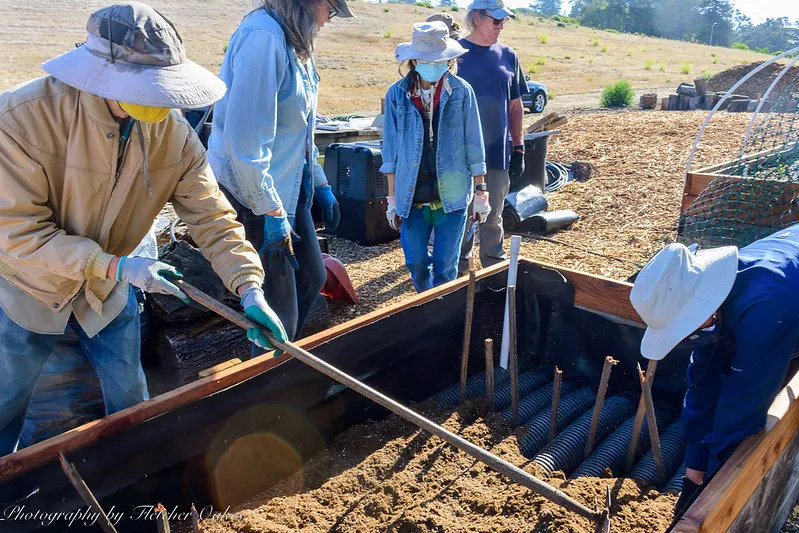
One more 4’ x 8’ bed was built that first year and was named the “Control Bed.” This bed has no rainwater harvesting method built into it. It’s used by the garden team to gauge how much water the 4’ x 8’ veggie beds would otherwise need if they didn’t have self-watering systems installed.
Stock Tank SIPs
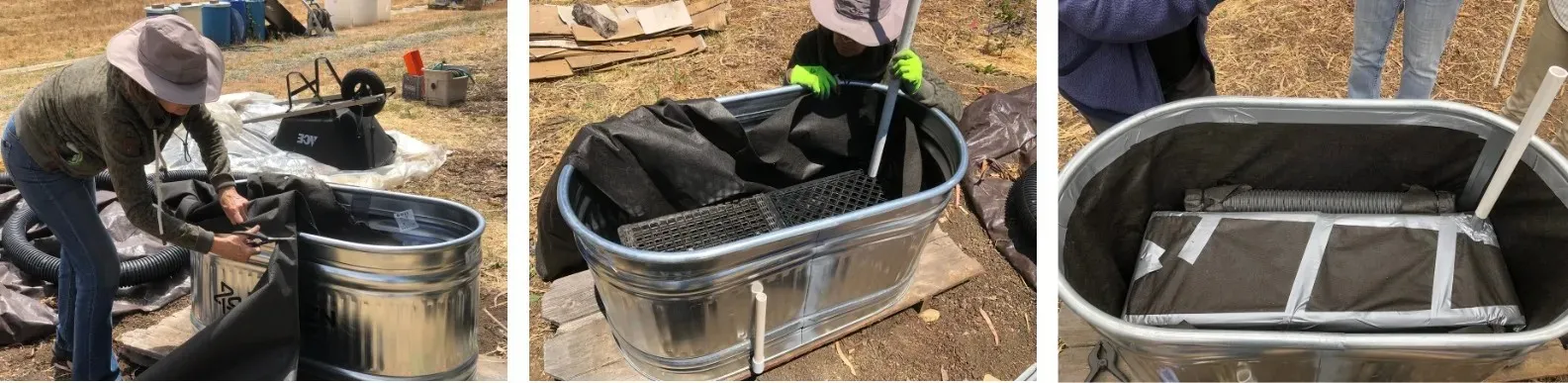
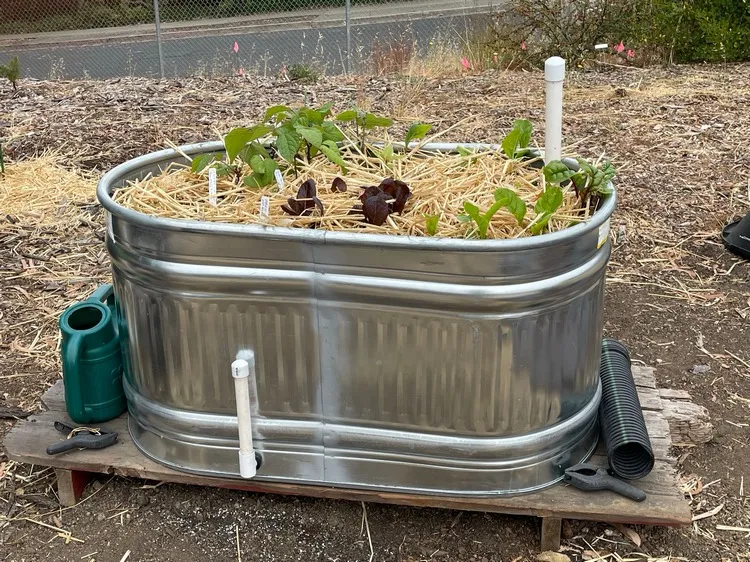
In May of this year, Liv Imset, who is the Master Gardener volunteer with an engineering background in SIPs and other drainage and water purification solutions, came up with the idea of converting stock tanks to SIPs. She planned to use commercial-grade plastic milk crates as the main reservoir. Tucking in several lengths of 3-inch drainage pipe around the sides of the crates would provide even more water-holding capacity. We promptly scheduled a public hands-on workshop where we built one on the site. This 100-gallon stock tank now has a subterranean water reservoir of 37 gallons.
Rainwater Harvesting Potential of the Site
Aside from the three raised veggie beds and the stock tank with the rainwater harvesting capacity, the site also has a 1,500-gallon cistern. A shed on the site empties rainwater off its 12' x 8' metal roof into six 55-gallon barrels. There are also eight more 55-gallon barrels near the beds.
The cistern and barrels have a total capacity of 2,270 gallons. The three raised beds and stock tank capture and store a total of 594 gallons. All told, the site collects and stores 2,864 gallons of water.
The large cistern is filled in a unique way: a concrete ditch runs along the bottom of the slope, channeling winter surface water from the hillside. That water is pumped uphill to the tanks using a solar-charged battery power station installed by Howdy Goudey. Thanks to this system, the cistern—holding 1,500 gallons—has been completely filled each winter for the past several years.
Measuring and Monitoring
Since the first plants were planted on this site, the garden team has kept meticulous water-use records. Every drop of water used on the site is measured and recorded. And the moisture levels in the soil of all the beds are noted, as well as the appearance quality of the plants. We're very proud that since January 2024, no supplemental water has been brought to the site. This garden subsists solely on the supply from the sky.
The Astonishing Part of this Story
Vegetables are high-water-use plants. They require a significant amount of water and need to be watched carefully and watered frequently. Using the water-use records for 2024, the following table shows how much water the garden team applied to the three sub-irrigated planters. Rainfall initially filled these beds’ reservoirs. The team didn’t need to add water to the reservoirs until August 10.
Bed in 2024 | Water Requirement - May 11 - Sept. 21 | Supplemental Water Added |
Alpha bed | 490 gallons | 40 gallons (8% of requirements) |
Beta bed | 490 gallons | 46 gallons (9% of requirements) |
Dr. Pepper bed | 490 gallons | 48 gallons (10% of requirements) |
Rainwater Harvesting Benefits on this Site
What makes this astonishing is the fact that at least 90% of the water needed for the vegetables in these beds was provided by rainfall - that free water that falls from the sky! Of the 490 gallons required during this dry period, the garden team only applied, at the most, an extra 48 gallons to each bed! Nature provided the rest. The ramifications of this are huge! These beds not only provide us a way to grow vegetables using 1/10 of the water needed, but they’re self-regulating as well. The plants have access to a constant supply of water. We only need to make sure there is water in the reservoirs. During this period in 2024, the rainwater in the reservoirs lasted three months before more water needed to be added.
This appears to be a wonderful solution to water supply issues that plague us on a regular basis in California. And the work done up front to provide the infrastructure for this massive water savings seems well worth it. Rainwater harvesting for the win!
Photos courtesy of Fletcher Oakes and Lori Palmquist