

Background of the Project
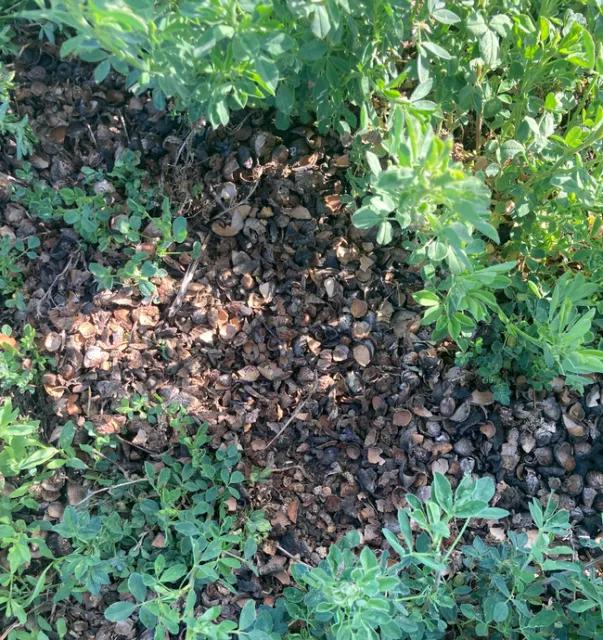
Recent regulations, incentive funding, and the state's goal of reducing organic matter into the waste stream has led to increased organic matter application to California Farmland. With increasing limitations on burning orchard by-products, some alfalfa growers have been applying almond shell mulch to their fields.
Almond shells are distinct from almond hulls, which are high in carbohydrates and fed widely to livestock. Unlike hulls (which are more similar to dried peaches), shells are woody and break down more slowly. Almond shells are high in carbon and low in nitrogen (N).
Link with Alfalfa
Almonds are grown throughout California's Central Valley, in areas where alfalfa is also grown. The application of almond shells to alfalfa is best suited for older, established stands and/or for Roundup Ready alfalfa. This is because almond shell application can interfere with pre-emergence herbicide applications. Concerns about N immobilization in the soil surface are reduced in the case of alfalfa due to N fixation by alfalfa and the deep rooting structure. There is a need to understand how almond shell application impacts alfalfa stand productivity including yield and weed pressure.
This study started in 2021, and is currently mid-stream. Below is a summary of preliminary information collected mid-project by UCCE Farm Advisors Sarah Light and Rachael Long.
Collection of Data
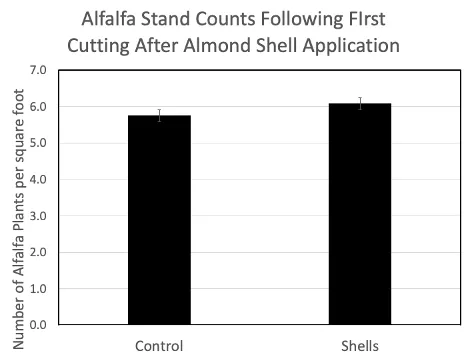
Almond Shells were applied in the Fall of 2021 to a three-year-old alfalfa stand at a rate of four to eight tons per acre with four replications. On April 8th, 2022 and October 17th, 2022, plots were hand-harvested prior to grower harvest. Two square meters were sampled from each plot in three locations per plot. Percent cover of weeds, alfalfa and bare soil were also collected on all harvest dates. Following first cutting, on April 30th, 2022, stand counts were collected to evaluate the potential impact of almond shell application on future stand performance. By spring 2022, almond shells were no longer visible.
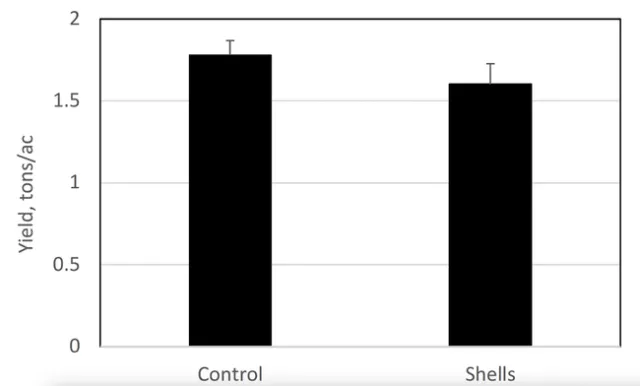
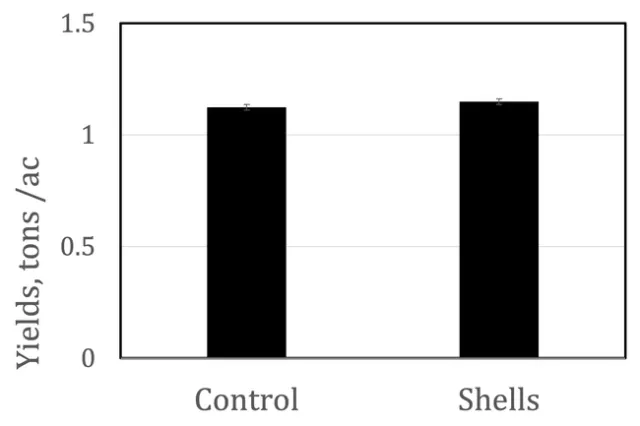
Data collected to date indicates that there was no difference in yield between plots that had almond shells and those that did not. Yield differences were not significant between treatments at either harvest date. Almond shell application to established stands does not appear to increase or reduce yields of established alfalfa stands.
Yield data from April 8th, 2022:
Yield data from October 17th, 2022:
Almond shell application did not affect the percent alfalfa, weeds or bare soil between treated and untreated plots either in the spring at first cutting or the following fall, a year after almond shell application. In the first year of the project, the application of almond shells did not affect the percent of alfalfa, weeds, or bare soil.
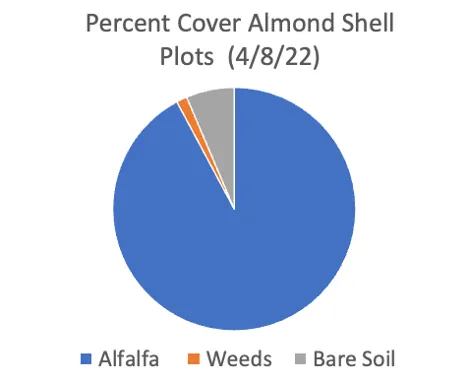
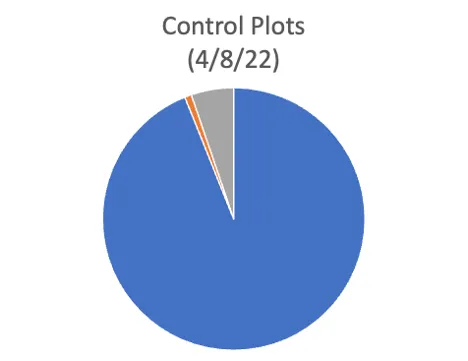
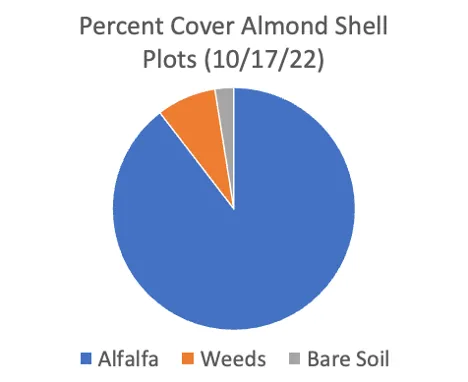
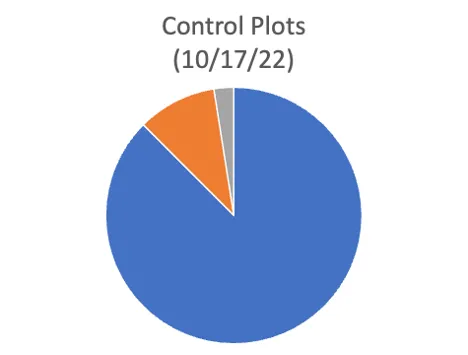
Alfalfa stands were consistent between treatments and not affected by almond shell applications. This data indicates that there isn't a negative impact to applying almond shells alfalfa fields.
Preliminary Conclusions
Almond shell mulch application to established alfalfa fields does not appear to negatively affect alfalfa stand productivity in the first year after application. Alfalfa fields may provide an opportunity for diverting almond shells from nearby orchards, improving organic matter recycling in the region.
This project will be continued for a second year. To try to measure differences between treatments, almond shells were applied on 11/19/22 at an increased rate of 12.5 tons/A to the same areas that had previously had almond shells applied. Yield measurements, percent cover measurements, and stand productivity measurements will be continued for the next year. In addition, the effect of almond shell application on soil nutrients and soil health will be quantified. Soil moisture measurements will also be collected.
Farmer Supported
Thank you to the California Alfalfa and Forage Research Foundation for funding this project, and to our farmer collaborator without whom this work would not be possible. Please contact Sarah Light, selight@ucanr.edu, or Rachael Long, rflong@ucanr.edu,for more information.