
This year has certainly put a damper on the joy and health benefits of gardening. One challenge after another has appeared in my usually productive garden.
Voles Move In
Earlier in the year, I noticed a mound of earth in one of the borders and assumed it was the result of ground squirrel activity. I set out various traps, but only caught rats.
Soon afterward, rows of holes about two inches across began appearing in the lawn. The holes were arranged in straight lines, spaced about one to two feet apart, and had no spoil heaps around them. I was intrigued by what the animal might be doing with all the excavated soil. Similar patterns appeared in several parts of the garden. Whatever was making these holes was either extremely industrious, or there were many of them.
Eventually, my husband spotted the culprit: a vole. One sunny day it emerged from a hole, stuffed its cheek pouches with dried grass, and disappeared underground again.
Voles are notoriously difficult to control. In my case, management is even more challenging because the lawn is irrigated with subsurface drip tubing. Digging risks damaging the system and creating costly repairs.
Then an unexpected ally appeared. A feral cat began showing great interest in one of the holes. As we watched, it pounced, caught the vole, and triumphantly carried it over the fence. Perhaps this cat will prove to be a better hunter than the long-tailed weasel that visited us last year.
Leaf Miners on Peach Trees
My latest challenge is a leaf miner infestation on an old, large peach tree that is otherwise healthy.
At first, I noticed white blotches on the leaves of a single branch, but I paid little attention because a bird’s nest is located just above that area. However, the damage soon spread. Closer inspection revealed that the leaves initially developed winding white trails that eventually merged into larger blotches. As the damage progressed, the leaves became riddled with holes, dried out, and died.
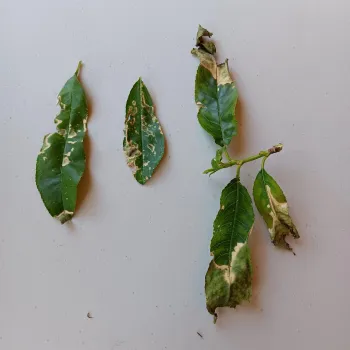
I have encountered leaf miners on various plants in the garden before, but never to this extent and never on a peach tree.
The recommended treatment is to remove affected leaves, since the larvae live between the leaf surfaces where insecticides cannot reach. I find this discouraging. After spending many hours thinning the fruit crop, it is difficult to face the prospect of thinning dozens of damaged leaves as well.
The Battle Against Cutworms
Earlier in the season, I also struggled with weeks of cutworm damage to young seedlings. Seemingly endless generations of these pests attacked newly planted crops.
My response included nightly flashlight patrols to locate and destroy the caterpillars, generous applications of diatomaceous earth around vulnerable plants, dusting foliage with Bacillus thuringiensis (Bt), and placing protective collars made from paper cups around seedlings.
Eventually, the plants produced enough new growth to withstand the attacks and have since grown well. However, this is normally the time when intermediate-day onions should be bulbing. Instead, many of my plants have developed thick necks, which suggests they may be preparing to flower rather than form good-sized bulbs.
Some Good News
Not everything in the garden has gone wrong!
The grapevine has experienced very little leafhopper damage so far. Despite being hit by a late frost, it has produced abundant new growth and many clusters of grapes.
The pollinator garden has been especially rewarding this year, with a spectacular display of flowers and the constant hum of busy pollinating insects. In spite of the pest challenges, it remains a reminder of the resilience and beauty of the garden.