
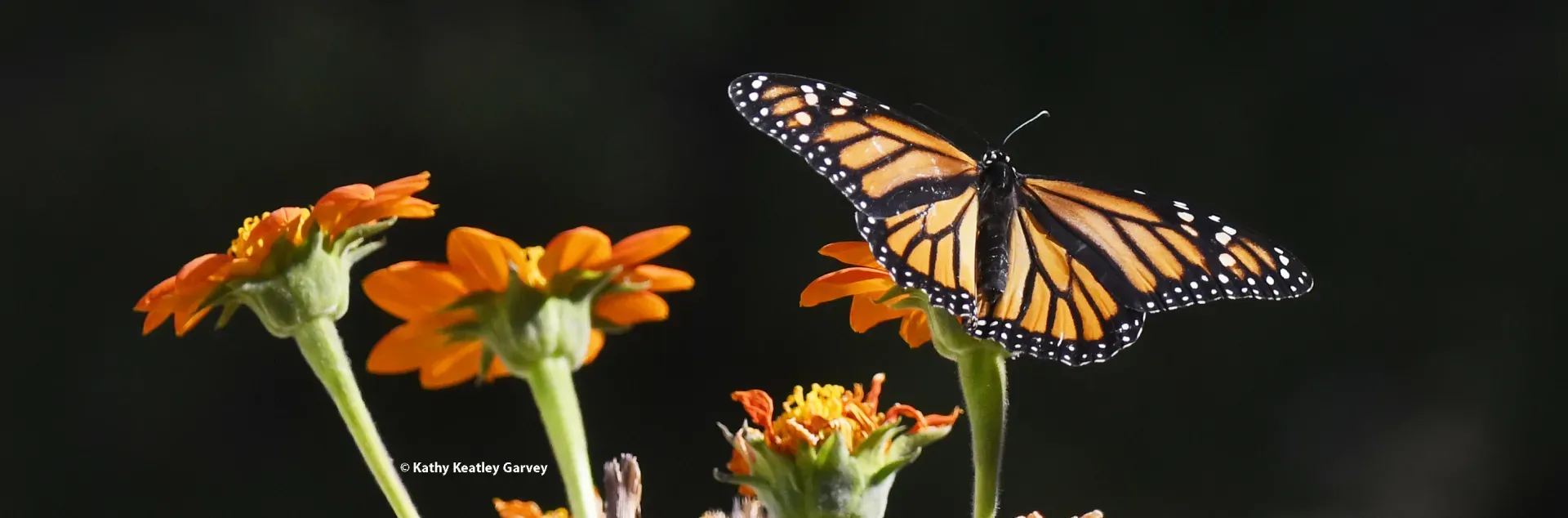
We've all been on the lookout for the endangered monarch butterfly.
The Xerces Society of Invertebrate Conservation, which leads the nnnual Western Monarch Count in coastal California where butterflies overwinter, recorded only 12,260 monarchs "across 249 sites during the typical peak overwintering period from late November through early December 2025."
Repeat: 12,260.
"This is the third-lowest tally since the count began in 1997, following low numbers last winter and a weak summer breeding season," Xerces says on its website. "The three lowest counts in the program’s history have all occurred in recent years: 1,901 individual monarchs in 2020, 9,119 in 2024, and 12,260 in 2025. Western monarchs numbered in the low millions regularly in the 1980s. The increasing frequency of record-low years heightens ongoing concerns about the health and stability of the western monarch migration."
Also from the website: “Western monarchs are in serious trouble. The migration is collapsing,” said Emma Pelton, a senior conservation biologist with the Xerces Society. “We must move quickly to safeguard existing monarch habitat and restore and better manage the landscapes monarchs depend on, or else we risk losing one of North America’s most incredible natural phenomena. Our window for action is narrowing, and our conservation efforts must accelerate.”
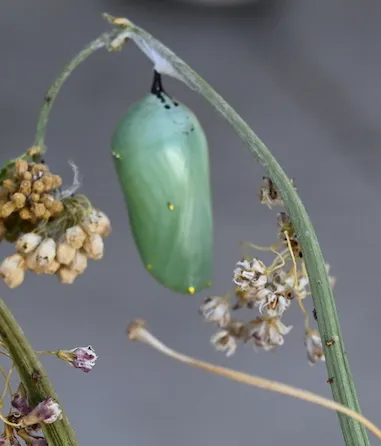
So it was with great delight that we saw three monarchs ovipositing on our milkweed over the last three weeks in our family's pollinator garden in Vacaville. We kept looking for the eggs and caterpillars, and then we saw them. Five caterpillars. F. I. V. E. They are now five chrysalids.
Our neighbors who also grow milkweed have seen no monarchs in their gardens. Just us.
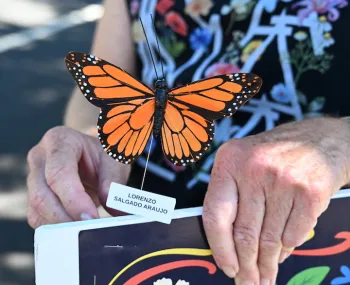
And then, last Saturday, July 25, we saw dozens of monarchs at the Vacaville Indivisible rally in front of Vacaville City Hall. It was a peaceful rally to remember Joan Sebastian Guerrero and Lorenzo Salgado Araujo, "two good men who were on their way to work," as Vacaville Indivisible organizer Carol Woods said. The event was part of a nationwide Day of Action and Accountability. The volunteers handed out monarch replicas. No words, but the meaning was clear.
What the Monarch Means to Us All
Have you seen the U.S. Fish and Wildlife web page, "Save the Monarchs? It recounts what the monarch means to us all.
"Our Beloved Butterfly. With its iconic orange and black markings, the monarch butterfly is one of the most recognizable species in North America. Monarchs are particularly remarkable because they migrate each year, flying from as far as Canada and across the United States to congregate at a few forested overwintering sites in the mountains of central Mexico and coastal California. These sites are an amazing phenomenon: thousands of monarchs cluster in the trees in California, and millions of monarchs drape large swathes of forest in Mexico.
"But over the past two decades, monarch numbers in North America have declined, prompting the U.S. Fish and Wildlife Service to join Tribes, state agencies, other federal agencies and non-government groups to identify threats to the monarch and take steps to conserve monarchs throughout their range." See more at https://www.fws.gov/initiative/pollinators/save-monarch
The monarch is not yet federally protected. "We have proposed to list the monarch butterfly as threatened under the Endangered Species Act," the U. S. Fish and Wildlife says on it website. "Protections would not apply until the effective date of a final rule."
"According to the most recent monarch Species Status Assessment, by 2080 the probability of extinction for eastern monarchs ranges from 56 to 74% and the probability of extinction for western monarchs is greater than 95%," U.S. Fish and Wildlife relates. "Threats to the species include the loss and degradation of breeding, migratory and overwintering habitat, exposure to insecticides and the effects of climate change."
Meanwhile, if all goes well, five monarchs will soon eclose from their chrysalids. F.I.V.E.