
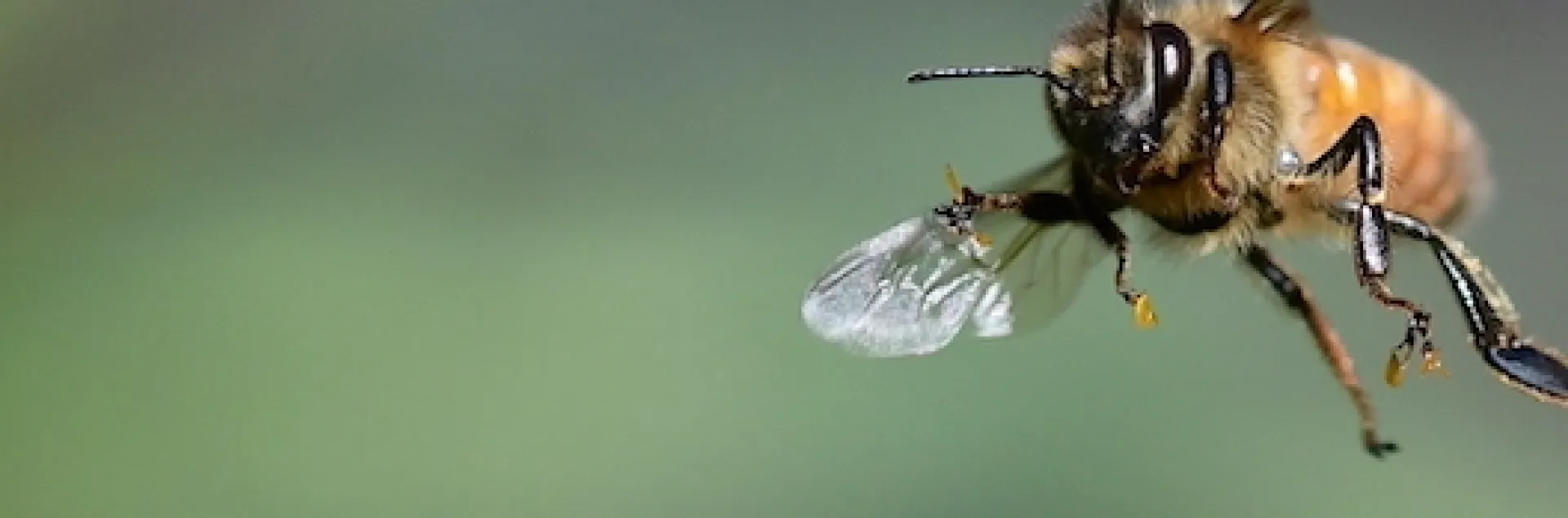
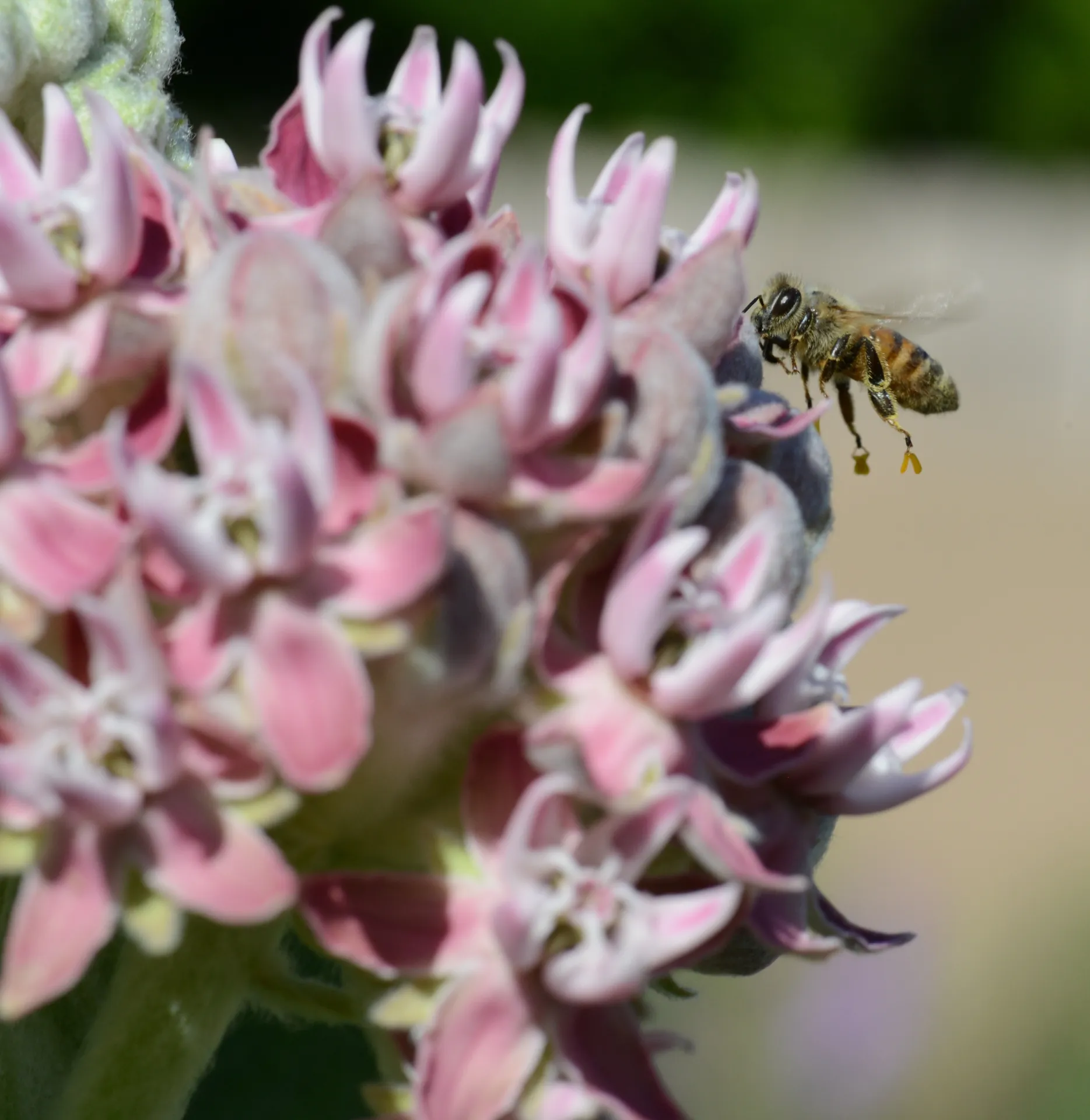
Have you seen honey bees stuck and dying in the elaborate pollination system of milkweed? Have you ever wondered about the ecological consequences?
Is the presence of dead bees a deterrent to future visitors, such as honey bees (Apis mellifera) and non-Apis visitors? Do the dead bees result in an influx of predators, like ants?
UC Davis Professor Louie Yang of the Department of Entomology and Nematology (ENT-NEM) and research scholar Ian Jett answer those questions in newly published research, “Trapped Honey Bees Reduce Floral Visitation on Milkweed Flowers,” in the journal Ecology.
The research is unique in that it examines the potential costs of arthropod entanglement. Jett, a 2025 UC Davis graduate in entomology, worked with Yang for three years as part of the Research Scholars Program in Insect Biology (RSPIB).
“Insects get occasionally get trapped on plants,” said Yang, a community ecologist. “In some cases, this helps the plant. For example, carnivorous plants trap insects to provide them with nutrition. In other cases, trapped insects attract scavenging predators which then act like bodyguards defending the plant. In our study, we found that the honey bees that are often trapped on milkweed flowers actually deter floral visitation. We initially thought this was because the ants that were scavenging on the dead honey bees were scaring other floral visitors away. However, our analysis suggests that honey bees avoided flowers with dead conspecifics, perhaps because dead conspecifics signal increased risks of disease or predation. This study illustrates some unexpected species interactions in nature.”

Unusual Pollination System
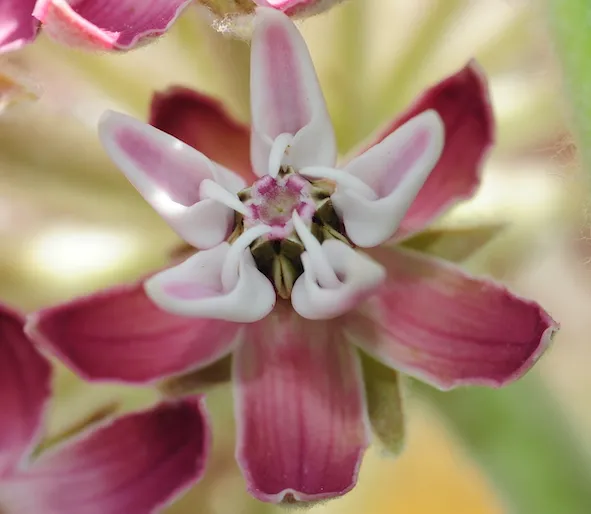
Jett noted that milkweeds (Asclepias spp.) "have an unusual pollination system that requires relatively large packets of pollen (pollinia) to become attached to the appendages of insect pollinators and be pulled through a narrow opening in the flower."
The scientists conducted field experiments in the UC Davis Study Garden--located west of the campus-- to examine how dead trapped honey bees affect floral visitation.
"We expected," they wrote in their abstract, "that the presence of a dead trapped bee would reduce floral visitation via two non-mutually exclusive pathways: (1) a direct deterrent effect on floral visitors and (2) an indirect deterrent effect mediated by an increased abundance of scavenging predators such as ants. The presence of a dead bee reduced floral visitation by 37 percent compared with controls, and this effect was stronger and more robust for honey bee visitors than non-Apis visitors."
"While ant densities were 51 percent higher on floral umbels with a dead bee and ants reduced floral visitation by 30 percent, our path analysis indicated that the direct deterrent pathway explained 91 percent of the total effect, consistent with an aversion to dead conspecifics among honey bees," they wrote. "Our results suggest that the lethal entanglement of honey bees is likely to incur an ecological cost for milkweed flowers, although the deterrence of honey bees could also shift the pollinator communities on milkweeds with unexpected consequences."
The scientists found that across all visits, 77.3 percent of the floral visitors were honey bees. The non-Apis floral visitors included a combination of native bees (Halictidae or the sweat bee family, and Apidae, such as carpenter bees), 15.1 percent; true bugs (including milkweed bugs and assassin bugs) 5.9 percent; jumping spiders, 0.7 percent; butterflies (gray hairstreaks, Western tiger swallowtails and skippers, 0.6 percent, wasps, 0.4 percent, flies (such as bee flies and tachnids), 0.2 percent; and lacewings, 0.1 percent.
Ant species documented included the Argentine ant, Linepithema humile; and Nylanderia vividula, Brachymyrmex patagonicus, and Dorymyrmex spp.
"Because honey bees are common and important pollinators of milkweed and contributed the vast majority of floral visits in our study, their deterrence as floral visitors probably reduces overall pollination services," the authors wrote. However, recent studies have also shown that honey bees may be less effective pollinators of milkweed in some cases, causing higher self-pollination rates and lower fruit production rates compared with some non-Apis pollinators. Thus, in cases where honey bees are less effective pollinators than other floral visitors, their specific deterrence could potentially shift the floral visitor community in ways that ultimately have a neutral effect on or improve plant fitness."
Ian Jett: Insects in Ecological Systems
Jett said his work in the Yang Lab cemented his "love for the role insects play in ecological communities."
"Prior to joining his lab I had collected isopods as a kid and enjoyed watching bees pollinate flowers but did not consider that you could actually study these animals professionally," he said. "Many members of the Yang Lab work on plant-insect interactions, particularly with milkweeds and monarchs, so I quickly became immersed in multiple projects exploring this avenue."
"In addition to working with monarchs, I also enjoyed curating insect collections to study the diversity of Hymenoptera, for example in different habitats," Jett shared. "While I greatly enjoyed working with monarchs, my interests focused on the broader insect community on milkweeds including all of its pollinators and herbivores, which led me to explore questions about floral visitation and pollinator behavior."
"Since developing this project which explored trapped bees on milkweeds and their impacts on conspecific behavior and the diversity of floral visitors," Jett said, "I have since continued pursuing a variety of questions relating to plant-insect interactions." They include:
- How does habitat fragmentation impact the diversity, density, and pollination services of native bees?
- What drives the population dynamics and disease outbreaks of various insect pests on trees?
"I hope to have the opportunity to explore these questions and more in a master’s degree in entomology."
UC Davis ENT Professor Phil Ward, an ant specialist, identified the ants visiting the site.
A National Science Foundation grant to Yang supported the pollinator-milkweed study. The next steps?
Next Steps
"Our results suggest several avenues for future study," the authors said. "To better understand this system, future studies could assess the incidence and implications of floral entanglement by other floral visitors and more mechanistic studies could investigate the specific sensory biology associated with aversion to trapped arthropods. Future studies could also contribute to a better understanding of the ecological costs and benefits of trapping arthropods, for example, by measuring seed set as a more direct measure of plant fitness. Another avenue of inquiry might ask if the attraction of scavenging predators to trapped arthropods could benefit milkweeds in other contexts, potentially by reducing herbivory or florivory."
"More broadly," they wrote, "the results of this study reflect the complexity and context-dependence of species interactions in nature. While pollination is sometimes described as a simple mutualism, the interactions between flowering plants and their arthropod communities can sometimes yield a much wider range of outcomes in nature. In this context, the entanglement of floral visitors by milkweed flowers presents an opportunity to examine general themes in the ecology of species interactions."
RSPIB, a campuswide program, was founded in 2011 by a trio of faculty members from ENT-NEM: UC Davis Distinguished Professor (now emeritus) Jay Rosenheim, an insect ecologist; Yang; and molecular geneticist and physiologist Joanna Chiu, now professor and chair of ENT-NEM. Their aim: "to provide academically strong and highly motivated undergraduates with a closely mentored research experience in biology." Yang and Chiu continue to direct the program.