

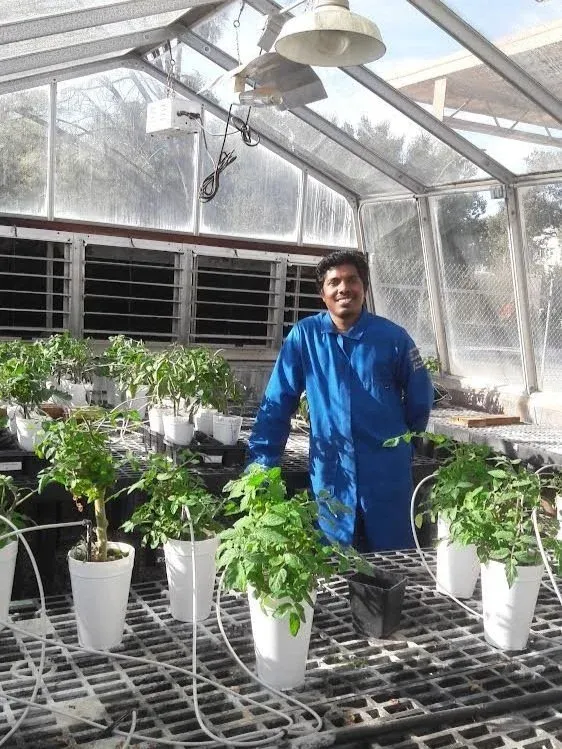
If you're curious about nematodes and tomatoes and the scientific research involved, be sure to head to the UC Davis campus on Friday, Sept. 4 to hear master's degree candidate Shah Alam of the Amanda Hodson lab, UC Davis Department of Entomology and Nematology, present his exit seminar on "Management Strategies and Disease Interactions of Resistance Breaking Root-Knot Nematodes."
It will be at 1 p.m., Friday, Sept. 4 in Room 176 of Hutchison Hall.
Alam, to receive his degree in September, holds a bachelor's degree in agriculture, Patuakhali Science and Technology University, Bangladesh (2017).
"Processing tomatoes are economically important to California, as the state accounts for approximately 95 percent of total U.S. production; root-knot nematodes in the genus Meloidogyne are considered highly damaging to this crop," he writes in his abstract. "Commercial tomato cultivars containing the Mi gene have been considered an effective option for managing root-knot nematodes. However, resistance-breaking root knot nematode populations have been identified in recent decades, posing a significant threat to the processing tomato industry."
"To determine if cultivars vary in quantitative resistance traits, in Chapter 1, I assessed the relative susceptibility of five tomato cultivars to four resistance breaking root knot nematode isolates—two each of Meloidogyne incognita (#157 and #213) and M. javanica (MJ198 and MJJDC). Results suggest that none of the tested cultivars differ in quantitative resistance levels, but there are differences in reproduction between nematode isolates, so that the aggressiveness of isolates may play a more important role than the cultivars grown in a particular field."
"To determine if cultivars vary in quantitative resistance traits, in Chapter 1, I assessed the relative susceptibility of five tomato cultivars to four resistance breaking root knot nematode isolates—two each of Meloidogyne incognita (#157 and #213) and M. javanica (MJ198 and MJJDC). Results suggest that none of the tested cultivars differ in quantitative resistance levels, but there are differences in reproduction between nematode isolates, so that the aggressiveness of isolates may play a more important role than the cultivars grown in a particular field."
"Root-knot nematodes (RKN) and Fusarium wilt are both detrimental to tomato health in California. Individually, each pathogen poses a significant threat to processing tomato production; however, when they occur together, they may form a disease complex which increases disease severity and subsequent yield loss."
Alam, a graduate student researcher at UC Davis since 2023, has collaborated with UC Agriculture and Natural Resources (UC ANR) farm advisors, university faculty, growers, Pest Control Advisors, and industry partners to design and implement greenhouse and field experiments.
He previously worked as a research assistant at Clemson University (2021-23).
His career plans? "I hope to serve the agricultural community through a government position."