Bug Squad Logo

Bug Squad

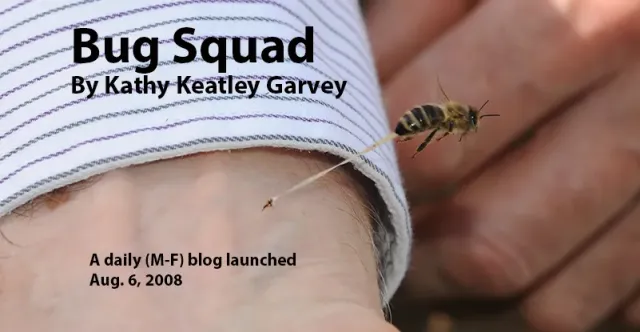
Bug Squad blog image depicts a honey bee sting in action.

Welcome to the Bug Squad blog! The Bug Squad blog was launched Aug. 6, 2008 and is a daily blog (Monday through Friday). It showcases entomologists and the work they do.  The blog focuses on scientists in the UC Davis Department of Entomology and Nematology, the Bohart Museum of Entomology, Harry H. Laidlaw Jr. Honey Bee Research Facility, the UC Davis Bee Haven, and assorted campuswide events, including UC Davis Picnic Day, UC Davis Biodiversity Museum Day, and Bohart Museum open houses. The blog spotlights insects, including bees, butterflies, dragonflies, and praying mantises, as well as arachnids such as jumping spiders and crab spiders. Author and photographer is Kathy Keatley Garvey, communications specialist, UC Davis Department of Entomology and Nematology, and a longtime journalist and community scientist with two degrees from Washington State University.  She is a member of the Entomological Society of America (ESA) and the Association for Communication Excellence (ACE). Her blog posts and images have won international awards from ACE and ESA and appeared on journal and magazine covers. She shoots primarily with a Nikon Z-8 mirrorless camera, a Nikon D500 and Nikon 800, with assorted macro lenses. Feedspot lists it as one of the top entomology blogs on the Internet. 
Primary Image
SUSAN COBEY shows a frame to the students in her 2008 class, "The Art of Queen Rearing." (Photo by Kathy Keatley Garvey)

BYOV--And That Means?

March 5, 2009
By Kathy Keatley Garvey
The honey bee population is declining throughout the world, but not the interest in the art of queen rearing. The annual class taught by bee breeder-geneticist Susan Cobey, manager of the Harry H. Laidlaw Jr.
View Article
Primary Image
Blue merle mini-Australian shepherds have one: a tongue. (Photo by Kathy Keatley Garvey)

Tongue-Tied

March 4, 2009
By Kathy Keatley Garvey
Blue merle mini-Australian shepherds have one. So do honey bees. What? A tongue. For a puppy, the tongue can symbolize pure happiness. For a worker honey bee: a solid work ethic.
View Article
Primary Image
SOLITARY SOAPBERRY BUG climbs a tree in the UC Davis Arboretum, a good place for nature walks and insect observations. (Photo by Kathy Keatley Garvey)

It Might as Well Be...Spring

March 3, 2009
By Kathy Keatley Garvey
If you like to take nature walks and lean against an occasional tree, you might rub shoulders with a red-eyed, red-shouldered bug. On warm, springlike days, soapberry bugs are exploring their territories--and doing what comes naturally.
View Article
Primary Image
Honey bee nectaring Claremont pink currant (Ribes sanguineum var. glutinosum 'Claremont') (Photo by Kathy Keatley Garvey)

Plan Bee

March 2, 2009
By Kathy Keatley Garvey
Scottish poet Robert Burns (1759-1796) lamented in his poem To a Mouse (1786) that The best laid plans of mice and men often go awry. He had just plowed into a mouse nest on his farm. The loss of life disturbed him.
View Article
Primary Image
QUEEN BUMBLE BEE--The queen bumble bees are out again, after overwintering. Entomologist Lynn Kimsey found this young queen in Briggs Hall on the UC Davis campus yesterday. (Photo by Kathy Keatley Garvey)

The Humble Bumble Bee

February 27, 2009
By Kathy Keatley Garvey
A sure sign of approaching spring... As the cold weather subsides, out come the overwintering queen bumble bees. They're gathering nectar and pollen, building their nests and laying eggs.
View Article