
Aloe Thrips: New Invasive Pest in California
The California Department of Food and Agriculture confirmed the presence of Hercinothrips dimidiatus, also known as aloe thrips, in Ventura, San Diego, and Santa Barbara counties. The CDFA assigned aloe thrips a B rating, which means they determined the pest is of known economic or environmental detriment. B-rated pests can enter the state if the receiving county agrees to accept them. You can read more about B-rated pests here.
This is the first official report of aloe thrips presence in the United States. Previously, aloe thrips were only reported in Portugal, Italy, France, the Netherlands, and South Africa. All specimens identified in California up until now were collected from the landscape - not from commercial nurseries. Collection from the landscape indicates that aloe thrips are well established in these three counties, although an upcoming survey will help determine the pervasiveness of the pest.
Damage
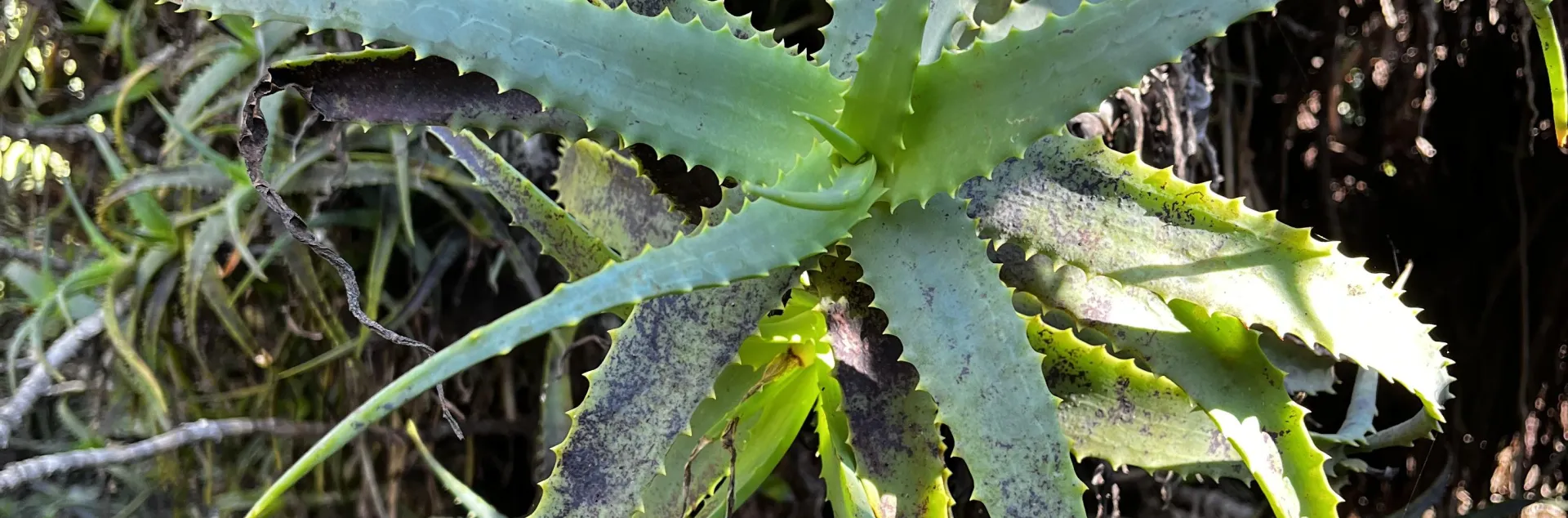
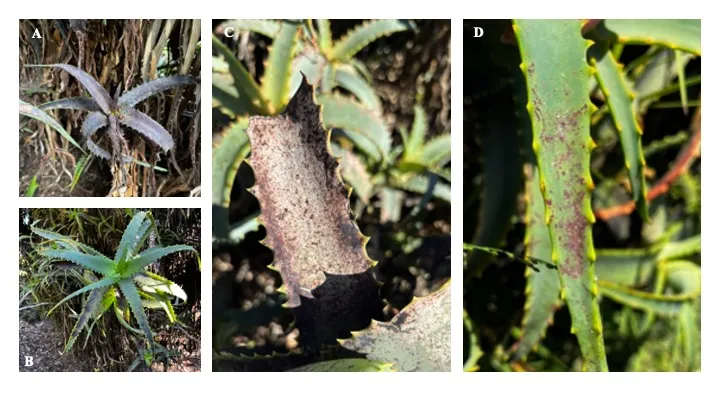
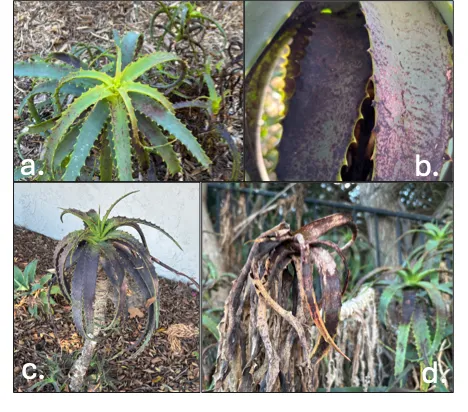
Aloe thrips feeding causes blackening and silvering of aloe leaves (Figure 1C, 1D). Damage usually occurs on older leaves (Figure 1B). Newly emerging leaves appear healthy, except when infestations are severe (Figures 1A, 2D). According to field observations, aloe thrips damage will cause plant dieback in severe cases.
Symptoms of aloe thrips feeding can easily be mistaken for abiotic damage, such as sunburn. If aloe thrips damage is suspected, look underneath new and old leaves for insects smaller than the size of a sesame seed and white bands on the wings. Up to the date of this publication, aloe thrips have only been collected on the aloe species Aloe arborescens, A. dawei, A. munchii, and A. vera in California. The only report of aloe thrips on a genus other than Aloe in the U.S. was in the 1940s when it was intercepted on a Haworthia plant.
Pest Description
There is no information on the biology and life cycle of aloe thrips. Adult females look similar to banded greenhouse thrips. They are slender dark insects around 1 mm long with 3 visible whitish bands on their backs and are often found near the crown of the aloes. The main difference between banded greenhouse thrips and aloe thrips is aloe thrips have 3 whitish bands, while banded greenhouse thrips have 2. Immature aloe thrips are shiny and almost wet-looking with red, brown, and pale coloration. They also usually have drops of dark liquid feces hanging on the tip of their abdomen, and you can see shiny flecks of these feces when they dry on the surface of the aloe leaves as well. Aloe thrips are hard to spot even under ideal conditions, so magnification and some patience will help a lot.
Control
Scientifically-backed information on aloe thrips control does not exist. An upcoming study will hopefully shed light on both chemical and biological control options for landscape and nursery settings.
Beucke, K. (2026, February 20). California pest rating profile for Hercinothrips dimidiatus Hood: Aloe thrips. California Department of Food and Agriculture. https://blogs.cdfa.ca.gov/Section3162/wp-content/uploads/2026/02/Hercinothrips-dimidiatus.pdf.
Mateus, C., Franco, J. C., Caetano, M. F., Borges da Silva, E., Ramos, A. P., Figueiredo, E., & Mound, L. (2015). Hercinothrips dimidiatus Hood (Thysanoptera: Thripidae), a new pest of Aloe arborescens. Phytoparasitica, 43(5), 689-692. https://link.springer.com/article/10.1007/s12600-015-0492-z.